
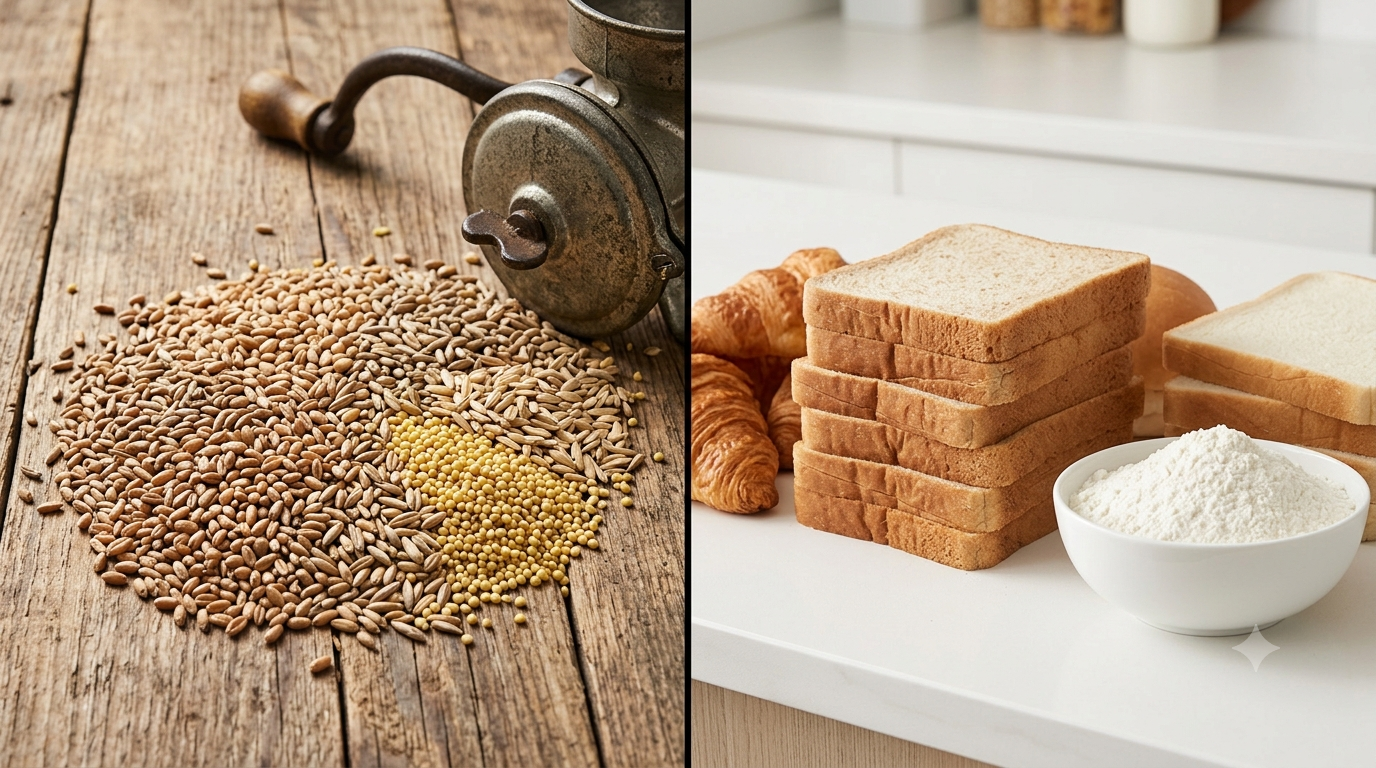
A grain of wheat does not look dangerous.
It is small, dry, hard, and simple. In its whole form, it is not easy to chew quickly. It needs grinding, soaking, fermenting, boiling, baking, or cooking before it becomes food. Traditional cultures understood this. They turned grains into porridge, sourdough, flatbreads, noodles, dumplings, fermented batters, soups, and slow meals.
Then modern milling changed everything.
Grains became fine flour.
Fine flour became soft bread.
Soft bread became pastries.
Pastries became snacks.
Snacks became breakfast.
Breakfast became dessert.
Dessert became something people could eat all day.
Refined flour did not only change grains. It changed the speed of eating.
It removed many of the natural “brakes” that once came with whole grains: chewing, fiber, texture, fermentation, meal structure, and preparation time. A hard seed became a soft product. A traditional staple became an ingredient in cookies, cakes, crackers, noodles, pizzas, cereals, buns, and packaged snacks.
This does not mean every flour-based food is bad. Bread, noodles, dumplings, pancakes, tortillas, and baked foods can all have cultural value. But refined flour deserves attention because it helped transform grains from slow foods into fast foods.
To understand modern eating, we need to understand what happened when the grain became powder.
What Is Refined Flour?
Refined flour is usually made by milling grains and removing much of the bran and germ, leaving mostly the starchy endosperm.
A whole grain has three main parts.
The bran is the outer layer. It contains fiber, minerals, and protective compounds. The germ is the part that can grow into a new plant. It contains fats, vitamins, and other nutrients. The endosperm is the starchy center that provides energy for the seed.
Refining makes flour softer, lighter, smoother, and more shelf-stable. This was useful for baking and storage. White flour became desirable in many societies because it looked clean, refined, and easier to work with.
But refining also changes the food.
When the bran and germ are removed, the flour loses much of the grain’s original structure. It becomes easier to digest quickly, easier to bake into soft products, and easier to combine with sugar, fat, salt, and flavorings.
Refined flour is not just ground grain. It is grain with much of its natural architecture removed.
That matters.
Whole Grains Were Slow Foods
Traditional grain foods were usually slower than modern refined flour products.
A whole grain had to be harvested, dried, stored, cracked, soaked, fermented, ground, boiled, or cooked. Even after preparation, many traditional grain foods had texture. They required chewing. They were usually eaten as part of meals.
Think of cooked oats, barley soup, wheat berries, millet porridge, brown rice, sourdough bread, dense rye bread, fermented grain batters, corn tortillas, or buckwheat dishes.
These foods are not eaten like candy. They have weight, texture, and structure.
Refined flour changed this. Flour can be turned into foods that are soft, fluffy, crisp, sweet, salty, or melt-in-the-mouth. These foods can be eaten quickly, often without much chewing.
This is one reason refined flour became so powerful in modern diets.
It made grain easier to eat than ever before.
Refining Removed Texture
Texture is one of the most overlooked parts of nutrition.
A food’s texture affects how fast we eat, how much we chew, how full we feel, and how satisfying the meal becomes.
Whole grains and traditional grain foods often have texture. They may be chewy, dense, coarse, moist, or fibrous. They slow the mouth down.
Refined flour creates a very different experience.
Soft white bread can be eaten quickly. Crackers break down fast. Cakes and pastries almost melt. Many noodles are smooth and easy to swallow. Cookies combine crunch with quick breakdown. Breakfast cereals are light, crisp, and easy to consume in large amounts.
When texture becomes too easy, eating speeds up.
Fast eating can make it easier to consume more food before fullness signals catch up. This is not only about willpower. It is about food design.
Whole grains often make you participate. Refined flour often lets you glide.
Refining Reduced Fiber
Fiber is one of the biggest differences between whole grains and refined flour.
Fiber adds bulk, slows digestion, supports digestive regularity for many people, and helps meals feel more satisfying. Fiber also helps feed certain beneficial gut microbes when it reaches the large intestine.
When grains are refined, much of the fiber-rich bran is removed.
This changes how the food behaves. A whole grain dish may take longer to chew and digest. A refined flour product may be softer, lower in fiber, and easier to overeat.
This does not mean refined flour is poison. It means refined flour should not dominate the diet.
A diet that includes some refined flour within a pattern rich in vegetables, beans, fruit, nuts, seeds, protein, and whole foods is different from a diet built around white bread, pastries, crackers, pizza, sweet cereal, noodles, and cookies.
The problem is not one slice of bread. The problem is when refined flour becomes the foundation of daily eating.
Refined Flour Became a Perfect Partner for Sugar
Refined flour changed modern food partly because it pairs so well with sugar.
White flour and sugar together create many of the most common modern foods:
Cookies
Cakes
Donuts
Muffins
Pastries
Sweet breads
Breakfast cereals
Snack bars
Pancakes with syrup
Crackers with sweet coatings
Packaged desserts
Sweet rolls
Pie crusts
Dessert-like breakfast foods
This combination is powerful because refined flour provides soft starch while sugar provides sweetness and quick reward. Add fat, salt, flavoring, and attractive texture, and the result becomes very easy to overeat.
Traditional grain foods were not always unsweetened, but sugar was not usually embedded into so many everyday products.
Modern refined flour made dessert portable, cheap, and normal.
A cake-like breakfast does not feel like dessert when it is sold as a muffin. A cookie-like cereal does not feel like candy when it is marketed as breakfast. A sweetened grain bar does not feel like dessert when it is wrapped like a health snack.
Refined flour helped blur the line between meal and treat.
Refined Flour Also Became a Partner for Fat and Salt
Sugar is not the only partner.
Refined flour also works beautifully with fat and salt.
This gives us:
Crackers
Chips made with flour or starch blends
Pizza crusts
Fast-food buns
Fried dough
Savory pastries
Instant noodles
Breaded meats
Snack mixes
Salty biscuits
Packaged flatbreads
Frozen convenience foods
Refined flour can become crisp, flaky, chewy, soft, or stretchy. It can carry oils, cheese, processed meats, sauces, and seasonings. It can turn into a vehicle for almost any flavor.
That versatility is one reason it became so common.
But it also means refined flour often arrives as part of an ultra-processed food, not as a simple grain.
A homemade flatbread with lentil soup is very different from a packaged cracker eaten mindlessly. A traditional noodle soup with vegetables and protein is different from instant noodles high in sodium and refined ingredients. A sourdough slice with eggs and greens is different from sweet packaged bread.
The flour is only one part of the pattern.
Why Refined Flour Foods Are Easy to Overeat
Refined flour foods often share several features that make them easy to eat quickly.
They are soft.
They are low in fiber.
They are often sweet or salty.
They pair well with fat.
They are portable.
They require little preparation.
They come in large packages.
They are familiar.
They are inexpensive.
They are often eaten while distracted.
This combination matters.
A person rarely overeats plain wheat berries. But it is easy to overeat cookies, crackers, pastries, soft bread, pizza, noodles, or snack products made from refined flour.
The issue is not that people lack discipline. The food has been designed to be easy.
Traditional grain foods had friction. Refined flour foods removed friction.
When food removes friction, awareness must replace it.
Refined Flour Changed Breakfast
Breakfast may be where refined flour had its greatest cultural impact.
Many traditional breakfasts were savory, simple, or meal-like: porridge, soup, eggs, rice, beans, fish, yogurt, leftovers, roots, bread with cheese, or cooked grains.
Modern breakfast often became a refined flour and sugar event.
Toast with sweet spread.
Pancakes with syrup.
Muffins.
Pastries.
Sweet cereals.
Waffles.
Breakfast bars.
Bagels with sweet toppings.
Doughnuts.
Sweet breads.
Instant grain products.
This shift matters because breakfast sets the tone of the palate.
A sweet refined-flour breakfast can make the day begin with soft starch and sugar. It may leave people hungry sooner than a meal with protein, fiber, and whole foods. It can also train the taste buds to expect sweetness early.
A better breakfast does not need to be extreme.
Eggs with vegetables.
Plain yogurt with fruit and nuts.
Oats with seeds and berries.
Soup or leftovers.
Beans with herbs.
Whole-grain toast with protein.
Rice with fish or eggs.
Sourdough with vegetables.
Breakfast does not need to be perfect. It just does not need to be dessert every day.
Refined Flour Changed Bread
Bread is one of humanity’s most important foods.
Traditional bread could be dense, sour, chewy, fermented, whole-grain, flat, coarse, or baked from local grains. It often had cultural meaning and was eaten with soups, cheeses, vegetables, oils, herbs, beans, fish, meat, or dairy.
Modern refined bread is often different.
It may be very soft, slightly sweet, fast to chew, low in fiber, and made to stay fresh-looking for a long time. It may be eaten as a sandwich wrapper rather than as a meaningful food. It may accompany processed meats, sugary spreads, fried foods, or fast-food meals.
This does not mean bread is bad.
It means bread quality matters.
A slow-fermented sourdough eaten with soup is not the same as sweet white bread eaten with sugary spread. A dense rye bread with fish and vegetables is not the same as a fast-food bun. A traditional flatbread with lentils and yogurt is not the same as a packaged refined wrap filled with processed ingredients.
Bread should be judged by its ingredients, fermentation, texture, portion, and what it is eaten with.
Refined Flour Changed Snacking
Snacking used to be limited by availability. Modern refined flour changed that.
Flour-based snacks are everywhere:
Crackers
Cookies
Biscuits
Snack cakes
Pretzels
Cereal bars
Pastries
Mini muffins
Packaged bread products
Sweet rolls
Flavored chips
Sandwich cookies
Wafers
Instant noodle cups
These foods are portable, shelf-stable, and easy to eat without a plate. They move eating away from meals and into constant grazing.
This changes hunger signals.
Instead of eating a meal and waiting for the next meal, people may eat small refined flour products throughout the day. These snacks may not provide enough protein, fiber, or real satiety, so hunger returns quickly.
The body receives energy, but not always nourishment.
A better snack pattern might include fruit with nuts, yogurt, boiled eggs, hummus with vegetables, leftovers, soup, roasted roots, or whole-grain foods paired with protein.
The goal is not to ban snacks. It is to make snacks behave more like food.
Refined Flour and Blood Sugar
Refined flour products can affect blood sugar because they are usually rich in digestible starch and lower in fiber than intact grains.
The effect depends on the food and the person. A refined flour pastry with sugar and fat is different from a simple flatbread. A large bowl of refined noodles eaten alone is different from noodles in broth with vegetables and protein. A cookie is different from bread eaten with eggs and salad.
People with diabetes, insulin resistance, reactive hypoglycemia, or blood sugar concerns may need more attention to refined flour intake. They may do better with smaller portions, higher-fiber grains, beans, lentils, vegetables, protein-rich meals, or professional dietary guidance.
For people without blood sugar concerns, refined flour can still be worth moderating because it often appears in low-fiber, ultra-processed foods.
The key is not fear. The key is context.
Ask: what is the flour food, how processed is it, what is it eaten with, and how does your body respond?
Refined Flour and the Gut
The gut does not only need calories. It needs variety.
Whole plant foods provide fibers, resistant starches, polyphenols, textures, and compounds that feed different gut microbes. Whole grains, beans, fruits, vegetables, nuts, seeds, roots, and fermented foods can all contribute to this diversity.
Refined flour products are often lower in fiber and plant diversity. If they replace whole plant foods, the diet becomes narrower.
This does not mean a slice of refined bread harms the gut. But a diet built heavily on refined flour products may leave less room for fiber-rich foods.
Think of the gut like a garden. It benefits from variety, not the same soft starch all day.
A better pattern is to include more whole grains, beans, lentils, vegetables, fruits, nuts, seeds, and fermented foods if tolerated.
Refined flour should not be the only plant food in the diet.
Enriched Flour: Helpful, but Not the Same as Whole
Many refined flours are enriched or fortified with certain vitamins and minerals. This can help reduce deficiency risks at a population level. Fortification has been important in public health.
But enriched flour is not identical to the whole grain.
Adding back selected nutrients does not fully restore the original food structure, fiber, germ, bran, oils, phytochemicals, texture, and slower eating experience.
This distinction matters.
Fortification can make refined flour less nutritionally empty, but it does not turn a soft pastry into a whole grain meal. A fortified cereal may contain added vitamins, but it may still be high in sugar and low in fiber. A white bread may be enriched, but it may still be easy to overeat.
Nutrient addition is not the same as food wholeness.
The Problem with “Made with Whole Grain”
Many packaged foods advertise “made with whole grain.”
This phrase can be useful, but it can also mislead.
A product may contain some whole grain but still be mostly refined flour, added sugar, oils, and flavorings. A cereal, cracker, cookie, or snack bar can use whole-grain language while still behaving like a processed snack.
The better question is not whether the product contains whole grain.
The better question is whether whole grain is the foundation of the food.
Look for:
Whole grain listed first
Meaningful fiber content
Low added sugar
Recognizable ingredients
Minimal refined flour
No dessert-like profile
A food that fits a meal, not just a snack craving
A whole-grain claim on the front of a package should not replace reading the ingredient list.
Flour Is Not Always the Enemy
A balanced article must be clear: flour is not automatically bad.
Many traditional foods use flour. Flatbreads, noodles, dumplings, tortillas, sourdough, pancakes, steamed buns, porridges, and fermented batters can all be part of cultural diets.
The problem is not flour alone.
The problem is when refined flour becomes:
Too frequent
Too sweetened
Too soft
Too low in fiber
Too processed
Too separated from meals
Too combined with sugar and refined oils
Too dominant in the diet
A handmade dumpling soup with vegetables is not the same as a box of cookies. A traditional corn tortilla with beans is not the same as chips. Sourdough bread with eggs and greens is not the same as packaged sweet bread.
Flour foods should be judged by form, preparation, and context.
Traditional Flour Foods Had More Context
Traditional flour foods were usually part of meals.
Flatbread with lentils.
Noodles in broth.
Dumplings with soup.
Bread with cheese and vegetables.
Tortillas with beans and salsa.
Sourdough with stew.
Fermented batter with chutney.
Pancakes made from grains and eaten with protein-rich sides.
Modern refined flour foods are often eaten alone.
A muffin in the car.
Crackers at a desk.
Cookies at night.
Toast with jam.
Cereal from a box.
Pastries with sweet coffee.
Snack bars between meetings.
The same ingredient category behaves differently depending on the meal pattern.
Traditional context gives flour boundaries.
Modern snacking removes those boundaries.
How to Choose Better Flour-Based Foods
You do not need to eliminate all flour to eat well. Instead, choose better forms more often.
Better choices may include:
Sourdough bread with simple ingredients
Whole-grain bread with meaningful fiber
Corn tortillas made traditionally
Buckwheat pancakes with protein-rich toppings
Fermented grain batters
Noodles served with broth, vegetables, and protein
Flatbreads eaten with beans, yogurt, or vegetables
Oat-based foods without much added sugar
Dense rye or whole-grain breads
Homemade baked goods with less sugar and more whole ingredients
Less helpful daily choices include:
Sweet pastries
Cookies
Snack cakes
Sugary cereals
Crackers made mostly from refined flour and oils
Soft sweet white bread
Fried dough
Flour-based desserts eaten as breakfast
Instant noodles with low nutrient value
Packaged snacks with refined flour as the main ingredient
The goal is better defaults, not perfect purity.
The “Flour Speed Test”
Here is a simple way to evaluate a flour food.
Ask: how fast could I eat this?
If the answer is “very fast,” be more mindful.
Soft white bread, cookies, cakes, crackers, pastries, and snack products often disappear quickly. Dense sourdough, chewy whole-grain bread, noodles in soup, dumplings with vegetables, or flatbread with protein may slow you down.
Speed is not the only factor, but it is a useful clue.
Foods that are eaten quickly often make it easier to overconsume.
A good flour food should usually belong to a meal, require some chewing, and come with protein, fiber, or real ingredients.
The slower the food, the more likely it behaves like food rather than a product.
How to Build a Better Grain Meal
Instead of eating refined flour alone, build a meal around it.
Start with the flour-based food, then add:
Protein: eggs, fish, yogurt, beans, lentils, tofu, poultry, meat, cheese, or nuts.
Plants: vegetables, herbs, greens, mushrooms, tomatoes, onions, fermented vegetables, or fruit.
Healthy fats: olive oil, avocado, nuts, seeds, fish fat, or modest dairy fat.
Acid and flavor: vinegar, lemon, salsa, mustard, yogurt sauce, herbs, spices, or fermented condiments.
Fiber: beans, vegetables, whole grains, fruit, oats, barley, nuts, or seeds.
Examples:
Sourdough toast with eggs and greens
Tortillas with beans, salsa, avocado, and vegetables
Noodles in broth with fish and greens
Flatbread with lentils and yogurt sauce
Whole-grain bread with sardines and salad
Buckwheat pancakes with plain yogurt and berries
Dumplings in vegetable soup
Pita with hummus, herbs, and vegetables
This changes flour from a snack into a meal component.
Practical Ways to Reduce Refined Flour Without Feeling Restricted
Reducing refined flour works best through replacement, not punishment.
Replace sweet cereal with oats, eggs, or yogurt with fruit.
Replace pastries at breakfast with sourdough toast and protein.
Replace crackers with nuts, vegetables, hummus, or fruit.
Replace white bread sandwiches with whole-grain bread, lettuce wraps, rice bowls, or soups.
Replace instant noodles with broth, vegetables, eggs, or real noodles in a balanced meal.
Replace cookies with fruit, yogurt, nuts, or homemade lower-sugar desserts most of the time.
Replace refined flour snacks with leftovers or simple meals.
You do not need to remove every flour food. Just reduce the refined flour foods that are automatic and forgettable.
Keep the flour foods that are meaningful, satisfying, and part of real meals.
The Plate Rule for Refined Flour
A simple rule:
Do not let refined flour be the whole meal.
If you eat bread, add protein and plants.
If you eat noodles, add broth, vegetables, and protein.
If you eat pizza, add salad and choose better toppings.
If you eat pancakes, add yogurt, nuts, or eggs and reduce syrup.
If you eat crackers, pair them with real food instead of eating from the box.
If you eat a pastry, enjoy it as a treat, not as daily fuel.
Refined flour becomes less problematic when it stops being the center of the diet.
It should be a guest, not the host.
Flour and Children’s Eating Habits
Children are often surrounded by refined flour foods.
Crackers, cookies, cereal, muffins, white bread, pizza, nuggets, snack bars, pancakes, waffles, and pastries are common in children’s diets.
These foods are easy, familiar, and convenient. But when they dominate, children may eat fewer beans, vegetables, fruits, proteins, soups, traditional starches, and whole grains.
The goal is not to make children fear bread or pasta. The goal is to build variety early.
Offer whole foods often.
Use less sweet breakfasts.
Serve fruit instead of cookies most of the time.
Pair bread with protein.
Add vegetables to noodles.
Choose whole-grain options when accepted.
Make soups, eggs, yogurt, beans, rice, potatoes, and fruit normal foods.
Keep refined flour treats as treats, not daily defaults.
Children do not need perfect diets. They need repeated exposure to real foods.
Flour and Emotional Eating
Refined flour foods often become comfort foods.
Bread, cookies, pastries, pizza, cakes, noodles, crackers, and baked goods can feel soothing, familiar, and emotionally warm. This is not wrong. Food is emotional.
The issue is when refined flour becomes the main tool for stress, boredom, sadness, loneliness, or fatigue.
Because refined flour foods are soft and quick, they can be easy to eat mindlessly. A person may not even remember how many crackers, cookies, or slices of bread they ate while distracted.
A healthier relationship with flour-based comfort foods includes awareness:
Sit down.
Use a plate.
Choose the food you truly want.
Eat slowly.
Pair it with something nourishing.
Avoid eating directly from the package.
Notice whether you are hungry or emotionally triggered.
Comfort food can be part of life. It just should not replace self-care.
Common Myths About Refined Flour
Myth 1: All flour is bad
Not true. Flour foods vary widely. Sourdough, traditional flatbreads, fermented batters, and whole-grain breads are different from cookies and pastries.
Myth 2: Whole wheat bread is always healthy
Some whole wheat products still contain added sugar, refined flour, and low fiber. Read labels and consider the whole food.
Myth 3: Gluten-free flour products are automatically better
Gluten-free packaged foods can still be made with refined starches, sugar, and oils. Gluten-free is essential for people with celiac disease, but it does not automatically mean healthy.
Myth 4: White flour is the same as whole grain
White flour has lost much of the grain’s natural structure, fiber, and nutrient complexity.
Myth 5: Bread is always the problem
Bread quality matters. What you eat with bread also matters. A bread-based meal can be balanced or highly processed.
Myth 6: Refined flour must be completely eliminated
Most people do not need total elimination. Reducing frequency and improving quality is a more sustainable approach.
A Simple Refined Flour Checklist
Before choosing a flour-based food, ask:
Is it mostly refined flour?
Does it contain added sugar?
Does it contain refined oils?
How much fiber does it have?
Is it part of a meal or a snack?
Will I eat it slowly or quickly?
What will I pair it with?
Is it a meaningful food or an automatic habit?
How often do I eat foods like this?
Does my body feel good afterward?
This checklist turns refined flour from a hidden habit into a conscious choice.
When to Be More Careful
Some people may need extra care with refined flour intake, including those with:
Diabetes
Insulin resistance
Blood sugar swings
Celiac disease
Wheat allergy
Non-celiac gluten sensitivity
Irritable bowel syndrome
Digestive disorders
High triglycerides
Dental concerns
Eating disorder history
Specific medical dietary restrictions
For these individuals, grain and flour choices should be personalized with professional guidance.
General food education is useful, but medical nutrition should be individualized.
The Traditional Lesson: Put the Grain Back in Context
Traditional diets do not teach us to fear grains. They teach us to respect grains.
Grains were soaked, fermented, boiled, cooked, ground, steamed, baked, and paired with other foods. They were part of meals. They carried culture. They required time.
Modern refined flour removed much of that context.
It made grains soft, fast, sweet, portable, and easy to eat without thinking.
The solution is not necessarily to abandon grains. The solution is to restore context.
Choose whole or minimally processed grains more often.
Use fermented grain foods when they fit.
Pair flour foods with protein and plants.
Reduce sweet refined flour products.
Limit flour-based snacks.
Bring back soups, stews, beans, vegetables, and real meals.
Treat pastries as treats, not breakfast staples.
This is how grains can return to a wiser place in modern eating.
Conclusion: The Powder That Changed the Plate
Refined flour changed human eating because it changed the grain itself.
A hard seed became a soft powder.
A slow staple became a fast product.
A meal ingredient became a snack base.
A traditional food became a carrier for sugar, fat, salt, and flavor engineering.
That does not make refined flour evil. It makes it powerful.
Powerful foods require awareness.
The question is not whether you must avoid every slice of bread, noodle, dumpling, or baked food. The better question is whether refined flour has quietly become too much of your diet.
Is it in your breakfast?
Your snacks?
Your lunch?
Your dinner?
Your dessert?
Your comfort foods?
Your children’s foods?
Your “healthy” packaged foods?
If refined flour appears everywhere, it may be time to bring back balance.
Eat more whole grains, beans, roots, vegetables, fruits, nuts, seeds, protein-rich foods, and traditional starches. Choose better bread. Use flour foods as part of meals. Reduce sweet and snack-like flour products. Let texture, fiber, and real ingredients return to the plate.
Refined flour changed the way humans eat grains.
A wiser modern diet can change the way we use flour again.
Disclaimer: This article is for educational purposes only and is not medical advice. Grain and flour tolerance varies by individual. If you have diabetes, celiac disease, wheat allergy, digestive disorders, blood sugar concerns, eating disorder history, pregnancy-related questions, or specific dietary needs, consult a qualified healthcare professional before making major dietary changes.