
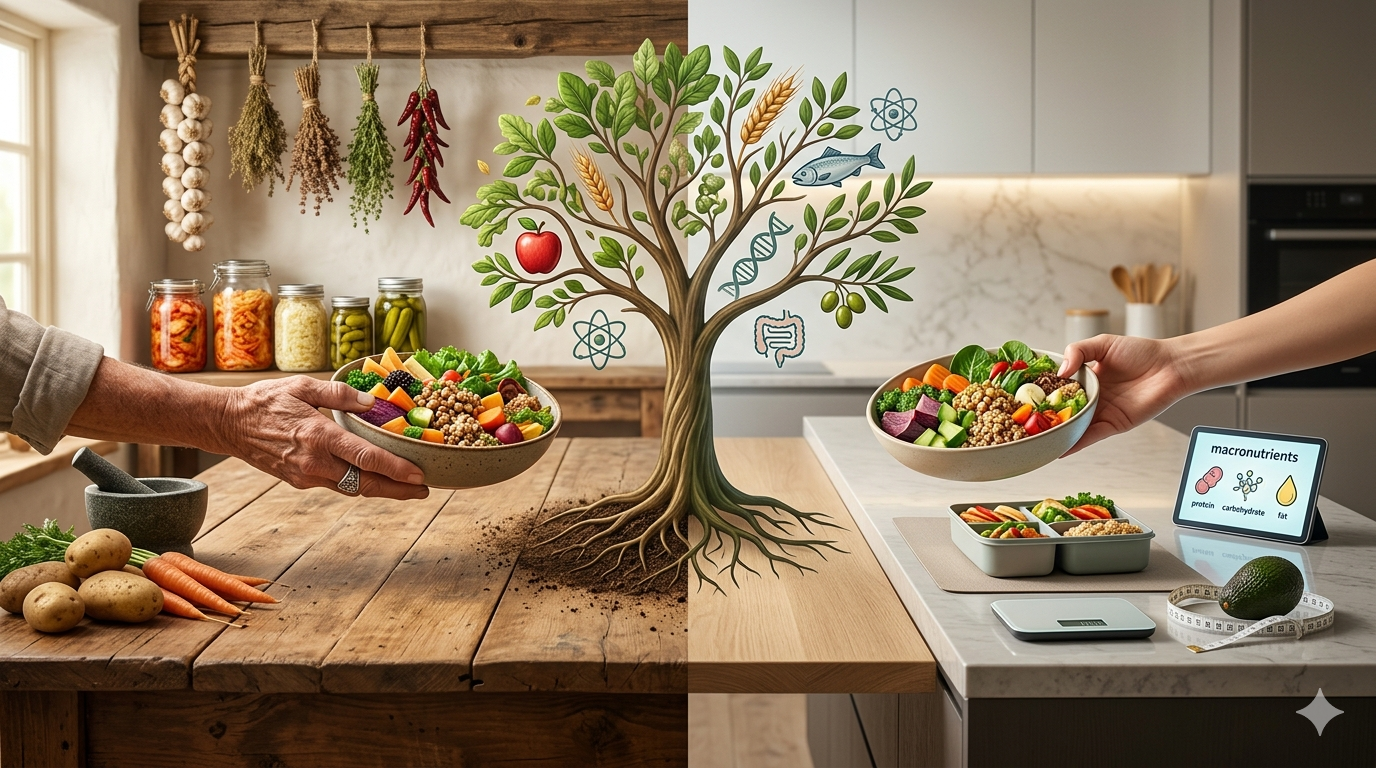
Modern diets are full of information but often short on wisdom.
People know about calories, macros, protein targets, low-carb plans, plant-based diets, intermittent fasting, superfoods, supplements, and food tracking apps. They can scan nutrition labels, compare ingredients, count grams of sugar, and follow online meal plans.
Yet many people still feel confused, overwhelmed, and disconnected from food.
They may know what they “should” eat but struggle to cook it. They may buy healthy ingredients but let them spoil. They may understand that ultra-processed foods are not ideal but still rely on them because they are fast, flavorful, and convenient. They may follow a diet for a few weeks, then return to old habits because the plan does not fit their kitchen, family, culture, schedule, or taste.
This is where traditional kitchens can teach modern diets something important.
Traditional kitchens were not perfect. They existed in worlds of scarcity, hard labor, limited medical care, and food insecurity. But they contained practical knowledge that modern eating often lacks: how to turn basic ingredients into meals, how to preserve food, how to use leftovers, how to balance flavors, how to cook with seasons, how to make staples satisfying, and how to connect eating with culture and daily life.
Modern diets often ask, “What should I eat?”
Traditional kitchens ask, “How do I turn what I have into nourishing food?”
That second question may be one of the missing pieces in modern wellness.
Traditional Kitchens Were Built Around Real Ingredients
Traditional kitchens usually began with ingredients, not products.
A kitchen might contain rice, beans, grains, roots, vegetables, herbs, eggs, fish, meat, milk, yogurt, cheese, fruit, nuts, seeds, spices, fermented foods, broths, oils, or preserved foods. These ingredients were then transformed into meals through cooking, soaking, fermenting, drying, grinding, roasting, boiling, steaming, or slow simmering.
Modern diets often begin in a different place. Many people start with packaged foods: bars, cereals, crackers, frozen meals, sweetened drinks, flavored yogurts, sauces, snacks, protein products, instant noodles, and ready-to-eat meals.
Some packaged foods can be useful, but a diet built mostly from products often weakens the connection between food and cooking.
Traditional kitchens remind us that real food usually begins before the package.
This does not mean every meal must be made from scratch. Modern life is busy, and convenience has value. But the foundation of daily eating should still come from recognizable ingredients as often as possible.
A simple traditional-style kitchen does not need to be fancy. It needs basic foods that can become many meals:
A few proteins
A few staple carbohydrates
Several vegetables
Some herbs and spices
A source of fat
A fermented or sour element
A few sauces or condiments
A way to use leftovers
This foundation gives a person more freedom than a shelf full of processed “diet foods.”
Lesson 1: Cooking Is a Health Skill
Modern nutrition often treats cooking as optional. Traditional kitchens treated cooking as essential.
Cooking changes food. It makes many foods safer, softer, tastier, and easier to digest. It turns raw ingredients into meals. It allows people to control salt, sugar, fat, flavor, portion size, and food quality. It also creates routines that can reduce dependence on takeout and packaged snacks.
A person who can cook a few basic meals has more control over their diet than someone who only follows diet rules.
You do not need advanced cooking skills to benefit. You only need a small set of repeatable methods:
Boiling grains or roots
Cooking eggs
Roasting vegetables
Making soup
Preparing beans or lentils
Cooking fish or simple proteins
Making a basic sauce
Using herbs and spices
Assembling leftovers into new meals
Traditional kitchens were built on repeatable skills. A grandmother did not need a new recipe every night. She knew methods. She knew how to adjust by season, budget, and what was available.
Modern diets can learn from that.
Instead of chasing complicated meal plans, build a small library of reliable meals you can cook again and again.
Lesson 2: Meals Matter More Than Isolated Foods
Modern diet culture often focuses on isolated foods.
Is rice healthy?
Is meat bad?
Is dairy good?
Are grains harmful?
Is fruit too sugary?
Are beans hard to digest?
Is salt dangerous?
Traditional kitchens think in meals, not isolated ingredients.
Rice may be eaten with fish, vegetables, broth, herbs, eggs, fermented sauce, or pickles. Bread may be eaten with soup, cheese, olive oil, beans, or vegetables. Meat may be served with roots, bitter greens, herbs, sour condiments, or fermented foods. Beans may be cooked with spices, grains, fat, vegetables, or broth. Dairy may be fermented and eaten with grains, fruit, or savory dishes.
The same ingredient can have a different effect depending on the meal around it.
A bowl of plain refined starch eaten alone is not the same as a traditional meal that includes starch, protein, vegetables, fat, acidity, and flavor. Fresh meat in a stew is not the same as processed meat in a fast-food meal. Whole fruit is not the same as sweetened fruit juice.
Traditional kitchens teach us to ask better questions:
What is this food eaten with?
How is it prepared?
Does the meal contain protein?
Does it contain fiber or plants?
Is there enough flavor to feel satisfied?
Is it mostly whole food or mostly refined product?
Does it fit my digestion and lifestyle?
This meal-based thinking is more useful than labeling foods as simply good or bad.
Lesson 3: Flavor Helps People Eat Better
Many modern diets fail because they are bland.
People try to eat plain chicken, plain vegetables, plain oats, plain salad, or plain steamed foods. At first, this may feel disciplined. Over time, it often becomes boring. Eventually, processed foods become tempting again because they offer flavor, texture, salt, sweetness, crunch, richness, and comfort.
Traditional kitchens rarely depended on blandness.
They used herbs, spices, sour foods, fermented condiments, broths, roasted flavors, toasted seeds, yogurt sauces, vinegar, citrus, garlic, onions, chili, mustard, fish sauce, miso, olive oil, pickles, and many other flavor tools.
Flavor is not the enemy of health. Poor-quality flavor systems are the problem.
Modern ultra-processed foods often create flavor through refined sugar, refined oils, excess salt, artificial flavors, and engineered textures. Traditional kitchens create flavor through cooking skill, fermentation, spices, acids, herbs, and balance.
A person who knows how to make vegetables taste good will eat more vegetables. A person who knows how to season beans will not see them as punishment. A person who can turn leftovers into soup or stir-fry will waste less food. A person who understands sauces and condiments will rely less on processed snacks.
Flavor is a health tool when it supports real food.
Lesson 4: Food Preparation Changes Food
Traditional kitchens understood something modern eaters often forget: preparation changes food.
A bean is not just a bean. It can be soaked, sprouted, boiled, fermented, mashed, seasoned, or turned into soup. A grain can be refined, whole, soaked, fermented, ground, steamed, boiled, or baked. Milk can become yogurt, kefir, cheese, butter, or sour cream. Vegetables can be raw, cooked, roasted, pickled, fermented, or dried.
These changes affect texture, taste, digestibility, storage, and how satisfying the food feels.
Modern diet debates often ignore preparation. They argue about “grains,” “dairy,” “meat,” “plants,” or “carbs” as if every version is the same.
Traditional kitchens know better.
Sourdough bread is different from sweet packaged bread. Yogurt is different from sweetened dairy dessert. Slow-cooked beans are different from undercooked beans. Whole fruit is different from juice. Roasted roots are different from chips. Fermented vegetables are different from candy-like sour snacks.
If modern diets paid more attention to preparation, many food arguments would become more balanced.
The question is not only what the food is. The question is what has been done to it.
Lesson 5: Preservation Reduces Waste and Adds Value
Traditional kitchens were careful with food because food was harder to obtain.
Before refrigeration and global shipping, seasonal abundance had to be managed. Vegetables were fermented or pickled. Fruits were dried or preserved. Fish was salted, smoked, or fermented. Meat was cured, dried, or slow-cooked. Milk became yogurt, cheese, butter, or kefir. Bones became broth. Leftovers became soup.
This reduced waste and added value.
Modern households often waste food because they buy ingredients without a plan, forget them in the refrigerator, or rely on takeout before using what they have. At the same time, they may spend money on packaged snacks because convenient foods feel easier.
Traditional kitchens teach a different mindset: food should be used fully.
A bunch of herbs can become a sauce. Vegetable scraps can flavor broth. Leftover rice can become a bowl, soup, or stir-fry. Aging fruit can become a cooked topping. Extra cabbage can become fermented vegetables. Bones can become stock. Beans can become soup, spread, or salad.
This approach is not only economical. It also makes eating more sustainable and creative.
Lesson 6: Staples Need Companions
Traditional diets often had staple foods: rice, wheat, maize, millet, potatoes, yams, cassava, beans, lentils, oats, or other regional foundations.
Modern diet culture often attacks or worships staples. Traditional kitchens did neither. They knew staples needed companions.
Rice needs vegetables, fish, eggs, legumes, broth, herbs, or fermented condiments. Bread needs soup, cheese, beans, olive oil, vegetables, or protein. Potatoes need fat, herbs, dairy, fish, meat, or vegetables. Beans need spices, acids, grains, herbs, or slow cooking. Grains need sauces, vegetables, protein, or fermentation.
Staples provide structure and energy, but they are not usually the whole meal.
Many modern problems come from eating refined staples without their traditional companions. White bread with sugary spread is not the same as bread with soup and protein. White rice with sweet drinks and processed meat is not the same as rice with fish, vegetables, and fermented condiments. Potatoes as chips are not the same as boiled potatoes with herbs and yogurt.
Traditional kitchens teach us how to complete staples.
That may be more helpful than simply fearing them.
Lesson 7: The Kitchen Is a System, Not a Single Meal
A traditional kitchen was a system.
It included storage, planning, preservation, leftovers, staples, cooking tools, seasonal ingredients, family roles, and repeated recipes. One meal often created the next. A pot of beans could become soup, side dish, spread, or filling. A roasted chicken could become dinner, broth, and leftovers. Cooked rice could become breakfast, lunch, or soup. Yogurt could become sauce, breakfast, marinade, or dessert.
Modern diets often treat each meal as separate. This can make healthy eating feel exhausting.
Traditional kitchens reduce effort by connecting meals.
Instead of cooking from zero every time, you can prepare building blocks:
Cooked grains
Roasted vegetables
A pot of beans or lentils
Boiled eggs
A simple soup
A sauce or dressing
Washed greens
Fermented vegetables
Cooked protein
Chopped herbs
These components can become different meals across several days.
A traditional kitchen is not about perfection. It is about flow.
When food flows from one meal to another, cooking becomes easier and waste decreases.
Lesson 8: Eating Is Social
Traditional kitchens were often social spaces.
People cooked together, ate together, shared food, taught children, prepared for festivals, preserved seasonal foods, and passed down recipes. Food was not only personal fuel. It was family, memory, hospitality, and community.
Modern diet culture often makes eating lonely. People follow private rules, eat separate “diet meals,” track apps, snack alone, or feel guilty at shared meals.
This can make nutrition emotionally stressful.
Traditional kitchens teach that food habits are easier when they are shared. A family that cooks together is more likely to eat real meals. A household with soup on the stove is less dependent on snacks. A community with food traditions gives people structure and belonging.
This does not mean every meal must be a family gathering. But even small rituals matter: eating without screens, sharing one meal per day, cooking with a child, preparing a traditional dish on weekends, or inviting friends for simple homemade food.
Food is easier to sustain when it belongs to life, not just discipline.
Lesson 9: Traditional Kitchens Respect Seasonality
Traditional kitchens changed with seasons.
Fresh greens, fruits, herbs, roots, grains, fish, dairy, and preserved foods appeared at different times of year. This created natural variety. It also helped people appreciate foods when they were at their best.
Modern food systems make many foods available all year. This convenience is valuable, but it can flatten our relationship with food. People may eat the same packaged products every day while ignoring seasonal ingredients.
Seasonality can make eating more interesting and affordable.
In warm months, meals may include fresh salads, fruits, herbs, grilled foods, lighter soups, and fermented vegetables. In colder months, meals may shift toward roots, stews, broths, beans, grains, preserved foods, and warming spices.
Seasonal eating does not need to be strict. It simply means letting the natural rhythm of food influence the kitchen.
Traditional kitchens teach us to ask, “What is good right now?”
That question can improve both flavor and variety.
Lesson 10: Traditional Kitchens Use Small Amounts of Powerful Foods
Traditional kitchens often use small amounts of intense foods to make simple meals satisfying.
A little fish sauce can season a pot. A spoonful of miso can deepen soup. A small amount of aged cheese can flavor bread or vegetables. A few pickles can brighten a plate. Herbs can transform leftovers. Vinegar can balance richness. Chili paste can make plain staples exciting. Nuts or seeds can add texture and satiety.
This is very different from modern processed flavor, where intensity often comes in large portions of chips, candy, sweet sauces, fast food, or snacks.
Traditional kitchens show that flavor can be concentrated without becoming the whole meal.
This is useful for modern eating because it makes whole foods more attractive. You do not need to eat a large amount of sauce, cheese, fermented food, or cured ingredient. A small amount used skillfully can improve the meal.
The principle is: use strong foods as accents, not the foundation.
Lesson 11: Simplicity Can Be Enough
Modern wellness often makes healthy eating look complicated.
There are superfood powders, supplement stacks, special meal plans, expensive products, imported ingredients, and complicated recipes. This can make people feel that eating well is out of reach.
Traditional kitchens remind us that nourishing food can be simple.
A bowl of soup.
Eggs with vegetables.
Beans with herbs.
Rice with fish and greens.
Potatoes with yogurt and pickles.
Lentils with spices.
Bread with soup.
Oats with nuts and fruit.
Vegetables with olive oil and vinegar.
A stew made from leftovers.
These meals are not flashy, but they work.
A sustainable diet is often built from ordinary foods prepared well.
The goal is not to impress. The goal is to nourish.
Lesson 12: The Best Diet Is the One You Can Cook
A diet that exists only in theory is not very useful.
If a diet requires foods you dislike, cooking skills you do not have, ingredients you cannot afford, or meals that do not fit your family, it will be hard to maintain.
Traditional kitchens teach practicality. They use what is available. They repeat reliable meals. They adapt. They respect budget. They value leftovers. They know that food must fit real life.
This may be the most important lesson modern diets can learn.
Before choosing a diet, ask:
Can I cook this way?
Can I shop this way?
Can I afford this?
Does my family eat this?
Do I enjoy these flavors?
Can I repeat these meals for months or years?
Does this work when I am busy?
Can I adapt my traditional foods instead of replacing them?
If the answer is no, the diet may not be sustainable.
A good diet should not depend on constant motivation. It should be supported by kitchen routines.
The Traditional Kitchen Framework for Modern Eating
Here is a practical framework inspired by traditional kitchens.
1. Choose a staple
This may be rice, potatoes, oats, beans, lentils, whole grains, sourdough bread, yams, corn, or another traditional carbohydrate that fits your body and culture.
2. Add a protein
Choose eggs, fish, seafood, yogurt, cheese, beans, lentils, tofu, poultry, meat, or another protein source.
3. Add plants
Include vegetables, herbs, greens, roots, fruits, or seasonal produce.
4. Add flavor balance
Use acid, salt, spice, herbs, fermented foods, broth, sauce, or condiments.
5. Add a satisfying fat
Use olive oil, nuts, seeds, avocado, dairy fat, fish fat, coconut, or another fat that fits the meal.
6. Use preparation wisely
Cook, soak, ferment, roast, simmer, steam, or preserve based on the food.
7. Plan for leftovers
Make meals that can become tomorrow’s lunch, soup, bowl, omelet, or stew.
This framework is flexible. It can support many cultures and dietary preferences.
How Modern Diets Can Rebuild Kitchen Wisdom
If your diet has become too dependent on packaged foods, start small.
Choose one meal to cook regularly.
Learn one soup.
Learn one bean dish.
Learn one egg meal.
Learn one grain bowl.
Learn one vegetable method.
Learn one sauce.
Learn one fermented or pickled side if tolerated.
Learn one way to use leftovers.
Do not try to become a perfect cook overnight.
Traditional kitchens were built through repetition. Skill grows when you cook the same basic things many times. Over time, you become less dependent on recipes. You learn how much salt is enough, how long foods take, how to rescue leftovers, how to balance sourness, how to season vegetables, and how to make a meal from what is available.
This is the kind of knowledge modern diets need.
Not more rules. More food competence.
A Week of Traditional-Kitchen Inspired Meals
Here is an example of how traditional kitchen principles can look in modern life:
Breakfast: plain yogurt with nuts, fruit, and oats
Lunch: rice bowl with eggs, greens, fermented vegetables, and sesame
Dinner: lentil soup with herbs, olive oil, and sourdough
Breakfast: eggs with leftover vegetables
Lunch: bean salad with vinegar dressing and herbs
Dinner: fish with potatoes, greens, and yogurt sauce
Breakfast: oatmeal with seeds and berries
Lunch: leftover soup with added greens
Dinner: chicken or tofu stew with rice and pickles
This is not a strict plan. It is an example of a pattern: whole ingredients, simple cooking, leftovers, condiments, balance, and repetition.
Traditional kitchens are not about novelty every day. They are about reliable nourishment.
Common Mistakes Modern Diets Make
Mistake 1: Focusing on rules instead of skills
Rules tell you what to avoid. Skills help you eat well for life.
Mistake 2: Treating traditional foods as outdated
Many traditional practices exist because they solved real problems: digestion, preservation, flavor, and meal balance.
Mistake 3: Making healthy food bland
Flavor is necessary for sustainability. Use herbs, spices, acid, fermented foods, and traditional sauces.
Mistake 4: Ignoring leftovers
Leftovers are not failures. They are ingredients for the next meal.
Mistake 5: Depending too much on packaged diet foods
A bar or shake may be convenient, but it cannot replace the long-term value of real meals.
Mistake 6: Copying a diet that does not fit your life
A diet must fit your culture, budget, schedule, kitchen, and body.
Traditional Kitchens and Modern Science Can Work Together
Traditional kitchens have wisdom, but modern science also matters.
Science helps us understand food safety, allergies, nutrient needs, metabolic health, disease risk, and individual differences. Traditional kitchens help us turn that knowledge into meals.
For example, science may suggest reducing added sugar. A traditional kitchen can replace sweet snacks with fruit, yogurt, nuts, tea, or homemade foods. Science may suggest eating more fiber. A traditional kitchen can provide beans, vegetables, oats, roots, and whole grains. Science may suggest limiting sodium for certain people. A traditional kitchen can adjust salty condiments and use herbs, acids, and spices for flavor.
The best approach is not old against new. It is old wisdom guided by modern understanding.
Conclusion
Modern diets can learn a great deal from traditional kitchens.
They can learn that cooking is a health skill.
They can learn that meals matter more than isolated foods.
They can learn that flavor helps people eat better.
They can learn that preparation changes food.
They can learn that preservation reduces waste.
They can learn that staples need companions.
They can learn that a kitchen is a system.
They can learn that eating is social.
They can learn that seasonality creates variety.
They can learn that simplicity can be enough.
The modern world has more nutrition information than ever, but information alone does not feed people. People need meals, skills, routines, and food cultures that make nourishment practical.
Traditional kitchens remind us that healthy eating is not only about choosing the right diet. It is about knowing what to do with food.
A better modern diet may begin not with a new rule, but with a pot of soup, a bowl of beans, a simple sauce, a jar of fermented vegetables, a roasted root, a cooked grain, a shared meal, or a recipe remembered from home.
The kitchen is where nutrition becomes life.
Disclaimer: This article is for educational purposes only and is not medical advice. Dietary needs vary by individual. If you have a medical condition, food allergy, digestive disorder, pregnancy-related concern, eating disorder history, or specific dietary need, consult a qualified healthcare professional before making major changes to your diet.