
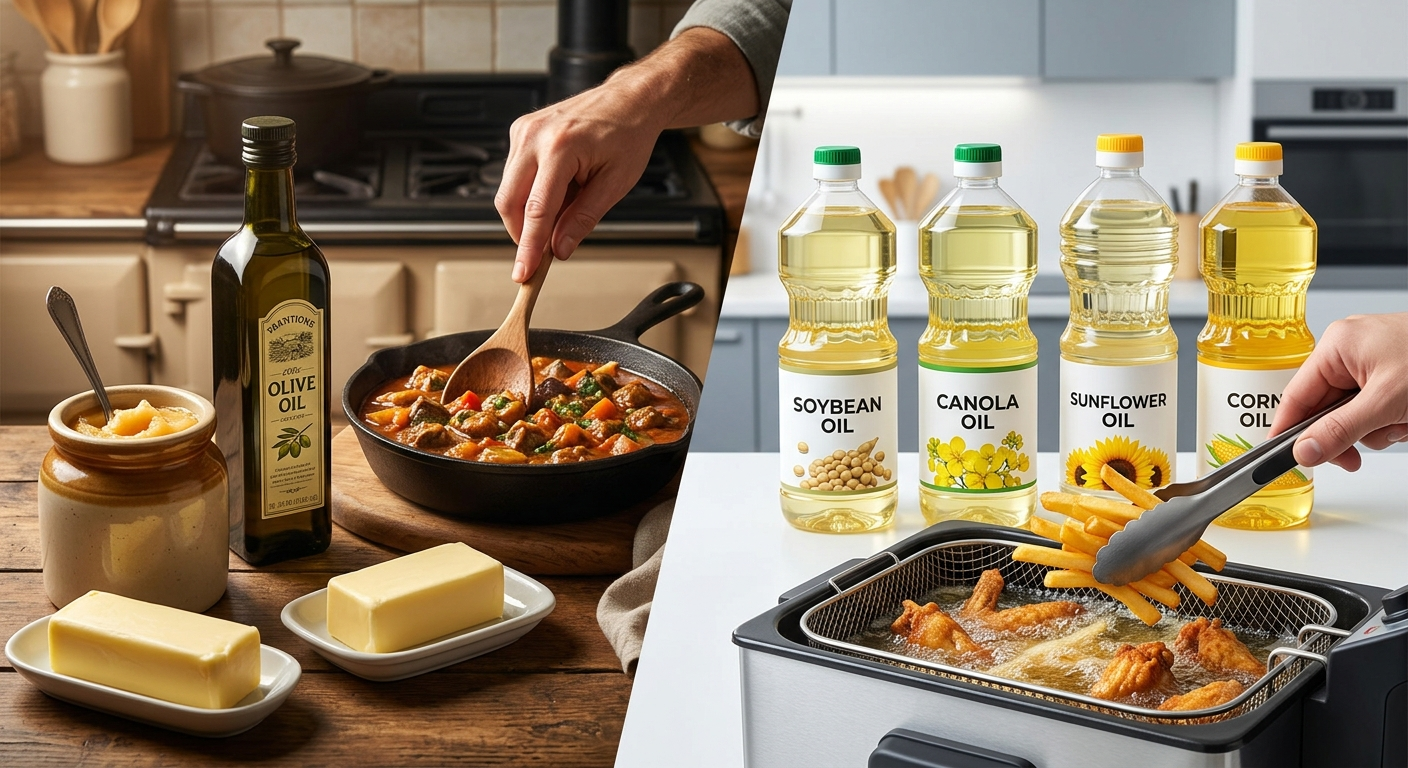
Most people think they know where fat comes from.
Butter on bread.
Oil in a pan.
Cheese on pizza.
Fat on meat.
Cream in coffee.
Avocado on toast.
Nuts in a snack bowl.
Fish on a plate.
But in the modern diet, much of the fat people eat is not so visible.
It hides inside chips, crackers, cookies, pastries, instant noodles, fried foods, salad dressings, mayonnaise, frozen meals, sauces, snack bars, fast food, processed meats, breaded foods, and restaurant meals. It may not look oily. It may not feel like “fat.” But it is there.
This hidden fat often comes from modern refined cooking oils, especially seed oils such as soybean oil, corn oil, sunflower oil, safflower oil, cottonseed oil, grapeseed oil, and blended vegetable oils.
These oils changed the modern food system.
They made frying cheaper. They made packaged foods easier to manufacture. They helped create shelf-stable snacks. They became common in restaurant kitchens. They replaced some traditional fats in home cooking. They also changed the balance of fatty acids in many diets.
This article is not a fear-based attack on all seed oils. It is not saying every drop of vegetable oil is dangerous. Nutrition is more complex than that.
The better question is:
How did modern refined oils become so common, and what happens when they replace traditional fats and whole-food fat sources?
What Are Seed Oils?
Seed oils are oils extracted from the seeds of plants. Common examples include:
Soybean oil
Corn oil
Sunflower oil
Safflower oil
Cottonseed oil
Grapeseed oil
Canola oil
Sesame oil
Rice bran oil
Some seed oils have long culinary traditions. Sesame oil, for example, has been used in many traditional cuisines for flavor. Mustard seed oil has cultural importance in some regions. Other oils became widely used more recently because industrial technology made extraction, refining, and large-scale production easier.
Modern refined seed oils are often neutral in flavor, inexpensive, and useful for frying, baking, packaged foods, and food manufacturing.
This is why they became so common.
The issue is not that a seed can produce oil. The issue is how much refined oil modern people consume, where it appears, what it replaces, and whether it comes mostly from whole foods or ultra-processed foods.
A spoonful of sesame oil used for flavor in a traditional dish is not the same as a diet full of fried snacks, packaged pastries, and fast food made with refined oils.
Context matters.
Traditional Fats Were Usually Tied to Place
Before modern industrial oils became widespread, most cultures used fats that matched their environment.
Mediterranean regions used olive oil.
Tropical regions used coconut and palm-based fats.
Pastoral cultures used butter, ghee, cream, and animal fats.
Coastal communities got fat from fish and seafood.
Some cultures used lard, tallow, duck fat, or chicken fat.
Nuts and seeds provided fat in whole form or as pastes.
Avocados, olives, coconuts, eggs, dairy, fish, and animals all played roles in different regions.
Traditional fats were not universal. They were local.
A community used what it could grow, harvest, press, render, ferment, or trade. Fats were often connected to cooking methods, climate, religion, animal husbandry, agriculture, and food preservation.
Fat was also valuable. It provided energy, flavor, satiety, and cooking power. In food-scarce environments, fat was not something to waste.
Modern refined oils changed this. Fat became cheaper, more standardized, more invisible, and easier to add to processed foods.
The old question was: what fat does this place provide?
The modern question became: what oil is cheapest and most useful for mass production?
The Big Shift: From Whole-Food Fats to Extracted Oils
Traditional diets often included fats within whole foods.
Fish contains fat with protein, minerals, and omega-3s.
Eggs contain fat with protein, choline, and micronutrients.
Nuts contain fat with fiber, minerals, and texture.
Seeds contain fat with fiber and plant compounds.
Olives contain fat with polyphenols and structure.
Avocados contain fat with fiber and potassium.
Dairy fat comes with protein and calcium in foods like yogurt or cheese.
Animal fat was often connected to meat, broth, organs, and whole-animal cooking.
Modern refined oils are different.
They are extracted fats separated from the original food structure. This makes them useful, but also easy to overuse. A handful of sunflower seeds takes chewing. A tablespoon of sunflower oil disappears into a dressing or fried food. Corn takes chewing. Corn oil can be hidden in a snack. Soybeans contain protein and fiber. Soybean oil can be used in packaged foods without the eater noticing.
This is one of the biggest changes in modern fat intake:
Fat moved from visible foods into invisible ingredients.
That shift matters because invisible calories are easier to overconsume.
Why Refined Oils Became So Popular
Modern refined oils became popular for practical reasons.
They are cheap.
They are widely available.
They are neutral in taste.
They work well in factories.
They can be used in frying.
They help create texture in baked goods.
They blend easily into sauces and dressings.
They can extend shelf life in packaged foods.
They are easy to transport and store.
They fit industrial food production.
From a business perspective, refined oils are extremely useful.
They help make chips crisp, crackers flaky, cakes soft, sauces creamy, fried foods golden, and snacks satisfying. They also allow manufacturers to create products that taste rich without using more expensive traditional fats.
This is why refined oils spread through the food supply.
Most people did not consciously decide to eat more seed oil. The food system decided for them. The oils entered through restaurant meals, packaged snacks, fast food, and convenience foods.
The modern eater often consumes refined oils passively.
The Hidden Oil Problem
A person may say, “I do not use much oil.”
That may be true at home. But the real question is: how much oil is hidden in foods eaten outside the home?
Hidden refined oils appear in:
Potato chips
Tortilla chips
Crackers
Cookies
Snack cakes
Frozen pizza
Instant noodles
Fast-food fries
Fried chicken
Breaded fish
Mayonnaise
Salad dressings
Packaged sauces
Granola bars
Pastries
Muffins
Microwave popcorn
Processed meats
Restaurant stir-fries
Packaged vegan foods
Creamy dips
Flavored nuts
Frozen convenience meals
These foods often combine refined oils with refined starch, sugar, salt, and flavorings. This combination can be very easy to overeat.
The problem is not only the oil. It is the delivery system.
A tablespoon of oil used to cook vegetables is very different from oil hidden in a bag of chips. One supports a meal. The other supports snacking.
Omega-6: Essential, but Easy to Overdo
Many seed oils are rich in omega-6 fatty acids, especially linoleic acid.
Omega-6 fats are essential. The body needs them. They help with normal growth, skin function, cell membranes, and signaling processes.
So omega-6 is not “bad.”
The concern is balance and source.
Modern diets can provide large amounts of omega-6 from refined oils while providing relatively little omega-3 from fatty fish, seafood, algae-based sources, flaxseed, chia, or walnuts. This shift may affect the overall fatty acid pattern of the diet.
It is also important to distinguish omega-6 from whole foods versus refined oils. Nuts and seeds contain omega-6, but they also contain fiber, minerals, protein, and texture. Refined oils are concentrated and easier to consume in larger amounts.
The practical message is not “avoid all omega-6.”
A better message is:
Get fats from whole foods more often.
Reduce ultra-processed foods rich in refined oils.
Include omega-3-rich foods if they fit your diet.
Use cooking oils intentionally.
Oxidation: Why Heat and Storage Matter
Oils are not all equally stable.
Polyunsaturated fats, which are common in many seed oils, can be more vulnerable to oxidation when exposed to heat, light, and air. Oxidation can affect flavor, quality, and potentially the way the oil behaves in the body.
This is especially relevant for repeated high-heat frying.
Restaurant fryers may heat oils for long periods. Fried foods may absorb oil. Packaged fried snacks may sit on shelves. The eater may have no idea how fresh the oil was, how hot it became, or how many times it was reused.
This does not mean all cooking with seed oils is automatically harmful. But it does mean oil quality, temperature, freshness, and cooking method matter.
Traditional cooking often used fats suited to local cooking methods. Olive oil for Mediterranean cooking. Ghee for Indian cooking. Coconut in tropical cooking. Animal fats in colder climates. Sesame oil often as a flavoring oil rather than deep-frying oil.
A wiser modern approach is to match the fat to the cooking method and avoid frequent consumption of deep-fried processed foods.
Traditional Fats Were Not Perfect Either
It is important not to romanticize traditional fats.
Butter, ghee, lard, tallow, coconut oil, palm oil, dairy fat, and animal fats can be high in saturated fat. For some people, especially those with elevated LDL cholesterol or cardiovascular risk, high saturated fat intake may need to be limited.
Traditional fats also existed in different lifestyles. People often moved more, ate fewer ultra-processed foods, consumed more fiber-rich plants in some cultures, and did not always have constant food abundance.
So the answer is not simply to replace all seed oils with unlimited butter, lard, or coconut oil.
That would be another oversimplification.
A balanced view recognizes that every fat has a context.
Olive oil is not the same as butter.
Fish fat is not the same as soybean oil.
Avocado is not the same as shortening.
Nuts are not the same as refined frying oil.
Coconut oil is not the same as salmon.
A fried snack is not the same as olive oil on vegetables.
The goal is not to worship one fat. The goal is to build a better fat pattern.
The Fat Pattern Matters More Than One Oil
People often ask, “Which oil is best?”
That question can be useful, but it is incomplete.
A better question is: what is the whole fat pattern of the diet?
Does most fat come from whole foods or packaged snacks?
Are you eating fatty fish or omega-3 sources?
Are nuts and seeds eaten in whole form?
Are fried foods frequent?
Do you cook at home or rely on restaurants?
Do you eat many sauces and dressings?
Are fats paired with vegetables and protein, or mostly refined starch?
Is saturated fat very high?
Are oils fresh and stored properly?
Is portion size reasonable?
Someone using a small amount of seed oil at home in an otherwise whole-food diet may have a very different pattern from someone eating fast food, chips, pastries, and packaged snacks daily.
Nutrition is about patterns, not isolated ingredients.
Seed Oils and Ultra-Processed Foods
Seed oils became controversial partly because they are deeply connected to ultra-processed foods.
Many ultra-processed products rely on refined oils for texture and flavor. These foods are often also high in refined starch, sugar, sodium, and additives. They are designed to be convenient and easy to overeat.
When people reduce seed oils, they often reduce ultra-processed foods at the same time. That can improve diet quality for many reasons:
Less refined starch
Less added sugar
Less sodium
Fewer snack foods
More home cooking
More whole foods
Better meal structure
More visible ingredients
Fewer fried foods
The benefit may not come only from removing a specific oil. It may come from changing the entire food pattern.
This is why people sometimes feel better after avoiding seed oils. They may also be avoiding chips, fast food, pastries, packaged snacks, and restaurant fried foods.
That is a major dietary shift.
The Restaurant Oil Question
Restaurants often use refined oils because they are affordable and practical.
This does not mean restaurant food is always unhealthy. But eating out frequently can increase hidden oil intake because restaurant cooking often uses more oil than home cooking.
Oil may be used in:
Frying
Sautéing
Dressings
Marinades
Sauces
Grilling surfaces
Roasted vegetables
Rice dishes
Noodles
Meats
Breaded foods
The eater may not see it.
A salad can contain more oil than expected because of dressing. A vegetable dish can be oily. A grilled protein may be cooked with oil. A sauce can add significant fat.
A practical approach is not to avoid restaurants completely. It is to be aware.
Ask for dressing on the side.
Choose grilled, steamed, baked, or broth-based foods more often than fried foods.
Limit deep-fried sides.
Choose simple dishes when possible.
Balance restaurant meals with home-cooked meals.
The more you eat out, the more hidden oils matter.
Fried Foods: The Most Important Place to Pay Attention
If someone wants to improve fat quality, fried foods are one of the most important places to start.
Fried foods often combine refined oils, heat exposure, refined flour or starch, salt, and highly palatable texture. They are easy to overeat and often appear in fast food and snack culture.
Examples include:
French fries
Fried chicken
Doughnuts
Fried fish sticks
Tempura-style foods
Chips
Fried snacks
Onion rings
Fried pastries
Breaded fried meats
Fried fast-food sides
Fried foods can be enjoyable occasionally. Many cultures have traditional fried foods for festivals or special occasions. The problem is frequency.
When fried foods become daily or routine, they can crowd out better meals and increase hidden oil intake significantly.
A balanced approach is to treat fried foods as occasional pleasure, not everyday fuel.
Whole-Food Fat Sources: A Better Foundation
A better fat pattern usually begins with whole-food fat sources.
These include:
Fatty fish
Eggs
Avocados
Olives
Nuts
Seeds
Plain yogurt or kefir if tolerated
Cheese in moderate amounts
Tofu or soy foods
Coconut in traditional contexts
Nut and seed butters
Whole animal foods in appropriate portions
Whole-food fats come with texture and nutrients. They are easier to recognize and harder to hide. They support meals rather than disappearing into ultra-processed products.
This does not mean oils are unnecessary. Oils can be useful for cooking and flavor. But whole-food fats should often be the foundation, with oils used intentionally.
A meal with salmon, vegetables, and potatoes is different from chips cooked in oil. A handful of walnuts is different from a packaged cookie made with refined oil. Olives are different from oil-heavy snack foods.
The food matrix matters.
Olive Oil: Why It Is Often Treated Differently
Olive oil is also an extracted oil, but it has a different cultural and nutritional context from many industrial seed oils.
Extra virgin olive oil is central to Mediterranean food traditions. It is often used with vegetables, legumes, fish, salads, herbs, and whole-food meals. It contains mostly monounsaturated fat and includes polyphenols when minimally refined.
This does not make olive oil magic or unlimited. It is still calorie-dense. But it is often part of a dietary pattern associated with whole foods and meal structure.
The key lesson is not simply “use olive oil.” It is:
Use fats in a way that supports real meals.
Olive oil on vegetables or beans is different from refined oil in packaged snacks. The food context is completely different.
Butter, Ghee, Lard, and Tallow
Traditional animal fats such as butter, ghee, lard, and tallow have been used in many cultures.
They are flavorful, useful for cooking, and culturally meaningful. But they are also higher in saturated fat than many plant oils. People with high LDL cholesterol or cardiovascular risk may need to limit them or use them carefully.
A small amount of butter for flavor is different from a diet built heavily around butter, cream, bacon, and low-fiber foods. Ghee used in traditional cooking with legumes, spices, and vegetables is different from adding large amounts of saturated fat to every meal.
Traditional does not mean unlimited.
Animal fats can have a place in some diets, but they should be used with awareness, especially if cholesterol markers are a concern.
Coconut and Palm Oils
Coconut oil and palm oil are plant fats, but they are high in saturated fat.
Coconut is traditional in many tropical diets. Palm oil has culinary and economic importance in several regions. These fats make sense in specific cultural and ecological contexts.
However, modern marketing sometimes presents coconut oil as a universal superfood. That is too simple. Coconut oil is still high in saturated fat and may not be appropriate in large amounts for everyone.
Palm oil also raises environmental concerns depending on production practices, including deforestation and habitat destruction in some regions.
Again, context matters.
Traditional use, portion, health status, and sourcing all affect how these fats fit into a modern diet.
Canola Oil: A More Complicated Seed Oil
Canola oil is often grouped with seed oils, but it has a different fatty acid profile from some others. It is lower in saturated fat and contains some ALA, a plant omega-3 fatty acid. It is commonly refined and used in cooking and processed foods.
Some people avoid canola oil because it is industrially processed. Others use it because it is affordable, neutral, and lower in saturated fat.
A balanced view is that canola oil is not the same as whole-food fat sources, but it also should not be treated as identical to deep-fried ultra-processed food.
The bigger question remains: what is the whole diet?
If canola oil is used occasionally in home cooking with whole foods, that is different from consuming large amounts through packaged snacks and restaurant fried foods.
How Much Oil Is Too Much?
There is no single perfect answer.
Oil is calorie-dense. Even healthy oils can contribute a lot of energy quickly. A tablespoon of oil may disappear into food without making the meal look much bigger.
For people trying to manage weight, blood sugar, cholesterol, or metabolic health, oil quantity can matter.
But oil should not be judged only by calories. It also helps carry flavors, cook vegetables, improve texture, and make meals satisfying.
The key is intentional use.
Pour oil into a spoon before adding it instead of free-pouring.
Use dressing lightly and add vinegar or lemon for volume.
Choose cooking methods that do not require large amounts of oil.
Use broth, steaming, roasting, or grilling when appropriate.
Use nuts, seeds, avocado, fish, or yogurt for whole-food fats.
Avoid oil-heavy snacks as daily foods.
Oil should serve the meal, not silently dominate it.
How to Choose Cooking Oils More Wisely
A practical oil choice depends on use.
For salads and low-heat flavor, extra virgin olive oil can be a good option.
For moderate cooking, olive oil or avocado oil may fit many kitchens.
For high-heat cooking, choose oils or fats suited to higher temperatures and avoid burning.
For traditional cuisines, use culturally appropriate fats in reasonable amounts.
For flavor, small amounts of sesame oil, butter, ghee, or other strong fats can go a long way.
For deep frying, reduce frequency rather than trying to make fried food a daily health food.
Also consider storage.
Keep oils away from heat, light, and air.
Do not use oils that smell rancid.
Buy amounts you can use before they go bad.
Avoid repeatedly heating oil at high temperatures.
Freshness matters.
Practical Ways to Reduce Hidden Refined Oils
Reducing hidden refined oils does not require obsession.
Start with the biggest sources:
Eat fewer chips and packaged snacks.
Limit fast food and fried foods.
Choose baked, grilled, steamed, or broth-based meals more often.
Use salad dressing intentionally.
Read labels on crackers, cookies, bars, sauces, and frozen meals.
Cook more at home.
Choose whole nuts instead of oil-heavy snack foods.
Use canned fish, eggs, beans, yogurt, and leftovers for quick meals.
Make simple sauces with yogurt, lemon, herbs, vinegar, tahini, or olive oil.
Avoid eating directly from snack packages.
This approach naturally reduces refined oils while improving overall diet quality.
Better Fat Swaps
Instead of oil-heavy packaged snacks, try nuts, fruit with nut butter, yogurt, boiled eggs, hummus with vegetables, or leftovers.
Instead of deep-fried potatoes, try boiled, baked, or roasted potatoes with herbs.
Instead of creamy bottled dressing, try olive oil, vinegar, mustard, lemon, yogurt, or tahini-based dressings.
Instead of fried chicken nuggets, try baked chicken, fish, eggs, tofu, beans, or a homemade version.
Instead of pastries for breakfast, try oats with seeds, eggs with vegetables, or plain yogurt with fruit.
Instead of chips with lunch, try soup, salad, fruit, fermented vegetables, or roasted roots.
These swaps are not about perfection. They are about changing the default.
The “Visible Fat” Rule
One useful principle is the visible fat rule.
Try to get most of your fats from foods you can see and understand.
You can see fish.
You can see eggs.
You can see nuts.
You can see avocado.
You can see olives.
You can see yogurt.
You can see a spoon of olive oil.
You can see butter if you add it.
Hidden fats in ultra-processed foods are harder to understand.
When fat is visible, you can choose it intentionally. When fat is hidden in snacks, sauces, and fried foods, you consume it passively.
Visible fat encourages awareness.
Invisible fat encourages overconsumption.
The Traditional Plate Approach to Fat
Traditional diets often used fat to complete meals, not replace them.
A little olive oil on vegetables.
A small amount of ghee in lentils.
Fish fat with rice and greens.
Nuts in a grain dish.
Yogurt sauce with meat or roots.
Cheese with bread and soup.
Sesame oil as a finishing flavor.
Animal fat in a stew with vegetables.
Coconut in a curry with roots and herbs.
Fat made food satisfying, but it belonged to a meal.
Modern processed foods often separate fat from meal structure. Fat becomes part of snack products, desserts, and fast foods.
To eat fat more wisely, put it back into meals.
A Simple Fat Quality Checklist
Before choosing a fat or oil, ask:
Is this fat coming from a whole food or a refined ingredient?
Is it visible or hidden?
Is it part of a meal or a snack product?
Is the food deep-fried?
How often do I eat this kind of fat?
Does the meal also include fiber-rich foods?
Am I getting omega-3 sources?
Is saturated fat high in my diet?
Do my cholesterol markers suggest I need changes?
Is this fat fresh and stored properly?
This checklist is practical, not extreme.
Common Myths About Seed Oils and Traditional Fats
Myth 1: All seed oils are poison
That is too extreme. The bigger concern is high intake of refined oils through ultra-processed foods and fried foods.
Myth 2: Traditional fats are always healthier
Traditional fats can be useful and flavorful, but some are high in saturated fat and may not suit everyone in large amounts.
Myth 3: Olive oil is unlimited because it is healthy
Olive oil can be part of a healthy pattern, but it is still calorie-dense and should be used intentionally.
Myth 4: Nuts and seeds should be avoided because they contain omega-6
Whole nuts and seeds are different from refined oils. They contain fiber, minerals, protein, and texture.
Myth 5: Avoiding seed oils automatically makes a diet healthy
A diet can avoid seed oils and still be poor if it is low in fiber, high in saturated fat, low in vegetables, or full of refined foods.
Myth 6: Cooking oil is the only fat that matters
Hidden fats in packaged foods, restaurant meals, and snacks may matter more than the oil used at home.
When to Get Personalized Guidance
Fat choices may need special attention if you have:
High LDL cholesterol
High triglycerides
Heart disease risk
Diabetes
Fatty liver concerns
Gallbladder problems
Kidney disease
Digestive disorders
Eating disorder history
Pregnancy-related concerns
Medication use affecting blood lipids
A medically prescribed diet
A qualified healthcare professional can help personalize advice based on labs, history, and goals.
General food education is useful, but medical nutrition should be individualized.
Conclusion: The Oil Changed, and So Did the Diet
Seed oils and refined cooking oils changed the modern diet because they changed where fat comes from.
Fat moved from visible foods into invisible ingredients. It moved from fish, eggs, nuts, seeds, olives, dairy, animals, and traditional cooking into chips, crackers, sauces, fried foods, pastries, fast food, and packaged meals.
The problem is not one oil alone.
The problem is the modern oil pattern: hidden fats, refined oils, ultra-processed foods, frequent frying, low omega-3 intake, reduced whole-food fats, and loss of traditional meal structure.
Traditional fats were not perfect, and modern seed oils are not automatically poison. The wisest view is more balanced.
Use oils intentionally.
Choose whole-food fats more often.
Reduce fried and packaged foods.
Include omega-3-rich foods if they fit your diet.
Do not replace seed oils with unlimited saturated fat.
Cook more at home.
Pay attention to hidden oils.
Build meals, not snack patterns.
Fat is not the enemy.
Invisible, excessive, ultra-processed fat is the real concern.
When we bring fat back into view, we can make better choices. We can use oil as a tool, not a background habit. We can enjoy traditional fats without romanticizing them. We can reduce hidden refined oils without becoming fearful.
The modern cooking oil shift changed the way people eat.
A wiser modern kitchen can change it again.
Disclaimer: This article is for educational purposes only and is not medical advice. Fat and oil choices should be personalized based on cholesterol levels, heart health, metabolic health, digestion, medications, pregnancy-related concerns, allergies, and dietary needs. Consult a qualified healthcare professional before making major dietary changes.