
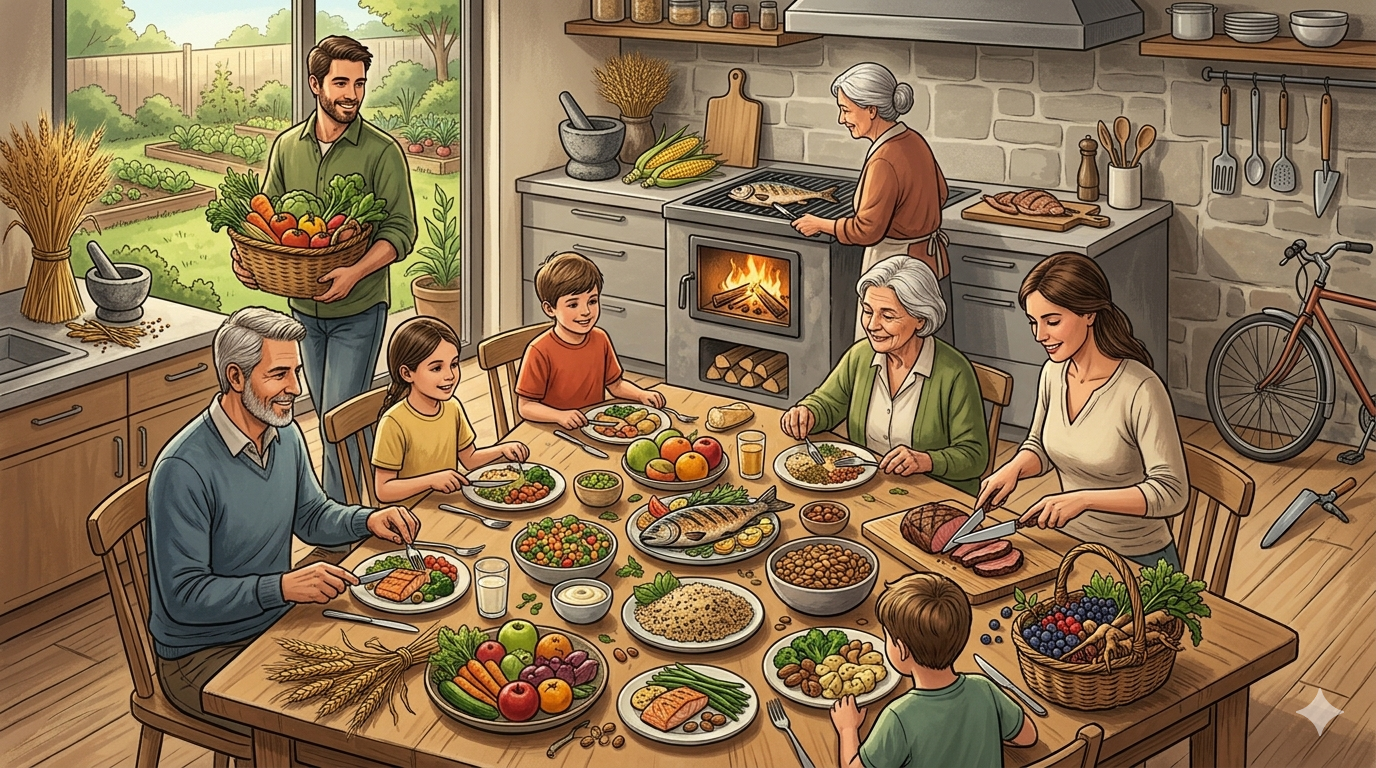
Modern eating is easier than ever, but it is also more confusing than ever.
Food is available all day. Supermarkets are full of choices. Restaurants deliver meals to our doors. Packaged snacks sit in drawers, cars, offices, and school bags. Sweet drinks, refined flour, processed meats, and convenience foods are everywhere. At the same time, people are surrounded by conflicting nutrition advice.
Eat more protein.
Avoid fat.
Eat less sugar.
Cut carbs.
Go plant-based.
Go low-carb.
Try fasting.
Eat small meals.
Eat like your ancestors.
Trust modern science.
It is no surprise that many people feel lost.
One helpful way to think more clearly about food is to look backward—not to copy the past perfectly, but to learn from it. Our ancestors did not have modern nutrition labels, diet apps, calorie calculators, or health influencers. Yet many traditional food cultures developed practical wisdom over generations.
They learned how to find food, prepare it, preserve it, combine it, and eat it within the rhythms of daily life. They understood, often through experience rather than laboratory science, that food was connected to work, seasons, community, survival, digestion, and culture.
Our ancestors cannot give us a single perfect diet. Human diets have always been diverse. But they can teach us important principles that still matter in modern life.
Lesson 1: Food Is More Than Nutrients
Modern nutrition often breaks food into parts: calories, protein, fat, carbohydrates, fiber, vitamins, minerals, cholesterol, sodium, sugar, and so on. These details can be useful, but they are not the whole story.
Food is also structure, preparation, culture, timing, environment, and experience.
A bowl of traditional soup is not just protein, water, sodium, and vegetables. It may represent a way of using bones, herbs, roots, seasonal plants, leftover ingredients, and slow cooking to create a nourishing meal. A fermented food is not just calories and acid. It may represent preservation, microbial transformation, flavor development, and digestive adaptation. A grain dish is not just starch. It may be soaked, fermented, stone-ground, steamed, boiled, or paired with legumes and vegetables.
Our ancestors remind us that food should be understood as a whole.
This matters because modern processed foods often imitate the parts of food while losing the whole. A packaged snack may contain carbohydrates, fat, salt, flavoring, and added vitamins, but it may lack the natural structure, fiber, water, chewing effort, and cultural context of a real meal.
When we see food only as nutrients, we can be tricked by products that look scientifically improved but do not truly nourish us.
Lesson 2: Whole Foods Should Be the Foundation
Our ancestors ate foods that were closer to their natural or traditional forms. This does not mean everything was raw or untouched. Humans have cooked and processed food for a very long time. But traditional processing usually had a purpose: make food safer, preserve it, improve flavor, reduce bitterness, soften tough fibers, or make nutrients more available.
Modern ultra-processed foods are different. Many are designed to be cheap, shelf-stable, convenient, and hard to stop eating.
A traditional meal might include roots, grains, fish, eggs, beans, vegetables, fruit, fermented foods, nuts, seeds, meat, herbs, or broth. A modern processed meal might be built from refined flour, refined oil, sugar, starch, salt, artificial flavor, and additives.
The ancestral lesson is simple: make real food the base of the diet.
This does not require perfection. It does not mean avoiding every modern food. But it does suggest that daily eating should be built mostly from foods that still look like food.
Useful examples include:
Whole fruits instead of fruit-flavored sweets
Cooked potatoes or roots instead of chips
Plain yogurt or fermented dairy instead of sugary dairy desserts
Whole grains or traditional bread instead of sweet packaged pastries
Fresh fish or eggs instead of highly processed meats
Beans or lentils instead of refined snack foods
Home-cooked meals instead of constant takeout
The more a food has been refined, sweetened, softened, and engineered for overconsumption, the more carefully we should treat it.
Lesson 3: Preparation Matters
One of the most valuable lessons from traditional diets is that preparation matters.
Many foods are not automatically ideal in their raw or modern form. Grains, legumes, tubers, dairy, fish, meat, vegetables, and fruits have often been prepared carefully in traditional cultures.
People soaked beans.
They fermented grains.
They cooked roots.
They dried fish.
They salted meat.
They smoked foods.
They made yogurt and cheese.
They sprouted seeds.
They used herbs and spices.
They turned seasonal foods into preserved foods.
These methods were not just about taste. They often helped with digestion, safety, storage, and nutrient availability.
For example, beans may become easier to digest after soaking and long cooking. Grains may change through fermentation. Milk may be better tolerated when turned into yogurt or cheese. Fish may be preserved through drying, salting, or fermentation. Vegetables may be transformed through pickling or fermentation.
Modern eating often skips preparation. It favors speed. Food is made ready-to-eat, ready-to-heat, ready-to-drink, or ready-to-snack.
Convenience has value, but when all food becomes fast food, we lose something important. We lose the knowledge of how food changes through time, heat, microbes, water, salt, and care.
Our ancestors remind us that cooking is not just a chore. It is part of nutrition.
Lesson 4: Diversity Protects the Diet
Traditional diets were often more diverse than modern diets in ways we do not always recognize.
A modern supermarket may appear diverse because it contains thousands of products. But many packaged foods are made from the same few ingredients: wheat, corn, soy, sugar, refined oils, starches, flavorings, and additives.
Traditional diets, especially foraging diets, often included many species of plants and animals across seasons. Even agricultural diets could be diverse when staple foods were combined with vegetables, legumes, herbs, spices, fermented foods, fish, eggs, dairy, or small amounts of meat.
Dietary diversity helps provide a wider range of nutrients, fibers, flavors, and plant compounds. It also reduces dependence on one food or one food group.
This does not mean every person needs to eat exotic ingredients. It means a diet should not be built from the same refined products every day.
A simple way to apply this lesson is to rotate foods:
Use different vegetables.
Try different fruits.
Include herbs and spices.
Alternate protein sources.
Choose different legumes or grains if tolerated.
Eat seasonal foods when possible.
Use fermented foods if they work for your digestion.
Explore traditional recipes from your own culture or others.
Diversity makes eating more resilient.
Lesson 5: Food Should Fit the Environment
Ancestral eating patterns were shaped by geography.
People near rivers and oceans often ate more fish and shellfish. People in cold climates relied more on preserved foods and animal foods. People in tropical regions had access to fruits, tubers, spices, insects, and plant diversity. Farming communities built meals around local staples such as rice, wheat, maize, millet, potatoes, beans, or yams.
This reminds us that diets are not created in isolation. They are shaped by climate, soil, water, animals, seasons, and culture.
Modern food systems make it possible to eat almost anything anywhere at any time. This can be wonderful, but it can also disconnect us from seasonality and place.
Eating with the environment in mind does not mean we must eat only local food. But it can encourage better questions:
What foods are naturally available where I live?
Which seasonal foods can I enjoy more often?
Which traditional foods make sense in my climate?
Am I eating mostly packaged products that could come from anywhere?
Could I cook more with fresh, regional ingredients?
Food that fits the environment often fits daily life more naturally.
Lesson 6: Animal Foods and Plant Foods Both Have Context
Modern diet arguments often create a battle between animal foods and plant foods. One side says animal foods are essential. Another says plant foods are best. But history shows a more complex picture.
Human beings have eaten both animal and plant foods in many different patterns.
Some communities relied heavily on fish, meat, eggs, shellfish, insects, or dairy. Others relied more on grains, legumes, tubers, fruits, vegetables, nuts, seeds, and fermented plant foods. Many traditional diets combined both.
The ancestral lesson is not that everyone must eat the same ratio of animal to plant foods. The lesson is that context matters.
Animal foods can provide high-quality protein, vitamin B12, iron, zinc, omega-3 fats, calcium, and other nutrients. But modern processed meats, deep-fried animal foods, and excessive intake in a sedentary lifestyle may create problems.
Plant foods can provide fiber, vitamins, minerals, antioxidants, starch, and beneficial compounds. But some plant foods require proper preparation, and some people have difficulty with certain fibers, grains, legumes, or fermentable carbohydrates.
Instead of asking whether animal foods or plant foods are universally good or bad, ask:
What kind?
How much?
Prepared how?
Eaten with what?
In what lifestyle?
For which person?
This balanced view is more useful than diet tribalism.
Lesson 7: Food Culture Matters
Our ancestors did not eat only for nutrients. They ate within cultures.
Meals marked family life, celebrations, seasons, work, religion, hospitality, and identity. Food connected people to place and memory. Traditional dishes often carried practical wisdom hidden inside flavor.
A sauce, soup, fermented condiment, spice blend, or preserved food may contain generations of experimentation. People discovered what tasted good, what lasted, what supported digestion, and what helped make simple staples satisfying.
Modern eating often weakens food culture. People eat alone, quickly, while distracted, in cars, at desks, or in front of screens. Food becomes fuel, entertainment, stress relief, or convenience.
Our ancestors remind us that how we eat matters too.
Eating slowly, sharing meals, cooking with family, respecting traditional recipes, and paying attention to food can change the experience of eating. These habits may support better portion awareness, digestion, satisfaction, and emotional connection.
A healthy diet is not only about ingredients. It is also about rhythm and relationship.
Lesson 8: Movement Was Built Into Daily Life
For most of human history, food required effort.
People walked, carried, dug, gathered, hunted, farmed, cooked, chopped, ground, washed, built fires, fetched water, and preserved food. Even ordinary daily life involved more movement than many modern routines.
Today, many people sit for long hours and still have constant access to calorie-dense foods. This changes the meaning of diet.
A traditional high-starch meal eaten by a physically active person is not the same as refined carbohydrates eaten repeatedly in a sedentary lifestyle. A calorie-dense meal after hard physical work is not the same as constant snacking during a day of sitting.
Our ancestors remind us that food and movement belong together.
This does not mean everyone needs intense exercise. Walking, cooking, gardening, cleaning, stretching, carrying groceries, taking stairs, and standing more often can all help reconnect the body with daily movement.
Modern eating problems are not caused by food alone. They are also shaped by a lifestyle that separates eating from physical effort.
Lesson 9: Sweetness Was Rare
In ancestral environments, concentrated sweetness was not available all day.
Fruit was seasonal. Honey was difficult to obtain. Sweet foods were often limited by geography, season, effort, and competition with animals. Today, sweetness is everywhere: soda, juice, candy, flavored yogurt, cereal, pastries, sauces, coffee drinks, protein bars, snacks, and desserts.
This constant sweetness can train the palate to expect sugar often. It can also make simple whole foods taste less exciting.
Our ancestors teach us that sweetness should be enjoyed, but not allowed to dominate the diet.
Whole fruit is different from sugary drinks and candy. Fruit contains water, fiber, texture, and natural food structure. But even with fruit, context matters. Modern fruits are often larger and sweeter than many wild fruits, and fruit juice removes much of the structure that helps regulate intake.
A practical ancestral-inspired approach is to reduce sweetened drinks and ultra-sweet snacks while enjoying whole fruits in reasonable amounts.
Lesson 10: Preservation Was a Skill
Before refrigeration, people had to preserve food carefully.
They dried meat and fish.
They fermented vegetables.
They salted foods.
They smoked foods.
They stored grains.
They made cheese and yogurt.
They turned fruits into preserves.
They buried, cured, or aged foods in specific ways.
Preservation was not just about survival. It shaped flavor and culture.
Modern refrigeration has made life easier and safer in many ways. But it has also made people less connected to preservation skills. Many preserved foods today are industrial products with excess sugar, refined oils, preservatives, or artificial flavors.
Traditional preservation can still be valuable. Fermented vegetables, yogurt, aged cheese, dried herbs, pickled foods, and traditionally preserved fish or meat can add flavor and diversity when used appropriately.
The key is to distinguish traditional preservation from ultra-processing.
Lesson 11: The Best Diet Is Not Always the Most Convenient Diet
Our ancestors lived in food systems that required patience. Meals often took time. Ingredients needed washing, soaking, grinding, chopping, cooking, fermenting, drying, or sharing.
Modern convenience has solved many problems, but it has created new ones. When every meal is instant, food can become disconnected from care. The easiest option is not always the most nourishing option.
This does not mean every meal must be slow or complicated. Modern life is busy. But a diet built entirely on convenience foods often becomes less balanced, less satisfying, and easier to overeat.
A practical compromise is to make simple traditional-style meals:
Eggs with vegetables
Soup with beans or meat
Rice with fish and herbs
Potatoes with yogurt or fermented vegetables
Lentil stew
Oatmeal with nuts and fruit
Sourdough bread with simple toppings
Grilled fish with vegetables
Broth-based soups
Cooked roots with protein and greens
These meals do not need to be fancy. They simply bring eating closer to real ingredients.
Lesson 12: Individual Tolerance Matters
Ancestral nutrition also teaches us that people are different.
Some populations adapted to dairy. Others did not. Some people tolerate grains well. Others may react poorly to wheat or gluten. Some digest beans easily. Others struggle with gas and bloating. Some enjoy fermented foods. Others need caution. Some metabolize alcohol better than others.
Traditional diets often reflect this variation. People ate what their communities had adapted to over generations, but even within a culture, individuals differed.
This is why modern eating should include self-observation.
Ask yourself:
Which foods give me steady energy?
Which foods cause discomfort?
Do I tolerate dairy?
Do I feel better with more or less starch?
Do fermented foods help or bother me?
Do I feel satisfied after meals?
Does my diet fit my culture, schedule, and health needs?
The goal is not to follow an ancestral rulebook. The goal is to build a diet that respects both human history and your own body.
What We Should Not Copy from the Past
Learning from ancestors does not mean romanticizing the past.
The past included food scarcity, famine, parasites, infections, unsafe water, high infant mortality, limited medical care, and periods of malnutrition. Not every traditional practice was healthy. Some foods were eaten because people had no better option. Some preservation methods increased salt intake. Some diets lacked important nutrients during hard seasons.
Modern science, hygiene, refrigeration, emergency medicine, food safety, and nutrition research have real value.
The best approach is not “ancient good, modern bad.” A better approach is:
Learn from traditional wisdom.
Use modern science.
Avoid extreme claims.
Respect individual needs.
Choose real foods more often.
Reduce ultra-processed foods.
Keep food connected to daily life.
Our ancestors offer guidance, not a perfect blueprint.
How to Eat More Traditionally in Modern Life
You do not need to live like a hunter-gatherer or farmer to apply ancestral lessons. You can start with realistic habits.
Cook more meals from basic ingredients.
Replace sweetened drinks with water, tea, or unsweetened drinks.
Eat whole fruit instead of fruit juice.
Choose traditional starches instead of refined snacks.
Use herbs, spices, and fermented condiments for flavor.
Try soaking or slow-cooking beans if you eat them.
Choose plain yogurt or fermented dairy if tolerated.
Eat fish or seafood if it fits your diet and values.
Include vegetables in meals, not only as an afterthought.
Pay attention to how your body responds to different foods.
Eat without screens when possible.
Move your body daily.
Build meals you can repeat and sustain.
Small changes matter when they are consistent.
A Balanced Ancestral-Inspired Plate
An ancestral-inspired modern plate does not need to look one specific way. It can vary by culture, preference, and tolerance.
One version might include:
A protein source such as fish, eggs, beans, yogurt, meat, tofu, lentils, or shellfish
A traditional starch such as potatoes, rice, oats, sourdough bread, millet, beans, yams, or whole grains
Vegetables, herbs, or greens
A source of natural fat such as olive oil, avocado, nuts, seeds, dairy fat, or fish fat
A fermented or flavorful element such as yogurt, sauerkraut, kimchi, pickles, miso, vinegar, or traditional sauce
Whole fruit if desired
The exact foods can change. The principle stays the same: real ingredients, thoughtful preparation, cultural fit, and personal tolerance.
Common Misunderstandings About Ancestral Eating
Myth 1: Ancestral eating means eating only meat
Some ancestral diets were rich in animal foods, but many included plants, tubers, fruits, nuts, seeds, insects, grains, legumes, and fermented foods.
Myth 2: Traditional diets were always healthy
Traditional diets contain wisdom, but they were also shaped by scarcity and survival. They should be understood, not blindly copied.
Myth 3: Modern science does not matter
Modern science helps us understand allergies, deficiencies, food safety, metabolic health, and disease risk. Ancestral wisdom and science can work together.
Myth 4: All processed food is bad
Cooking, fermenting, drying, grinding, and salting are forms of processing. The concern is mainly ultra-processing that makes food less nourishing and easier to overconsume.
Myth 5: Everyone should eat the same ancestral diet
There was never one ancestral diet. Human diets have always been diverse.
Conclusion
Our ancestors cannot hand us a perfect meal plan for modern life. They lived in different environments, with different challenges, tools, and food supplies. But they can teach us principles that remain deeply useful.
They teach us that food is more than nutrients.
They teach us to value whole foods.
They teach us that preparation matters.
They teach us to respect diversity, culture, and seasonality.
They teach us that food and movement belong together.
They teach us that sweetness was once rare.
They teach us that personal tolerance matters.
They teach us not to separate eating from life.
Modern eating does not need to reject the past or blindly follow it. The wisest path is to use ancestral food wisdom as a lens.
Look at your food.
Ask where it came from.
Ask how it was prepared.
Ask whether it nourishes or merely entertains.
Ask how your body responds.
Ask whether your eating pattern can support long-term wellbeing.
The goal is not to eat exactly like our ancestors. The goal is to eat with more awareness, more balance, and more respect for the long relationship between humans and food.
Disclaimer: This article is for educational purposes only and is not medical advice. If you have a medical condition, food allergy, digestive disorder, pregnancy-related concern, or specific dietary need, consult a qualified healthcare professional before making major changes to your diet.