
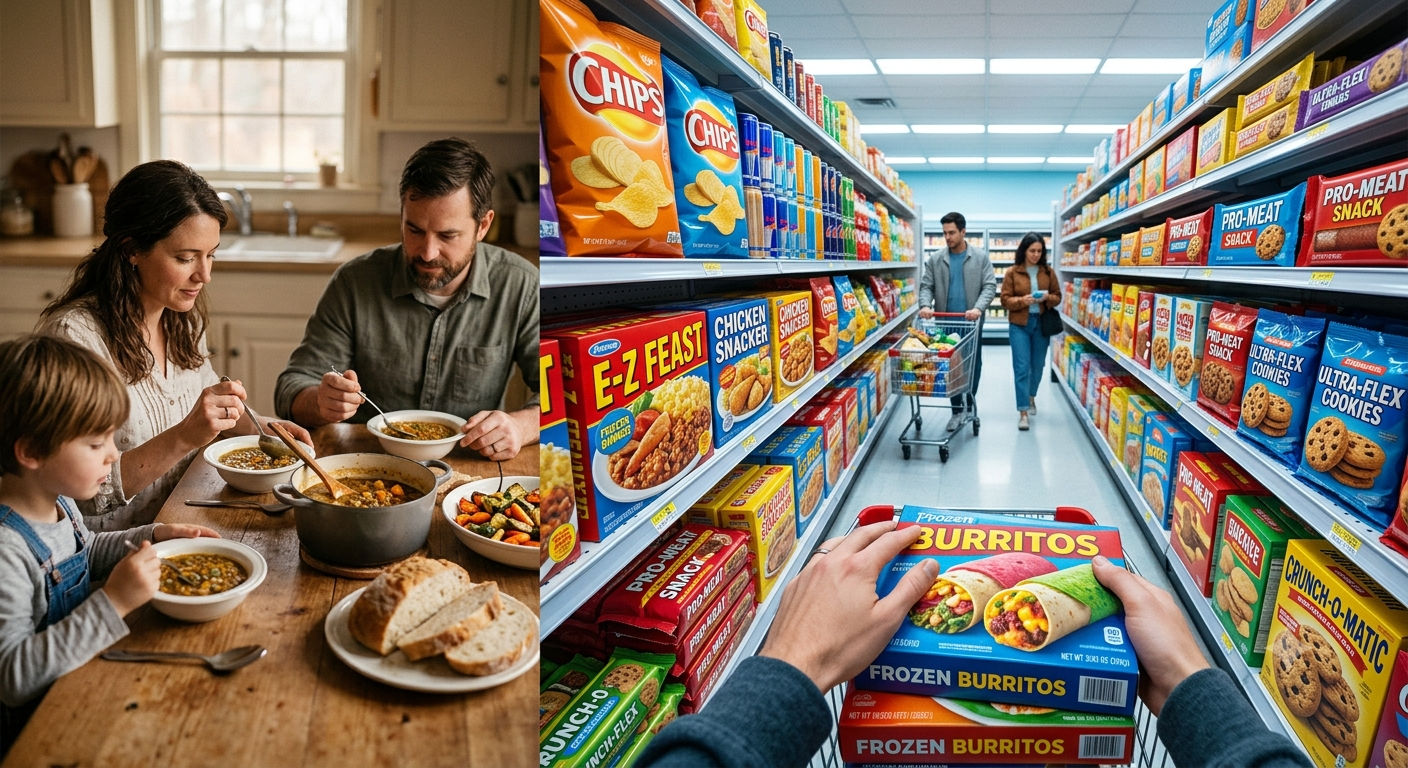
Modern processed foods did not simply add new items to the supermarket.
They changed the way humans eat.
They changed breakfast from a cooked meal into a sweet product poured from a box. They changed lunch from a shared meal into something eaten quickly at a desk. They changed snacks from occasional foods into an all-day habit. They changed drinks from water, tea, broth, or milk into sweetened beverages available everywhere. They changed flavor from something built slowly through cooking into something engineered instantly with sugar, salt, fat, aroma, crunch, and softness.
In traditional diets, food was connected to place, season, family, kitchen skill, preservation, culture, and physical effort. Modern processed foods changed that relationship. They made food faster, cheaper, softer, sweeter, more portable, more predictable, and easier to consume without thinking.
This does not mean every processed food is bad. Cooking is processing. Fermentation is processing. Drying, salting, grinding, freezing, and canning can all be useful. The real issue is not processing itself.
The issue is modern ultra-processing: foods designed for long shelf life, low cost, intense flavor, convenience, and repeat consumption.
To understand modern diet and metabolic health, we must ask a deeper question:
What happens when food becomes easier to eat than the body was prepared for?
First, What Counts as Processed Food?
The word “processed” can be confusing.
Technically, any food changed from its original state is processed. A chopped carrot is processed. Cooked rice is processed. Yogurt is processed by fermentation. Olive oil is processed from olives. Cheese is processed from milk. Dried fish, sourdough bread, roasted nuts, and frozen vegetables are all processed in some way.
So the question is not simply: “Is this food processed?”
A better question is: “What kind of processing happened, and why?”
There are helpful forms of processing:
Cooking food to make it safer or easier to digest
Fermenting food to preserve it and create flavor
Freezing vegetables to prevent waste
Drying herbs or fruits for storage
Grinding grains into traditional flour
Canning beans or fish for convenience
Making yogurt, kefir, cheese, or sourdough
Then there is ultra-processing.
Ultra-processed foods are often made from refined ingredients such as starches, sugars, oils, protein isolates, flavorings, colors, emulsifiers, stabilizers, and additives. They may contain little resemblance to the original food. They are often designed to be convenient, highly palatable, shelf-stable, and easy to eat quickly.
Examples include many packaged snacks, sweetened cereals, soft drinks, instant noodles, candy, cookies, crackers, fast-food items, processed meats, snack cakes, flavored chips, sugary yogurts, frozen convenience meals, and sweetened beverages.
Traditional processing usually helped food become more useful.
Ultra-processing often helps food become more sellable.
That difference matters.
The Big Shift: From Meals to Products
Traditional eating was usually meal-based.
People cooked soups, stews, grains, roots, vegetables, fish, meat, beans, eggs, dairy, and fermented foods. Even simple meals had structure. There was a staple, a protein, vegetables, sauce, broth, herbs, or fermented side dishes. Food belonged to a table, a kitchen, a season, or a family routine.
Modern processed foods changed food from meals into products.
Instead of breakfast, there is a cereal bar.
Instead of soup, there is an instant cup.
Instead of fruit, there is a fruit-flavored snack.
Instead of fish, there is a breaded fish stick.
Instead of yogurt, there is a sweet dessert cup.
Instead of bread, there is a soft packaged product.
Instead of water, there is a flavored sweet drink.
Instead of cooking, there is opening.
This shift matters because meals and products behave differently.
Meals usually require some effort. They include multiple ingredients. They are eaten in a place. They have a beginning and an end.
Products can be eaten anywhere, anytime, often without a plate, without cooking, without attention, and without natural stopping points.
Modern processed foods did not only change ingredients. They changed eating behavior.
Convenience Became the New Food Culture
Convenience is one of the most powerful forces in modern eating.
People are busy. They work long hours. They commute. They care for children. They live alone. They have limited time, limited energy, and sometimes limited cooking skills. Processed foods solve real problems.
They are fast.
They are portable.
They are predictable.
They are cheap in many places.
They require no cooking.
They last a long time.
They taste familiar.
They reduce decision-making.
This is why processed foods became so successful. They fit modern life.
But convenience has a hidden cost. When food becomes too convenient, it can disconnect eating from preparation, awareness, and satiety. A meal that once required shopping, washing, chopping, cooking, serving, chewing, and sharing can become a product eaten in five minutes.
The body may receive calories before the mind even notices a meal happened.
Convenience is not the enemy. But convenience without boundaries can reshape appetite.
The challenge is not to reject all modern convenience. The challenge is to use convenience in ways that still support real food.
Frozen vegetables, canned beans, canned fish, plain yogurt, pre-washed greens, and simple cooked grains can be convenient and useful. Ultra-processed snacks and sweet drinks are a different kind of convenience.
One supports meals. The other often replaces them.
Flavor Engineering Changed the Human Palate
Traditional foods get flavor from cooking, fermentation, herbs, spices, acids, smoke, broths, fats, salt, roasting, and time.
Modern processed foods often get flavor from engineering.
They are designed to hit the senses quickly and strongly. They may combine sugar, salt, fat, starch, crunch, softness, aroma, and flavor enhancers in precise ways. The goal is not only taste. The goal is repeat eating.
This can change the palate.
When someone regularly eats ultra-sweet, ultra-salty, crunchy, soft, creamy, and intensely flavored foods, simple foods may begin to taste boring. A plain apple may seem less exciting than candy. Oats may seem bland compared with sweet cereal. Vegetables may seem dull compared with flavored chips. Water may seem boring compared with sweet drinks.
The human palate adapts to what it experiences often.
This is one of the biggest ways processed foods change eating: they raise the flavor volume.
Traditional foods can be deeply flavorful, but their flavor is often more complex and slower. Fermented vegetables are sour and salty. Broth is savory. Herbs are aromatic. Bitter greens require attention. Roasted roots are naturally sweet but not candy-like.
Ultra-processed foods often create faster pleasure with less effort.
Over time, the modern eater may need stronger stimulation to feel satisfied.
Texture Became Softer and Faster
One overlooked feature of processed foods is texture.
Many modern foods are designed to be easy to chew and swallow. Soft bread, sweet drinks, snack cakes, nuggets, instant noodles, creamy desserts, processed meats, refined cereals, and many packaged foods require little chewing.
This matters because chewing is part of eating.
Chewing slows the meal. It gives the mouth, stomach, and brain more time to register food. Whole foods such as apples, nuts, vegetables, beans, meat, roots, and traditional grains often require more physical engagement.
Ultra-processed foods can reduce that engagement.
A person can drink hundreds of calories quickly. A soft snack cake can disappear in seconds. Chips combine crunch with rapid breakdown. Sweetened drinks bypass chewing completely.
The body may not receive the same satiety signals from foods that are consumed quickly and easily.
Traditional foods often had natural brakes: fiber, water, bones, skins, seeds, chewing, heat, bitterness, sourness, or meal structure.
Modern processed foods often remove the brakes.
Snacking Became Normal
In many traditional food cultures, eating had rhythm.
Meals were defined. Snacks existed, but they were often occasional, seasonal, or connected to real foods: fruit, nuts, leftovers, bread, yogurt, roasted roots, or small traditional foods.
Modern processed foods turned snacking into a constant environment.
Snacks are everywhere: offices, cars, schools, gas stations, vending machines, checkout counters, backpacks, bedrooms, and screens. Many people no longer eat only meals. They graze.
Morning snack.
Coffee drink.
Lunch.
Afternoon snack.
Sweet drink.
Evening snack.
Late-night snack.
Small bites in between.
This changes the body’s relationship with hunger.
Instead of eating because a meal is needed, people may eat because food is visible, available, marketed, or emotionally comforting. Processed snacks are often designed to be eaten without preparation and without much attention.
Snacking also changes food culture. Food moves away from the table and into every moment of life.
A traditional diet asked: “What is the next meal?”
A processed food environment asks: “What can I eat right now?”
Sweet Drinks Changed the Meaning of Calories
One of the biggest changes in modern eating is the rise of sweet drinks.
Soda, fruit drinks, sweet teas, energy drinks, flavored coffees, sports drinks, sweetened milk drinks, bottled smoothies, and many packaged beverages deliver sweetness quickly and easily.
Liquid calories are different from food you chew.
A person may drink a large sweet beverage without feeling as full as they would after eating a meal with the same energy. Sweet drinks can become habitual because they are refreshing, stimulating, portable, and socially normal.
Traditional drinks were not always sugar-free. Many cultures had fermented drinks, milk, fruit-based beverages, honey drinks, or sweetened teas. But modern sweet drinks are widely available, inexpensive, oversized, and consumed daily by many people.
This changed the sweetness baseline of the modern diet.
When sweetness comes through drinks, it can be consumed without the natural limits of whole fruit, chewing, fiber, or meal structure.
A key modern nutrition habit is simple but powerful:
Drink fewer sweet calories.
Water, unsweetened tea, black coffee, sparkling water, broth, or lightly flavored unsweetened drinks can help reset the palate.
Portions Became Bigger and Less Visible
Traditional portions were often limited by availability, effort, season, and shared meals.
Modern processed foods changed portions in several ways.
Packages became larger. Drinks became larger. Restaurant servings became larger. Snacks became multi-serving bags. “Value size” became a selling point. People began eating directly from packages rather than serving food onto a plate.
When portion size increases, people often eat more without noticing.
Processed foods make this easier because they are highly palatable and easy to consume. A large bag of chips, a box of cookies, a big soda, or a family-sized frozen meal can normalize larger intake.
Portions also became less visible. A home-cooked meal on a plate is easier to understand. A snack eaten from a bag has no clear endpoint. A sweet drink has no chewing. A packaged bar may seem small but contain concentrated energy.
Modern processed foods hide portion size behind convenience.
A practical response is to reintroduce visibility: put food on a plate, choose smaller packages, avoid eating directly from large containers, and build meals instead of grazing.
Food Became Available All the Time
For most of human history, food availability was limited.
Season, weather, harvest, storage, hunting, cooking time, market access, and household labor all shaped when food could be eaten. Even in agricultural societies, food required planning and work.
Modern processed foods created constant availability.
A person can eat at midnight. Food can be delivered. Snacks can be stored for months. Drinks can be bought anywhere. Fast food is open late. Frozen meals wait in the freezer. Candy sits near checkout counters. Food advertising follows people through screens.
This constant availability is new in human history.
The body’s appetite systems evolved in environments where food often required effort. Modern food requires almost no effort.
This mismatch can make self-control harder. The problem is not only personal willpower. It is the food environment.
If highly stimulating foods are always within reach, the brain must say no repeatedly. That is exhausting.
A healthier environment reduces the number of decisions required.
Keep real foods visible. Keep ultra-processed snacks less available. Build meal routines. Make water easy. Prepare simple foods in advance. Design the environment so better choices require less willpower.
Processed Foods Changed Breakfast
Breakfast is one of the clearest examples of change.
Traditional breakfasts varied widely: porridge, soup, eggs, bread, rice, leftovers, yogurt, fruit, beans, fish, vegetables, or simple cooked foods. Many were not sweet.
Modern breakfast often became dessert-like.
Sweet cereal.
Flavored yogurt.
Pastries.
Pancakes with syrup.
Sweet coffee drinks.
Breakfast bars.
Juice.
Packaged muffins.
Instant sweet oatmeal.
This shift matters because the first meal can set the palate for the day. A very sweet breakfast can make sweetness feel normal early in the morning. It can also crowd out protein, fiber, and savory foods.
A more balanced breakfast does not need to be complicated.
Eggs with vegetables.
Plain yogurt with fruit and nuts.
Oats with seeds and berries.
Soup or leftovers.
Beans with vegetables.
Sardines or eggs on toast.
Rice with fish and greens.
Smoothie with protein and fiber, not just fruit juice.
The lesson is not that breakfast must follow one rule. The lesson is that breakfast does not need to be a processed dessert.
Processed Foods Changed Children’s Taste
Children learn food through repetition.
If children regularly eat sweet cereals, flavored yogurts, juice boxes, candy, nuggets, fries, packaged snacks, and sweet drinks, those foods become normal. Vegetables may seem strange. Plain water may seem boring. Unsweetened yogurt may seem too sour. Whole grains may seem too plain.
Modern processed foods often reach children early through packaging, cartoons, colors, shapes, rewards, and advertising.
This can shape lifelong preferences.
The good news is that taste can change. Children can learn to enjoy real foods when they are exposed repeatedly, gently, and without pressure. Family meals, cooking together, offering fruits and vegetables in different forms, using herbs and sauces, and reducing sweet drinks can help.
The goal is not to create perfect eaters. The goal is to protect the palate from being trained only by ultra-processed foods.
A child who learns the taste of soup, fruit, eggs, vegetables, beans, yogurt, rice, fish, herbs, and simple home meals has more food freedom later.
Processed Foods Changed Cooking Skills
One of the biggest hidden costs of processed foods is the loss of cooking skills.
When people rely heavily on ready-made foods, they may never learn how to cook basic meals. They may not know how to prepare beans, roast vegetables, cook fish, make soup, season grains, use herbs, ferment vegetables, or build leftovers into new meals.
This creates dependence.
If someone cannot cook, packaged food becomes the default. If packaged food is the default, taste adapts to processed flavors. If taste adapts, real food feels harder to enjoy. The cycle continues.
Traditional kitchens passed food skills through family and community. Modern food systems often replace those skills with products.
Rebuilding cooking does not require becoming a chef.
Learn five meals.
Learn one soup.
Learn one egg dish.
Learn one bean dish.
Learn one vegetable method.
Learn one simple sauce.
Learn how to use leftovers.
Food skills are health skills.
The more a person can cook, the less dependent they become on ultra-processed foods.
Processed Foods Changed the Meaning of “Healthy”
Modern food marketing often uses health language.
Low-fat.
High-protein.
Natural.
Gluten-free.
Keto.
Plant-based.
No added sugar.
Whole grain.
Fortified.
Organic.
Made with real fruit.
Contains vitamins.
Energy boosting.
Some of these labels can be useful. But they can also make processed foods seem healthier than they are.
A sugary cereal with added vitamins is still a sugary cereal. A gluten-free cookie is still a cookie. A plant-based snack can still be ultra-processed. A protein bar can still be a candy-like product. A fruit-flavored drink is not the same as whole fruit.
Marketing changed how people judge food. Instead of asking whether a food is close to a real meal, people may look for a claim on the package.
Traditional food did not need health claims. An egg is an egg. A bean is a bean. A fish is a fish. A potato is a potato. Yogurt is yogurt.
The more claims a food needs, the more carefully it should be examined.
Processed Foods Changed the Relationship Between Hunger and Emotion
Food has always been emotional. Traditional foods carry comfort, memory, celebration, and identity.
But modern processed foods are especially good at targeting emotion.
They are convenient during stress. They are comforting when tired. They are rewarding after work. They are used for entertainment, boredom, loneliness, distraction, and celebration. Their flavors are intense and predictable.
This can create a strong connection between emotion and ultra-processed eating.
Feeling stressed? Eat something sweet.
Feeling tired? Drink caffeine and sugar.
Feeling bored? Open a snack.
Feeling sad? Order fast food.
Feeling rewarded? Eat dessert.
Watching a screen? Keep eating.
The problem is not emotional eating itself. Humans are emotional beings. The problem is when the main emotional foods are ultra-processed products designed for overconsumption.
A healthier food culture offers other forms of comfort: soup, tea, fruit, yogurt, home-cooked meals, shared dinners, warm broths, slow cooking, and rituals that nourish without hijacking appetite.
Processed Foods Changed the Gut’s Daily Environment
The digestive system responds to the foods it receives regularly.
A diet built on whole foods often includes different fibers, textures, resistant starches, fermented foods, polyphenols, proteins, and natural fats. A diet built on ultra-processed foods may be lower in fiber and higher in refined starch, sugar, additives, and processed fats.
This changes the daily environment of the gut.
Fiber-rich foods such as beans, lentils, oats, fruits, vegetables, roots, nuts, and seeds help feed certain beneficial gut microbes. Fermented foods may add acids, flavors, and in some cases live cultures. Whole foods require more digestive work and create different signals.
Ultra-processed foods are often easier to digest quickly, lower in fiber, and less diverse in plant compounds.
This does not mean every processed food harms the gut. But a pattern low in whole plant foods and high in ultra-processed products may reduce dietary diversity.
The gut does not need perfection. It needs regular exposure to real foods.
Processed Foods Changed Metabolic Health
Modern processed foods can influence metabolic health through multiple pathways.
They can make it easier to consume excess calories.
They can increase intake of added sugars.
They can reduce fiber intake.
They can encourage frequent snacking.
They can increase refined starch intake.
They can increase sodium intake.
They can promote sweet drinks.
They can reduce cooking and meal structure.
They can make portions larger.
They can displace nutrient-dense foods.
Metabolic health is not about one food or one nutrient. It includes how the body manages blood sugar, blood fats, blood pressure, waist size, liver fat, energy balance, and inflammation-related processes.
Ultra-processed foods can affect many of these indirectly because they change eating behavior.
The issue is not simply “calories in, calories out.” It is that processed foods can make calories easier to consume and harder to notice.
They change the environment around appetite.
The Difference Between “Processed” and “Prepared”
This may be the most important distinction.
Prepared food is food changed with care to become a meal.
Processed food, in the modern industrial sense, is often food changed into a product.
Prepared food may include:
Soup
Stew
Fermented vegetables
Cooked rice
Sourdough bread
Roasted roots
Yogurt
Beans
Grilled fish
Boiled eggs
Homemade sauces
Canned beans used in a meal
Frozen vegetables cooked with herbs
Ultra-processed food may include:
Chips
Soda
Candy
Snack cakes
Sugary cereals
Processed meat snacks
Instant noodles
Sweetened drinks
Packaged pastries
Fast-food meals
Many frozen convenience meals
Artificially flavored snacks
Prepared food supports eating.
Ultra-processed food often encourages consumption.
That is the difference modern readers need to understand.
A New Framework: The Five Ways Processed Foods Changed Eating
Here is a simple framework to help readers remember the big picture.
1. They changed speed
Food became faster to buy, prepare, chew, and swallow.
2. They changed flavor
Flavor became more intense, sweeter, saltier, softer, crunchier, and more engineered.
3. They changed frequency
Eating moved from meals to constant snacking and sipping.
4. They changed portions
Larger packages and bigger servings became normal.
5. They changed food culture
Cooking skills, family meals, seasonal eating, and traditional preparation became less central.
This framework shows why processed foods matter. They changed the entire eating system.
How to Recognize Ultra-Processed Foods
You do not need a laboratory to recognize many ultra-processed foods.
Ask these questions:
Does it have a long ingredient list?
Does it contain ingredients you rarely use in home cooking?
Is it mainly refined starch, sugar, oil, and flavorings?
Is it designed to be eaten straight from the package?
Is it very sweet, salty, crunchy, creamy, or soft?
Is it marketed with strong health claims?
Does it make you want to keep eating even when you are not hungry?
Does it replace a meal instead of supporting one?
Not every packaged food is ultra-processed. Canned beans, frozen vegetables, plain yogurt, oats, canned fish, and simple bread can be useful.
The goal is not to avoid every package. The goal is to understand what role the food plays.
Does it help you build a meal, or does it replace real eating?
How to Reduce Processed Foods Without Feeling Restricted
Many people fail when they try to quit processed foods suddenly. A better approach is replacement.
Do not only remove. Replace.
Replace soda with sparkling water, unsweetened tea, or infused water.
Replace sweet cereal with oats, yogurt, nuts, fruit, or eggs.
Replace chips with roasted potatoes, popcorn, nuts, or vegetables with dip.
Replace processed meat sandwiches with eggs, tuna, beans, chicken soup, or leftovers.
Replace candy with whole fruit most of the time.
Replace instant noodles with quick soup using broth, vegetables, eggs, or tofu.
Replace sweet yogurt with plain yogurt plus fruit.
Replace packaged desserts with fruit, yogurt, nuts, or homemade occasional treats.
The goal is not perfection. The goal is better defaults.
When better foods are available and enjoyable, processed foods lose power.
Rebuilding Meal Structure
One of the best ways to reduce ultra-processed food is to rebuild meals.
A balanced meal usually includes:
A protein source
A plant food
A traditional starch or fiber source if tolerated
A fat source
A flavor element such as herbs, spices, acid, or fermented food
Examples:
Eggs with vegetables and potatoes
Rice with fish, greens, and fermented vegetables
Lentil soup with herbs and olive oil
Oats with nuts, fruit, and yogurt
Chicken stew with roots and vegetables
Beans with salsa, avocado, and corn tortillas
Sardines with salad and whole-grain toast
Plain yogurt with berries and seeds
When meals are satisfying, random snacking often becomes less necessary.
Meal structure is not strict dieting. It is food rhythm.
Make Real Food Convenient
Processed foods win because they are easy.
So real food must become easier too.
Keep boiled eggs ready.
Cook extra rice or potatoes.
Wash greens in advance.
Keep canned fish or beans available.
Prepare one sauce or dressing.
Keep plain yogurt in the fridge.
Roast vegetables for two days.
Freeze soup portions.
Keep fruit visible.
Use frozen vegetables.
Plan simple breakfasts.
Cook once, eat twice.
This is how traditional food wisdom adapts to modern life.
You do not need to cook every meal from scratch. You need a system that makes real food easier than ordering or opening snacks.
The modern kitchen must compete with modern convenience.
The 80/20 View
A healthy relationship with food does not require purity.
For most people, it is more realistic to make whole and minimally processed foods the foundation while allowing occasional processed foods without guilt.
The problem is not one cookie, one fast-food meal, or one packaged snack.
The problem is when ultra-processed foods become the daily base of the diet.
An 80/20 mindset can be useful:
Most of the time: real meals, whole foods, home cooking, simple ingredients.
Some of the time: convenience, celebration, travel, social foods, flexibility.
This approach reduces stress and supports long-term consistency.
Food should not become a moral battlefield.
What Modern Diets Can Learn from Traditional Diets
Traditional diets offer useful lessons for escaping ultra-processed eating.
They teach us to cook.
They teach us to use leftovers.
They teach us to ferment and preserve.
They teach us to build meals around staples.
They teach us to use herbs, spices, and sauces.
They teach us to eat seasonally.
They teach us to share meals.
They teach us that flavor does not require artificial products.
They teach us that food takes time, but not always complicated time.
Modern life cannot fully return to the past, and it does not need to.
But modern eating can recover the parts of traditional diets that protect us: meal structure, cooking skill, real ingredients, food culture, and respect for appetite.
A Seven-Day Reset Without Extremes
Here is a simple way to reduce processed foods without dieting.
Day 1: Replace one sweet drink
Choose water, tea, or unsweetened coffee instead of one sweet drink.
Day 2: Build one real breakfast
Try eggs, oats, plain yogurt, leftovers, or fruit with nuts.
Day 3: Add one vegetable-based side
Add salad, soup, cooked greens, roasted vegetables, or fermented vegetables.
Day 4: Replace one packaged snack
Choose fruit, nuts, yogurt, boiled eggs, or leftovers.
Day 5: Cook one simple dinner
Soup, rice bowl, stew, eggs with vegetables, beans, or fish with roots.
Day 6: Prepare one convenience food yourself
Make a sauce, cook grains, roast vegetables, or prepare soup portions.
Day 7: Notice your palate
Ask what tastes different. Are sweet foods too sweet? Is real food more satisfying?
This is not a strict plan. It is a way to change the food environment one step at a time.
Common Myths About Processed Foods
Myth 1: All processed foods are bad
Not true. Cooking, freezing, fermenting, canning, and drying can be useful. The main concern is ultra-processing.
Myth 2: If a processed food has vitamins, it is healthy
Added vitamins do not automatically make a food nourishing. The whole food matters.
Myth 3: Low-fat, gluten-free, or high-protein always means healthy
These labels can appear on ultra-processed products. Read the full ingredient list and consider the meal context.
Myth 4: Processed foods only affect weight
They can also affect appetite, meal patterns, taste preferences, sodium intake, fiber intake, and metabolic health.
Myth 5: Avoiding processed foods requires expensive eating
Not always. Beans, eggs, oats, rice, potatoes, frozen vegetables, canned fish, lentils, and seasonal foods can be affordable.
Myth 6: People eat processed foods because they lack discipline
The food environment is designed for convenience and repeat consumption. Better systems are more useful than blame.
A Simple Processed Food Checklist
Before eating a packaged food, ask:
Is this food helping me build a meal or replacing a meal?
Does it contain mostly recognizable ingredients?
Is it very sweet, salty, oily, or easy to overeat?
Does it contain fiber or protein?
Is the portion realistic?
Would I cook something like this at home?
Am I eating it because I am hungry, stressed, bored, or because it is visible?
What could I pair it with to make it more balanced?
This checklist encourages awareness without guilt.
Conclusion: The Food System Changed, So Awareness Must Change
Modern processed foods changed the way we eat.
They changed meals into products, cooking into opening, hunger into grazing, sweetness into a daily background, flavor into engineering, portions into packages, and food culture into convenience.
They did not win because people are weak. They won because they fit modern life perfectly.
They are fast, tasty, portable, cheap, available, and heavily marketed.
But the human body still responds best to food patterns built around nourishment, structure, variety, and real meals. Whole foods, traditional preparation, cooking skills, fermented foods, fiber-rich plants, quality proteins, and shared meals still matter.
The goal is not to fear every processed food. The goal is to know the difference between processing that helps food and processing that turns food into a product designed for overconsumption.
Modern eating needs a new kind of wisdom:
Use convenience, but do not let convenience control you.
Enjoy flavor, but retrain the palate toward real food.
Eat snacks sometimes, but protect meal structure.
Read labels, but trust simple ingredients more than marketing.
Cook when possible, and make real food easier.
Let traditional food wisdom guide modern choices.
Processed foods changed the way we eat.
Now the task is to change some of it back — not by returning fully to the past, but by bringing real meals, real flavor, and real awareness into modern life.
Disclaimer: This article is for educational purposes only and is not medical advice. Dietary needs vary by individual. If you have diabetes, heart disease, kidney disease, digestive disorders, eating disorder history, pregnancy-related concerns, food allergies, or specific medical conditions, consult a qualified healthcare professional before making major dietary changes.