
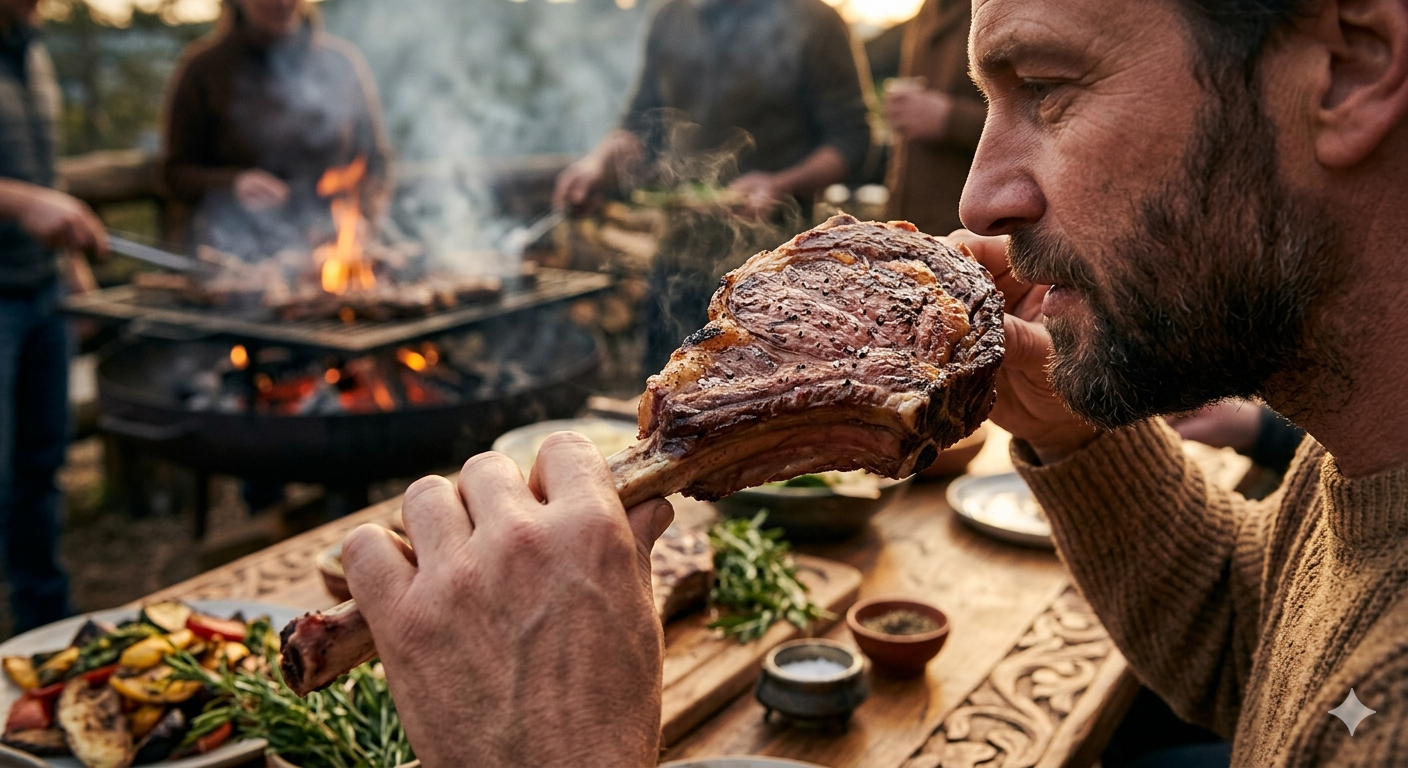
There is a reason the smell of roasting meat can stop people in their tracks.
A pot of slow-cooked stew. A fish grilling over fire. A broth simmering with bones and herbs. A piece of meat browning in a pan. A holiday roast on the table. A small amount of cured meat flavoring a soup. A family recipe passed down for generations.
Meat has a powerful place in human life.
For some people, meat represents nourishment, strength, comfort, celebration, and tradition. For others, it raises concerns about health, ethics, sustainability, modern farming, and processed foods. Few foods create as much emotion, debate, memory, and identity as meat.
But why are humans so drawn to meat in the first place?
The answer is not just taste. It is biology, culture, survival, nutrition, scarcity, cooking, memory, and social meaning.
Meat has been part of many human diets for a very long time, but it has not always been eaten in the same way. A small amount of wild meat shared by a physically active group is not the same as a modern fast-food meal. A slow-cooked stew made with vegetables and herbs is not the same as processed meat eaten daily with refined bread and sugary drinks.
To understand meat clearly, we need to move beyond simple arguments.
Meat is not automatically a miracle food. It is not automatically a harmful food. It is a powerful food that depends on context.
Meat Was Valuable Because It Was Dense
In ancestral environments, food was not always easy to obtain. People had to gather, hunt, fish, dig, cook, preserve, and share. Energy, protein, fat, and micronutrients mattered because survival was never guaranteed.
Meat offered something important: density.
Compared with many wild plant foods, meat could provide concentrated nutrition in a relatively small amount. It offered protein, fat, minerals, and certain vitamins that were difficult to get from some plant foods alone, depending on the environment.
This made meat valuable.
A successful hunt could feed a group. A fish catch could support a family. A small animal could provide important nourishment. Bones could become broth. Organs could provide nutrients. Fat could provide energy. Skin, hides, and bones could become tools, clothing, or materials.
In traditional life, meat was rarely just “food.” It was resource.
That is one reason humans developed such strong attention toward animal foods. When food required effort, a nutrient-dense food was worth noticing.
Biology: Why Meat Appeals to the Human Body
Humans are omnivores. That means we can eat and digest a wide range of foods from both plants and animals. Our flexibility helped us survive in many environments.
Meat appeals to human biology in several ways.
First, meat is rich in protein. Protein helps build and repair body tissues and contributes to satiety. Second, meat contains savory flavors that humans often find deeply satisfying. Third, animal foods can provide nutrients such as vitamin B12, iron, zinc, selenium, and certain fats. Fourth, cooked meat develops aromas and textures that strongly attract the senses.
The taste called umami is especially important. Umami is the deep savory flavor associated with protein-rich and aged foods. Meat, broth, fish sauce, aged cheese, mushrooms, soy sauce, and miso all have umami qualities.
Humans are drawn to umami because it often signals protein and depth of flavor.
This does not mean everyone needs to eat large amounts of meat. It means meat speaks to biological systems that evolved in food-scarce environments.
In a world of abundance, that attraction needs wisdom.
Cooking Made Meat More Powerful
Meat became more useful when humans learned to cook.
Cooking changes meat in important ways. It improves flavor, softens texture, reduces some food safety risks when done properly, and makes the eating experience more satisfying. Browning meat creates complex aromas. Slow cooking can turn tough cuts into tender meals. Boiling bones and connective tissue can create broths. Smoking, drying, salting, and fermenting can preserve meat for later.
Fire did not only change food. It changed culture.
Cooking meat likely encouraged sharing, gathering, planning, and cooperation. A cooked meal around fire is not just nutrition. It is social life.
Traditional meat preparation often involved patience. Meat could be roasted, stewed, boiled, smoked, dried, cured, fermented, or cooked with vegetables, herbs, roots, grains, or legumes. These methods shaped cuisines around the world.
Modern eating often separates meat from this older context. Meat becomes fast, processed, oversized, fried, or packaged.
The method matters.
A slow-cooked soup with meat, vegetables, and herbs is not the same food pattern as processed meat eaten with fries and soda.
Culture: Meat as Celebration, Status, and Memory
Meat is not only biological. It is cultural.
In many societies, meat has been linked with celebration, hospitality, wealth, religious ritual, family gatherings, and social status. A feast may include meat because meat was once expensive, rare, or difficult to obtain. Sharing meat could show generosity. Serving meat to guests could show respect.
This cultural meaning still exists.
A roast at a holiday table, barbecue with friends, grilled fish at a seaside meal, chicken soup during illness, lamb at a religious celebration, or beef stew from a family recipe all carry meaning beyond nutrients.
Meat often marks special occasions because historically it was not always available every day.
That is a key lesson.
In many traditional diets, meat was powerful partly because it was meaningful. It was not always cheap, constant, and unlimited. It had a place in the rhythm of life.
Modern food systems changed this. In many places, meat became available daily and cheaply, often in highly processed forms. What was once occasional or carefully prepared may now be eaten casually and frequently.
When a food moves from celebration to constant habit, its role changes.
Meat in Traditional Diets Was Often Nose-to-Tail
Modern meat consumption often focuses on a few preferred cuts: chicken breast, steak, ground beef, pork chops, bacon, sausages, or processed deli meats.
Traditional meat eating was often different.
When an animal was hunted or slaughtered, people tried to use as much as possible. Muscle meat, organs, fat, bones, skin, blood, marrow, and connective tissue could all have uses depending on the culture. This was practical, respectful, and economical.
Bones became broth.
Organs were eaten.
Fat was rendered.
Tough cuts were slow-cooked.
Blood was used in traditional dishes.
Skin became food or material.
Leftovers became soups or stews.
This nose-to-tail approach made animal foods more diverse and reduced waste.
Modern meat eating can become narrow and disconnected. People may eat only muscle meats while ignoring the broader animal food traditions that shaped many ancestral diets. They may also rely more on processed meat products than on whole animal foods.
Traditional meat wisdom was not simply “eat meat.” It was “use the animal carefully.”
Meat and Protein: Why Satiety Matters
One reason many people feel satisfied after eating meat is protein.
Protein is often more satiating than refined carbohydrates or highly processed snack foods. A meal with enough protein may help people feel fuller and reduce the urge to snack constantly.
Meat, fish, eggs, dairy, legumes, and soy foods can all provide protein. Meat is one concentrated source among several.
In traditional diets, protein was usually part of a meal pattern. Meat might be eaten with roots, grains, vegetables, herbs, fermented foods, soups, or sauces. It was not always eaten as a giant standalone portion.
This is important today.
A balanced protein-rich meal can support satisfaction. But meat eaten in a highly processed meal may not have the same overall effect if it comes with refined bread, fries, sugary drinks, and large portions.
The protein itself is only one part of the meal.
Better questions include:
What kind of meat is it?
How was it cooked?
What is it eaten with?
How often is it eaten?
Is it fresh or processed?
Does the whole meal support wellbeing?
Meat, Iron, Zinc, and Vitamin B12
Animal foods are important sources of several nutrients.
Meat can provide heme iron, a form of iron that is generally more easily absorbed than non-heme iron from plants. It can also provide zinc, vitamin B12, selenium, and high-quality protein. These nutrients are important for many body functions.
This helps explain why meat became valuable in many environments.
However, nutrient density does not mean unlimited intake is ideal. It also does not mean meat is the only way to get all nutrients. People can build different diets depending on culture, ethics, access, and health needs. But people who avoid meat or all animal foods need to plan carefully, especially for nutrients such as vitamin B12, iron, zinc, iodine, omega-3 fats, calcium, and protein.
The balanced view is this: meat can be nutritionally useful, but it is not the only factor in a healthy diet.
Nutrition is a pattern, not a single food.
The Difference Between Fresh Meat and Processed Meat
One of the most important distinctions is fresh meat versus processed meat.
Fresh meat includes foods such as beef, lamb, pork, chicken, turkey, game, or other animal meats that are cooked from relatively whole cuts or ground meat without heavy processing.
Processed meat includes products preserved or altered through smoking, curing, salting, chemical preservatives, or industrial processing. Examples may include bacon, sausages, hot dogs, deli meats, salami, pepperoni, and many packaged meat products.
Traditional cultures did preserve meat through drying, salting, smoking, fermenting, or curing. But modern processed meat is often eaten more frequently, in larger amounts, and in different food patterns than traditional preserved meats.
A small amount of cured meat flavoring a stew is not the same as daily processed meat sandwiches. A traditional dried meat used during travel is not the same as highly processed meat in a fast-food meal.
This distinction matters for modern health discussions.
When people debate meat, they often fail to separate fresh, minimally processed meat from processed meat products.
Meat and the Modern Food Environment
The modern food environment changes how meat is eaten.
In traditional settings, meat often required effort: hunting, fishing, raising animals, butchering, cooking, preserving, and sharing. Today, meat can be purchased quickly, cooked instantly, delivered as fast food, or eaten in processed forms.
This convenience can be helpful, but it can also lead to overconsumption or poor-quality choices.
Modern meat is often paired with:
Refined white bread
Sugary sauces
Fried potatoes
Sweet drinks
Processed cheese
Large portions
Low vegetable intake
Sedentary lifestyle
Frequent snacking
Low fiber meals
This pattern is very different from traditional meat meals that included broths, roots, vegetables, herbs, grains, legumes, fermented foods, or seasonal sides.
The problem is often not meat alone. It is the entire modern meal pattern.
A grilled fish or meat stew with vegetables is a different pattern from a processed meat fast-food meal.
Context changes the meaning of the food.
Meat and Fat: A More Nuanced View
Meat can contain different amounts and types of fat depending on the animal, cut, feed, preparation, and processing.
For many years, dietary advice focused heavily on reducing saturated fat. More recent discussions are often more nuanced, but this remains an area where individual health context matters. People with certain cardiovascular risk factors or medical conditions may need personalized guidance.
Traditional diets often used animal fat carefully. Fat was valuable because it provided energy. In some environments, animal fat was essential. In others, plant fats such as olive oil, coconut, nuts, seeds, or avocado played larger roles.
Modern diets complicate the picture because meat fat may appear alongside refined carbohydrates, fried foods, processed snacks, and low activity. That combination is different from traditional whole-food eating.
A balanced approach is to choose meat quality carefully, avoid relying heavily on processed meats, include vegetables and fiber-rich foods, and consider personal health markers.
The goal is not fear of fat or celebration of unlimited fat. It is context.
Meat and Sustainability
Modern meat production raises important sustainability questions.
Large-scale industrial animal agriculture can affect land use, water use, greenhouse gas emissions, animal welfare, antibiotic use, and environmental quality. These issues vary by production system, region, animal type, and farming practices.
Traditional animal food systems were often more integrated with local ecology. Animals could graze land unsuitable for crops, provide manure, help with labor, and convert grasses or food scraps into milk, meat, or eggs. But traditional systems also had limits and could not always support modern levels of consumption.
This is why sustainability requires thoughtful choices.
Some people may choose to eat less meat but better-quality meat. Others may emphasize fish, eggs, legumes, dairy, or plant proteins. Some may choose pasture-raised, regenerative, local, or lower-waste options when available. Others may reduce processed meats and oversized portions.
A practical modern approach is not necessarily all-or-nothing. It may be:
Eat meat with more respect.
Waste less.
Use smaller portions.
Choose quality when possible.
Eat more plant foods alongside meat.
Avoid making processed meat a daily staple.
Learn from traditional nose-to-tail thinking.
Sustainability begins with awareness.
Why Meat Feels Emotionally Powerful
Meat can create strong emotions because it sits at the intersection of survival, ethics, identity, and pleasure.
For one person, meat may represent family meals, cultural pride, comfort, and nourishment. For another, it may raise ethical concerns about animals. For another, it may be connected to masculinity, strength, celebration, or status. For another, it may be tied to health worries.
Food is rarely just food.
This is why conversations about meat can become tense. People are not only debating protein. They are debating values, memories, bodies, traditions, and worldviews.
A respectful approach recognizes that people may make different choices for valid reasons.
Some people eat meat. Some reduce it. Some avoid it. Some choose fish but not red meat. Some eat meat only occasionally. Some focus on traditional animal foods. Some choose plant-based diets.
A good nutrition website should not shame readers. It should help them think clearly.
How Traditional Diets Used Meat Differently
Traditional diets often used meat in ways modern diets can learn from.
Meat as a flavoring
A small amount of meat, bone, fat, or fermented animal food could flavor a large pot of grains, beans, vegetables, or soup.
Meat as a seasonal food
In some cultures, meat intake changed with hunting seasons, religious calendars, climate, or availability.
Meat with vegetables and herbs
Meat was often cooked with roots, greens, spices, sour condiments, or fermented foods.
Meat as part of the whole animal
Organs, bones, fat, and connective tissue were often used instead of only prime cuts.
Meat as a shared food
Large portions were often shared in families or communities.
Meat as preserved food
Drying, smoking, salting, and curing helped meat last, but preserved meats were often used in context.
This older relationship with meat was often more careful than modern casual meat consumption.
A Balanced Way to Think About Meat Today
A balanced modern approach to meat does not need to be extreme.
You can ask several practical questions:
Is the meat fresh or highly processed?
How often do I eat it?
What portion size feels appropriate?
What is it eaten with?
Am I including enough vegetables, fiber, and plant diversity?
Does this meat replace ultra-processed food or add to an already heavy diet?
How is it cooked?
Do I feel satisfied and energized after the meal?
Does my health status require personalized guidance?
Can I choose better quality or reduce waste?
These questions help move the discussion away from ideology and toward practical wisdom.
Meat is best understood as part of a meal and a lifestyle, not as an isolated moral or nutritional symbol.
Better Meat-Based Meal Patterns
Here are examples of meat-based meals that follow traditional food wisdom more closely:
Beef stew with root vegetables, herbs, and broth
Chicken soup with greens, carrots, onions, and rice
Grilled fish with vegetables and fermented condiments
Lamb with lentils, herbs, and yogurt sauce
Small amounts of meat in bean soup
Eggs with vegetables and potatoes
Meatballs with tomato sauce and vegetables
Roasted chicken with salad and fermented vegetables
Bone broth with grains, greens, and mushrooms
Stir-fried meat with vegetables and rice
These meals use meat as part of a broader pattern. They include plants, flavor, texture, and balance.
The goal is not simply to eat meat. The goal is to build a nourishing meal.
Cooking Methods Matter
How meat is cooked can influence flavor, texture, and healthfulness.
Gentle cooking methods such as stewing, boiling, steaming, and slow cooking can create satisfying meals and reduce reliance on burning or charring. Grilling and roasting can be delicious but should be balanced with avoiding excessive charring. Frying meat in low-quality oils or eating heavily breaded fried meat often moves the meal closer to fast-food patterns.
Traditional methods often used moisture, herbs, spices, acidity, and long cooking.
Stews, soups, braises, broths, and slow-cooked dishes can stretch meat and include more vegetables. These methods may be more aligned with traditional meat use than oversized portions of fried or heavily processed meat.
Cooking is not a detail. It is part of the food.
Processed Meat: Why Caution Makes Sense
Processed meat deserves more caution than fresh meat.
Many processed meats are high in sodium, preservatives, additives, and saturated fat. They may be smoked, cured, or preserved in ways that make them flavorful but less ideal as daily staples.
This does not mean a slice of bacon or occasional sausage ruins a diet. Food culture includes occasional preserved foods. But daily reliance on processed meats is not the same as traditional occasional use.
A practical approach is:
Choose fresh meats more often than processed meats.
Use processed meats as occasional flavor accents, not daily staples.
Read ingredient labels.
Watch sodium intake.
Pair preserved meats with vegetables and whole foods.
Avoid making processed meat the center of every breakfast or lunch.
This balanced approach is more realistic than fear-based restriction.
What About People Who Do Not Eat Meat?
Meat can be nutritionally valuable, but it is not part of every diet.
Many people avoid meat for ethical, religious, environmental, cultural, digestive, or personal reasons. A meat-free diet can be balanced if planned well. It should include adequate protein, vitamin B12 if avoiding animal foods, iron, zinc, iodine, calcium, omega-3 fats, and overall energy.
Traditional plant-rich diets often used legumes, grains, nuts, seeds, dairy, eggs, fermented foods, and careful preparation to provide nourishment.
The key is planning.
Avoiding meat does not automatically make a diet healthy. A meat-free diet built on refined snacks, sugar, and ultra-processed foods can still be poor quality. Likewise, a meat-containing diet built on whole foods can be balanced.
The quality of the whole diet matters.
How Much Meat Is Enough?
There is no single perfect amount of meat for everyone.
Some people eat meat daily. Others eat it a few times per week. Some eat fish and eggs but little red meat. Some avoid meat entirely. Needs vary by age, activity level, health status, culture, budget, and values.
Instead of searching for a universal number, focus on patterns.
If meat crowds out vegetables, legumes, fruits, whole grains, or fiber-rich foods, the diet may need more balance. If meat is mostly processed, quality may need improvement. If a person avoids meat but does not replace its nutrients, the diet may need planning.
A helpful idea is to treat meat as a nutrient-dense ingredient, not an unlimited centerpiece.
In many meals, a moderate portion of meat with vegetables, herbs, traditional starches, and fermented foods can be more balanced than a very large portion of meat with refined sides.
A Simple Meat Decision Framework
Use this framework when deciding how meat fits into your diet.
1. Source
Is it fresh, minimally processed, heavily processed, or fast food?
2. Preparation
Is it grilled, stewed, roasted, fried, smoked, cured, or slow-cooked?
3. Portion
Is meat the entire meal or one part of the plate?
4. Companions
Is it eaten with vegetables, herbs, legumes, roots, grains, broth, or fermented foods?
5. Frequency
Is it occasional, daily, or several times per day?
6. Personal context
How do your digestion, energy, values, budget, and health markers fit?
This framework helps readers think clearly without falling into extreme diet arguments.
Common Myths About Meat
Myth 1: Humans are drawn to meat only because of culture
Culture matters, but biology also matters. Meat provides protein, umami, fat, and nutrients that humans often find satisfying.
Myth 2: Meat is always unhealthy
Fresh, minimally processed meat can be part of many balanced diets. The type, portion, cooking method, and meal pattern matter.
Myth 3: Meat is always necessary
Meat can provide valuable nutrients, but people can build meat-free diets if they plan carefully, especially for vitamin B12, protein, iron, zinc, and omega-3s.
Myth 4: Processed meat is the same as fresh meat
Processed meat and fresh meat should not be treated as identical. Processing, additives, sodium, and frequency matter.
Myth 5: Traditional meat eating was unlimited meat eating
Many traditional diets used meat carefully, seasonally, nose-to-tail, or as part of mixed meals.
Myth 6: Protein is the only reason meat matters
Meat also has cultural, sensory, historical, and social meaning. Food is more than nutrients.
Practical Tips for Eating Meat More Wisely
Choose fresh or minimally processed meat more often than processed meat.
Use meat as part of a balanced meal, not the whole meal.
Include vegetables, herbs, roots, grains, legumes, or fermented foods.
Try soups, stews, broths, and slow-cooked dishes.
Use smaller amounts of meat to flavor larger meals.
Avoid relying on processed meats as daily staples.
Respect personal values around animal foods.
Consider sustainability and waste.
Pay attention to how your body responds.
Consult a healthcare professional if you have medical concerns.
These steps allow meat to fit into modern wellness without becoming extreme.
A More Respectful Relationship with Meat
Perhaps the most important lesson from traditional diets is respect.
Meat came from an animal. In traditional life, obtaining it often required skill, labor, risk, and community. It was not an anonymous product wrapped in plastic. It was connected to land, life, death, cooking, sharing, and gratitude.
Modern food systems can make meat feel ordinary and disconnected. This can lead to waste, overconsumption, and loss of meaning.
A more respectful approach does not require everyone to make the same choice. It simply asks us to be more conscious.
Eat meat if it fits your diet and values.
Reduce meat if that fits your goals.
Avoid meat if that fits your ethics or needs.
But whatever you choose, choose with awareness.
Meat deserves more thought than a quick fast-food habit.
Conclusion
Humans are drawn to meat for many reasons.
Biologically, meat offers protein, savory flavor, fat, and important nutrients. Culturally, it has been connected to celebration, hospitality, identity, status, and family memory. Historically, it helped many communities survive in environments where food was uncertain. Nutritionally, it can provide valuable compounds, but its role depends on the whole diet.
The most important lesson is context.
Fresh meat is not the same as processed meat.
Traditional meat meals are not the same as fast-food meals.
A stew with vegetables is not the same as a processed meat sandwich.
A small amount of meat used for flavor is not the same as oversized daily portions.
Meat in an active traditional lifestyle is not the same as meat in a sedentary ultra-processed diet.
Modern readers do not need another extreme argument. They need a wiser framework.
Meat can be part of a balanced diet for many people. It can also be reduced or avoided by others with proper planning. What matters is quality, preparation, portion, frequency, personal tolerance, ethical values, and the meal pattern around it.
The question is not simply, “Is meat good or bad?”
The better question is:
What kind of meat?
Prepared how?
Eaten with what?
How often?
In what lifestyle?
For which person?
That question brings meat back into its proper place: not as a symbol in a diet war, but as a powerful food that deserves respect, balance, and thoughtful use.
Disclaimer: This article is for educational purposes only and is not medical advice. Meat and animal food intake may need to be personalized based on health status, ethics, allergies, digestion, cardiovascular risk, kidney function, pregnancy-related concerns, and dietary needs. Consult a qualified healthcare professional before making major dietary changes.