
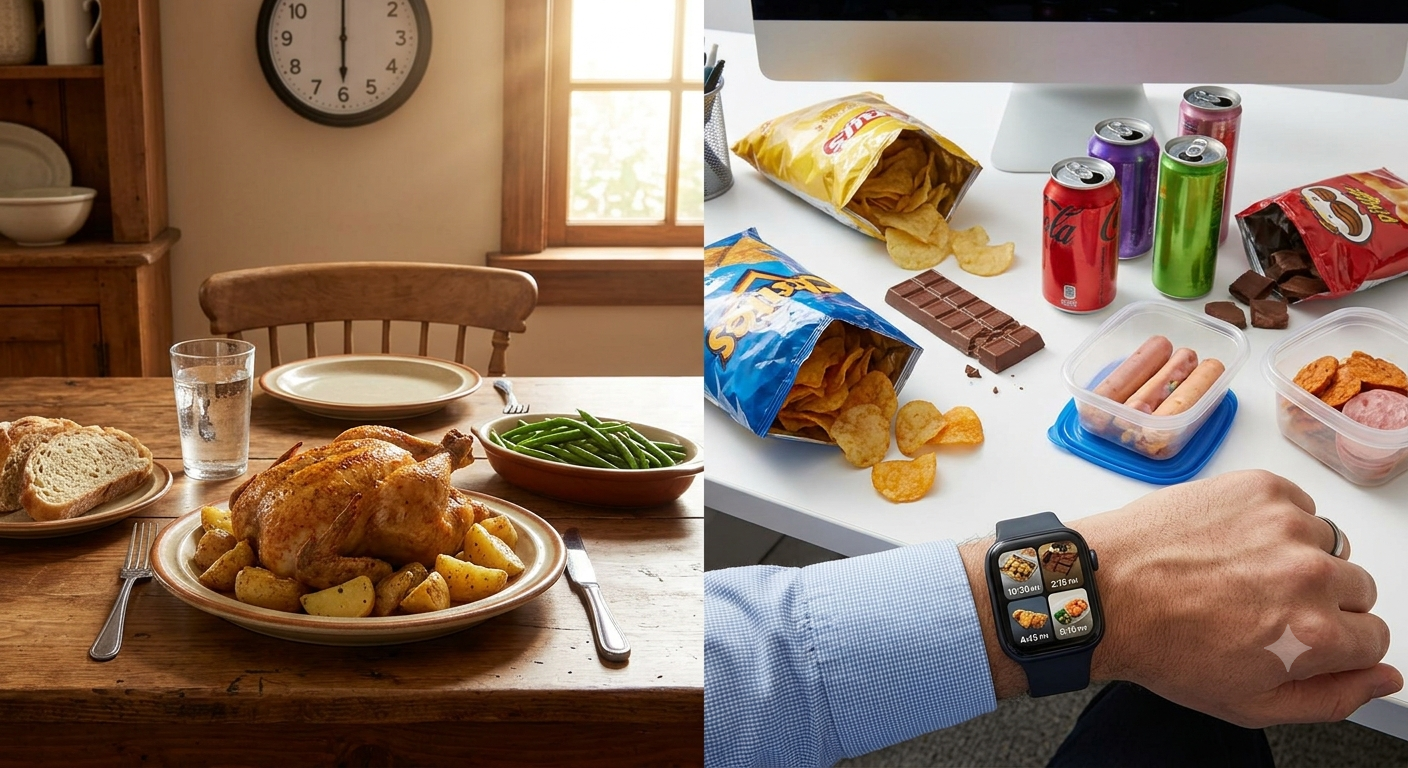
There was a time when eating had edges.
A meal began.
A meal ended.
People cooked, sat down, ate, cleaned up, and moved on.
Food belonged to a table, a kitchen, a market, a field, a fishing boat, a family routine, a season, or a celebration. Even when traditional diets included snacks, they were usually limited by availability, effort, culture, and time.
Modern eating is different.
Food no longer has clear edges. It follows people everywhere.
A sweet coffee on the way to work.
A breakfast bar at the desk.
A handful of crackers between tasks.
A soft drink during a meeting.
A snack while driving.
A few bites while cooking.
A dessert after dinner.
A late-night snack while watching a screen.
Many people are not eating meals anymore. They are eating moments.
This is one of the biggest differences between traditional meal patterns and modern food habits. The problem is not only what people eat. It is how often food enters the body, how little attention it receives, and how much of it comes from ultra-processed products designed for convenience and repeat consumption.
Eating all day is not the same as nourishment.
It is a new eating pattern, and the body may not always know how to interpret it.
Traditional Meals Had Rhythm
Traditional eating patterns varied around the world. Some cultures ate two meals a day. Some ate three. Some had a larger midday meal. Some ate light breakfasts. Some included tea, fruit, bread, fermented foods, or small snacks. Some fasting practices were religious. Some meal timing was shaped by farming, climate, labor, daylight, or family structure.
There was no single traditional meal pattern.
But many traditional diets shared one important feature: rhythm.
Food was not always available every minute. Meals required work. Someone had to cook rice, bake bread, prepare soup, milk animals, gather vegetables, catch fish, soak beans, grind grains, ferment foods, or start a fire. Even preserved foods required planning.
This effort created pauses between eating.
The pauses mattered.
They allowed hunger to build. They made meals meaningful. They helped people distinguish between true hunger, boredom, stress, habit, and celebration. They gave the body time to process food before the next eating event.
Modern life removed many pauses.
Food is now portable, packaged, delivered, advertised, and available at all hours. Eating no longer needs a meal.
That is a major shift.
The Modern Snack Environment
Modern snacking is not simply a person choosing to eat a little more.
It is an environment.
Snacks are placed at checkout counters. They sit in office drawers. They appear in vending machines, gas stations, schools, airports, gyms, pharmacies, and entertainment spaces. They are designed for cars, desks, backpacks, pockets, and couches.
They are also designed to be easy.
Open. Bite. Chew briefly. Swallow. Repeat.
Many modern snacks combine refined flour, sugar, seed oils, salt, flavorings, chocolate, cheese powder, crunch, softness, and attractive packaging. They are not built like traditional foods. They are built for speed, stimulation, and convenience.
Traditional snacks, when they existed, were often closer to real foods: fruit, nuts, roasted roots, leftovers, yogurt, bread, cheese, dried fish, fermented foods, boiled eggs, or simple seasonal foods.
Modern snacks are often products.
This distinction matters because products can bypass natural eating limits. A handful of nuts requires chewing and has density. A bag of flavored crackers can disappear without much awareness. A piece of fruit has water and fiber. A fruit-flavored snack may be mostly sugar and starch. A bowl of soup is a meal. A snack bar is a portable formula.
The modern snack environment makes eating effortless.
Effortless eating can easily become constant eating.
Eating Frequency Changed Before We Noticed
Many people focus on calories, carbs, fat, sugar, or protein. Fewer people notice eating frequency.
But eating frequency has changed dramatically for many modern eaters.
A person may begin the day with sweetened coffee before breakfast. Then breakfast. Then a snack. Then lunch. Then another drink. Then an afternoon snack. Then dinner. Then dessert. Then late-night eating.
This can create eight, nine, or ten eating events per day, even if the person thinks they only had three meals.
A bite counts.
A drink counts.
A sweetened coffee counts.
A handful of chips counts.
A few crackers count.
A spoonful of dessert counts.
A late-night snack counts.
The body does not only respond to formal meals. It responds to every intake of energy.
This does not mean everyone must eat only three times a day. Some people need snacks, including children, athletes, pregnant people, people with certain medical conditions, and those with specific energy needs. But constant eating has become so normal that many people no longer ask whether they are hungry.
They ask only what is available.
That shift matters.
Hunger Became Confusing
Traditional meal patterns often made hunger easier to recognize.
You worked, waited, cooked, and then ate. Hunger had a place. Appetite was connected to meals.
Modern eating blurs hunger.
People may eat because food is visible.
Because they are stressed.
Because they are tired.
Because they are bored.
Because a screen is on.
Because a meeting has snacks.
Because they smell food.
Because the package is open.
Because the drink is sweet.
Because it is “just a bite.”
Because eating has become part of every activity.
Over time, the body’s hunger signals can become harder to read.
Is this real hunger?
Is it craving?
Is it habit?
Is it thirst?
Is it tiredness?
Is it stress?
Is it a reaction to a sweet snack?
Is it the result of not eating enough protein at the last meal?
Eating all day can make these questions harder.
A structured meal pattern does not require strict dieting. It simply gives hunger a chance to speak clearly.
Snacking Often Replaces Meal Quality
One hidden problem with constant snacking is that it can reduce the quality of real meals.
When people snack all day, they may arrive at meals only partly hungry. Then they eat a smaller or less balanced meal. Later, hunger returns quickly because the meal did not provide enough protein, fiber, or satisfaction. Then they snack again.
This creates a loop.
Snack.
Small meal.
Snack.
Unbalanced meal.
Snack.
Craving.
Snack.
Late-night eating.
Traditional meals were often built to satisfy. They included a staple, protein, vegetables, broth, fat, herbs, sauces, fermented foods, or seasonal ingredients. They were not always nutritionally perfect, but they were often meals.
Modern snacks are rarely complete meals. They may provide energy without enough nourishment.
This can lead to a strange modern condition: a person may eat frequently but still feel undernourished.
The body receives calories, but the meal pattern does not feel complete.
Sweet Drinks Turn Sipping into Eating
Sweet drinks are one of the biggest reasons eating all day becomes invisible.
People may not think of drinks as food, but sweet drinks deliver energy. Soda, sweet tea, fruit drinks, energy drinks, flavored coffees, sweetened milk drinks, bottled smoothies, and sports drinks can all become eating events.
The problem is that sipping does not feel like eating.
A person may drink sweetness over several hours, keeping taste stimulation constant. The mouth receives flavor. The body receives sugar. But the mind may not register a meal.
Traditional drinks existed, but they were usually tied to culture, season, fermentation, meals, or special occasions. Modern sweet drinks are portable and constant.
This changes the rhythm of eating.
If someone wants to reduce all-day eating, drinks are one of the first places to look.
Water, unsweetened tea, black coffee, sparkling water, or lightly flavored unsweetened drinks can help restore pauses between meals.
A simple principle is powerful:
Do not drink snacks all day.
The Desk, Car, and Couch Changed Eating
Where people eat matters.
Traditional eating often happened in specific places: kitchen, table, field break, communal space, market, or family setting. Even quick foods had context.
Modern eating happens everywhere.
At the desk.
In the car.
On the couch.
In bed.
During calls.
While scrolling.
While watching television.
While walking through stores.
While working late.
While standing in the kitchen.
This makes eating less visible.
When food is paired with screens, work, driving, or stress, attention moves away from the body. People may not notice taste, fullness, portion size, or satisfaction.
The food disappears into the activity.
This is one reason people can finish a bag of snacks without feeling like they made a decision. They did not eat with attention. They ate while doing something else.
Traditional meal patterns often protected attention because food had a place.
Modern eating needs to rebuild that boundary.
The Body Likes Predictability
The body is rhythmic.
Sleep has rhythm. Hormones have rhythm. Digestion has rhythm. Hunger has rhythm. Energy has rhythm. Movement has rhythm.
Eating patterns can support or disrupt this rhythm.
When meals happen at somewhat predictable times, the body can prepare for digestion. Appetite may become easier to understand. People may feel more stable because food intake is organized.
When eating happens constantly and randomly, the body may receive mixed signals. A sweet drink here, a snack there, a late meal, a late dessert, a bite before bed, and a skipped breakfast followed by grazing can make the day feel chaotic.
This does not mean every person must follow a rigid schedule. Life varies. Work varies. Family routines vary. But some structure helps.
A body living in constant food noise may benefit from quieter patterns.
Rhythm does not mean restriction.
Rhythm means food has a place.
Constant Eating and Metabolic Health
Metabolic health refers to how well the body manages energy, blood sugar, blood fats, blood pressure, waist size, liver fat, and related systems.
Eating all day may affect metabolic health indirectly through several pathways.
It can increase total energy intake.
It can increase added sugar intake.
It can increase refined flour intake.
It can increase seed oil intake through snacks.
It can reduce meal quality.
It can make hunger signals less clear.
It can encourage late-night eating.
It can reduce time between digestive events.
It can make processed foods more common than whole foods.
The issue is not simply frequency by itself. A person eating frequent balanced meals for athletic training is different from a person grazing on sweet drinks, crackers, candy, chips, and pastries.
Food quality matters. Personal health matters. Activity level matters.
But in many modern diets, high eating frequency is not driven by nutritional need. It is driven by convenience, marketing, stress, and ultra-processed foods.
That is the concern.
Late-Night Eating: When the Kitchen Reopens
Late-night eating is one of the most common modern habits.
After dinner, the day is technically over. But the eating often continues.
Dessert.
Chips.
Cookies.
Ice cream.
Leftovers.
Sweet drinks.
Alcohol.
Crackers.
Cereal.
Chocolate.
Takeout.
Late-night eating often happens for emotional reasons: fatigue, reward, boredom, loneliness, stress, or screen time. It may not be true hunger.
Traditional meal patterns often had evening boundaries. Food preparation took effort. Kitchens closed naturally. Darkness, labor, and household rhythm limited eating.
Modern kitchens never close. Delivery apps never sleep. Packaged snacks wait in the cupboard. Screens keep people awake longer.
This creates a new problem: eating after the body may be ready to wind down.
For some people, reducing late-night snacking can improve the overall rhythm of eating. A simple strategy is to make dinner more satisfying and create a clear “kitchen closed” ritual: tea, brushing teeth, cleaning the kitchen, or moving away from food cues.
The goal is not punishment. It is closure.
Why Traditional Fasting Practices Existed
Many cultures have fasting traditions.
Some are religious. Some are seasonal. Some are tied to discipline, purification, mourning, gratitude, or community identity. Some involve avoiding food for certain hours. Others restrict specific foods. Some are daily. Some are annual.
These practices show that humans have long recognized the value of not eating sometimes.
Fasting traditions were not always about weight or metabolism. Often, they were about meaning. But they created structure around food.
Modern intermittent fasting has become popular, but it is often removed from cultural and spiritual context. It may help some people reduce snacking and restore meal boundaries, but it is not right for everyone.
Children, pregnant people, people with eating disorder history, people with certain medical conditions, and those on specific medications should be cautious and seek guidance.
The deeper lesson is not that everyone must fast. The lesson is that constant eating is not the only human pattern.
Not eating sometimes has always had a place in human culture.
Grazing Is Not the Same as Nourishment
Some people say they “graze” throughout the day.
Grazing sounds natural, but humans are not grazing animals in the same way cows or sheep are. Human meals are shaped by cooking, culture, digestion, social life, and food quality.
A grazing pattern can work for certain people if it is planned and nourishing. But modern grazing is often not planned. It is usually packaged, distracted, and snack-based.
A few bites of this.
A sip of that.
A handful here.
A sweet there.
A package opened.
A snack finished.
This can create a day with no satisfying meals and no real pauses.
Nourishment requires more than intake. It requires enough protein, fiber, micronutrients, hydration, satisfaction, and rhythm.
Grazing may provide energy, but it often fails to provide completion.
Meals complete eating.
Snacks often extend it.
Children and All-Day Eating
Children often snack more than adults, and that can be appropriate. They have smaller stomachs, high energy needs, and growth demands.
But modern children are also surrounded by constant snack culture.
Crackers, fruit snacks, sweet drinks, cereal bars, cookies, flavored yogurts, chips, candy, and processed snacks are often presented as normal daily foods.
This can create several issues.
Children may arrive at meals without appetite. They may prefer snack foods over real meals. They may learn to expect sweetness all day. They may associate boredom with eating. They may drink calories instead of eating nourishing foods.
A better approach is not to eliminate all snacks. It is to make snack time structured and food-like.
Better snacks may include fruit, yogurt, cheese if tolerated, nuts or nut butter when age-appropriate and safe, boiled eggs, hummus, vegetables, leftovers, oatmeal, soup, or simple sandwiches with real ingredients.
Children benefit from rhythm too.
Snack time should support meals, not replace them.
The Protein Problem
Many modern snacks are low in protein.
They may provide refined starch, sugar, oil, and salt, but little lasting satiety. This can make hunger return quickly.
Protein helps meals feel more complete. It can come from eggs, fish, meat, poultry, yogurt, cheese, beans, lentils, tofu, tempeh, nuts, seeds, or other sources depending on dietary preference.
When people eat enough protein at meals, they may feel less need to snack constantly.
A breakfast of sweet cereal may lead to hunger soon. A breakfast with eggs and vegetables, yogurt with nuts, oats with seeds, or beans and rice may last longer.
This is not about high-protein obsession. It is about meal completeness.
If you snack all day, ask whether your meals are actually satisfying.
Sometimes the solution to snacking is not more discipline.
It is better meals.
Fiber: The Other Missing Piece
Fiber-rich foods also help meals feel more complete.
Beans, lentils, oats, barley, fruits, vegetables, roots, nuts, seeds, and whole grains can add volume, texture, and digestive support for many people.
Ultra-processed snacks often lack meaningful fiber. Even when fiber is added back, the food may not behave like whole beans, vegetables, fruits, or grains.
Traditional meals often included fiber naturally through plant foods, staples, herbs, roots, and legumes.
Modern snack foods can displace fiber-rich foods.
If someone eats crackers, chips, sweet bars, and refined flour snacks all day, there may be less room for beans, vegetables, fruit, oats, and roots.
A practical goal is simple:
Make meals rich enough in protein and fiber that snacks become optional, not necessary.
Snacking and Emotional Regulation
Food can regulate emotion.
A snack can give a break, comfort, pleasure, reward, distraction, or a sense of control. This is normal. Humans are emotional eaters because humans are emotional beings.
The problem is when food becomes the main coping tool.
Stress leads to snacks.
Boredom leads to snacks.
Anxiety leads to snacks.
Fatigue leads to sugar.
Loneliness leads to late-night eating.
Work pressure leads to constant chewing.
Modern processed snacks are perfectly designed for emotional eating because they are fast, predictable, and rewarding.
A healthier approach is not to remove comfort from food. It is to add other forms of comfort.
Take a walk.
Drink tea.
Call someone.
Stretch.
Rest.
Breathe.
Journal.
Listen to music.
Eat a real meal.
Create an evening routine.
Keep nourishing snacks available.
Sit down when eating.
Food can comfort, but it should not be the only comfort.
How to Tell If You Are Eating All Day
Many people do not realize how often they eat.
For one day, without judging yourself, write down every eating event:
Meals
Snacks
Sweet drinks
Coffee with sugar or cream
Small bites
Taste tests
Desserts
Alcohol
Late-night foods
Office snacks
Car snacks
Children’s leftovers
Sauces or sweetened drinks
Then count the number of times your body received energy.
This is not about calorie counting. It is about rhythm awareness.
You may discover that your “three meals” are actually ten eating events. That awareness alone can change behavior.
Modern eating becomes powerful when it becomes invisible.
Make it visible again.
A Better Framework: Meals First, Snacks Second
A useful modern rule is:
Build meals first. Add snacks only if needed.
Many people do the opposite. They snack all day, then try to fit meals around snacks.
Start with meals.
A good meal usually has:
Protein
Fiber-rich plants
A satisfying fat
A traditional starch if tolerated
Flavor from herbs, spices, acids, or fermented foods
Enough volume to feel complete
Then ask if a snack is truly needed.
If you are hungry between meals, choose a snack that behaves like food, not candy:
Fruit with yogurt
Nuts and fruit
Boiled eggs
Hummus with vegetables
Leftover soup
Cheese and fruit if tolerated
Plain yogurt with berries
Lentil salad
Oats with seeds
Canned fish on toast
Vegetables with tahini or yogurt sauce
Snacks should support the day, not hijack it.
The “Pause Test”
Before eating outside a meal, try the pause test.
Pause for one minute and ask:
Am I physically hungry?
When did I last eat?
Did my last meal have protein?
Did it have fiber?
Am I thirsty?
Am I tired?
Am I stressed?
Am I bored?
Would I eat a simple real food right now, or only a specific snack?
Can this wait until the next meal?
This is not meant to shame you. It is meant to create space.
If you are truly hungry, eat. If you are emotionally triggered, you may still choose to eat, but now it is conscious.
A pause turns automatic eating into intentional eating.
Rebuilding Traditional Meal Rhythm in Modern Life
You do not need to copy the past exactly. Modern life is different. Work schedules, family routines, travel, night shifts, medical needs, and personal preferences all matter.
But you can rebuild rhythm.
Try these steps:
Eat meals at relatively consistent times.
Make breakfast less sweet if possible.
Build meals with protein and fiber.
Reduce sweet drinks between meals.
Keep snacks planned, not random.
Avoid eating directly from large packages.
Sit down when possible.
Create a kitchen-closed time at night.
Use water or unsweetened drinks between meals.
Keep nourishing snacks available for true hunger.
Do not let screens become automatic eating triggers.
This is not a diet. It is rhythm restoration.
What About Intermittent Fasting?
Intermittent fasting is popular because it creates eating boundaries. For some people, a shorter eating window helps reduce late-night eating, sweet drinks, and constant snacking.
But fasting is not necessary for everyone, and it is not automatically healthy.
Some people feel better with three balanced meals. Others need snacks. Some may overeat after fasting. Some may develop an unhealthy relationship with restriction. People with certain medical conditions should not fast without guidance.
The traditional lesson is not that everyone must fast.
The lesson is that pauses between meals matter.
You can create pauses without extreme fasting. You can simply stop grazing, reduce sweet drinks, eat satisfying meals, and avoid late-night snacks.
Meal rhythm can be gentle.
Practical Meal Rhythm Examples
Here are simple patterns. These are not rules, just examples.
Three-meal pattern
Breakfast: eggs with vegetables and potatoes
Lunch: rice bowl with fish, greens, and fermented vegetables
Dinner: lentil soup with yogurt sauce and fruit
Two meals plus one snack
Late breakfast: plain yogurt with oats, berries, and nuts
Snack: fruit with cheese or boiled eggs
Dinner: chicken stew with roots and vegetables
Family-friendly pattern
Breakfast: oatmeal with nuts and fruit
Lunch: soup and whole-grain bread
Snack: yogurt or fruit
Dinner: rice, eggs or fish, vegetables, and broth
Active person pattern
Breakfast: eggs, oats, and fruit
Lunch: meat or tofu bowl with rice and vegetables
Snack: yogurt, nuts, or smoothie with protein
Dinner: fish, potatoes, vegetables, and olive oil
The right pattern depends on the person. The key is structure.
How to Handle Cravings Between Meals
Cravings are not always hunger.
A craving may come from habit, stress, sleep deprivation, low protein intake, blood sugar swings, emotional triggers, dehydration, or food cues.
When cravings appear, try this sequence:
Drink water or tea.
Wait five minutes.
Check if you are physically hungry.
If hungry, choose a real-food snack.
If not hungry, change environment.
Move away from the screen or kitchen.
Take a short walk.
Eat the craved food intentionally if you still want it.
The goal is not to never eat craved foods. The goal is to stop responding automatically every time a craving appears.
Cravings get weaker when they stop receiving instant obedience.
The Role of Sleep
Poor sleep can increase hunger and cravings for many people.
When people sleep less, they may crave more sugar, refined starch, caffeine, and snack foods. Late nights also create more hours for eating.
This is one reason eating rhythm and sleep rhythm are connected.
If someone snacks heavily at night, the solution may not only be food discipline. It may be better sleep structure.
Set a kitchen closing time.
Reduce late caffeine.
Eat a satisfying dinner.
Create an evening routine.
Keep screens away from food.
Go to bed before the snack window opens.
Sometimes the best snack strategy is sleep.
Common Myths About Eating Frequency
Myth 1: Everyone should eat six small meals a day
Some people may benefit from smaller meals, but many people do well with fewer structured meals. There is no universal rule.
Myth 2: Snacking is always bad
Snacking can be useful when it is planned, nourishing, and needed. The problem is constant ultra-processed snacking.
Myth 3: Hunger is dangerous
Mild hunger before a meal is normal for many healthy people. However, medical conditions and individual needs matter.
Myth 4: Skipping snacks means dieting
Not necessarily. It may simply mean meals are satisfying enough.
Myth 5: Late-night eating is always emotional
Sometimes it is true hunger, especially if dinner was too small. But often it is habit, fatigue, or screen-related eating.
Myth 6: Intermittent fasting is the only solution
You can restore meal rhythm without strict fasting.
A Simple Seven-Day Meal Rhythm Reset
This is a gentle experiment, not a strict diet.
Day 1: Count eating events
Write down meals, snacks, sweet drinks, and bites.
Day 2: Remove one sweet drink between meals
Choose water, tea, or unsweetened coffee.
Day 3: Build a protein-rich breakfast
Try eggs, yogurt, oats with nuts, tofu, beans, or leftovers.
Day 4: Plan one real snack
Choose fruit with nuts, yogurt, boiled eggs, hummus, or leftovers.
Day 5: Eat without a screen for one meal
Notice taste, speed, and fullness.
Day 6: Create a kitchen closing time
After dinner, drink tea, brush teeth, and move away from the kitchen.
Day 7: Review your hunger
Ask: did hunger feel clearer? Did cravings change? Did meals feel more satisfying?
This reset helps reveal whether eating all day is truly necessary or mostly habitual.
When to Seek Professional Guidance
Eating frequency should be personalized if you have:
Diabetes
Reactive hypoglycemia
Pregnancy-related needs
History of eating disorders
Medication requiring food timing
Digestive disorders
Intense athletic training
Chronic illness
Children with growth concerns
Unexplained fatigue or dizziness
Blood sugar concerns
In these situations, do not copy generic meal timing advice. Work with a qualified healthcare professional.
Conclusion: Bring Back the Pause
Eating all day is not the same as traditional meal patterns.
Traditional diets varied widely, but many had rhythm. Meals had beginnings and endings. Food required preparation. Snacks were limited by culture, season, effort, and availability. Hunger had space to appear. Fullness had space to register.
Modern eating removed many boundaries.
Food became portable, sweet, soft, packaged, and available everywhere. Snacks entered desks, cars, couches, beds, meetings, schools, and screens. Sweet drinks turned sipping into hidden eating. Late-night food became normal. Hunger became harder to interpret.
The solution is not extreme restriction.
The solution is rhythm.
Build better meals.
Eat with more attention.
Reduce sweet drinks.
Plan snacks instead of grazing.
Make protein and fiber part of meals.
Create pauses between eating events.
Close the kitchen at night when possible.
Let hunger become clear again.
Let food return to meals, not constant background noise.
Modern life made eating continuous.
A wiser modern diet brings back the pause.
And sometimes, that pause is where appetite, metabolism, and food culture begin to make sense again.
Disclaimer: This article is for educational purposes only and is not medical advice. Meal timing and eating frequency should be personalized based on age, activity level, medical conditions, medications, pregnancy, blood sugar needs, eating disorder history, and individual health goals. Consult a qualified healthcare professional before making major dietary changes.