
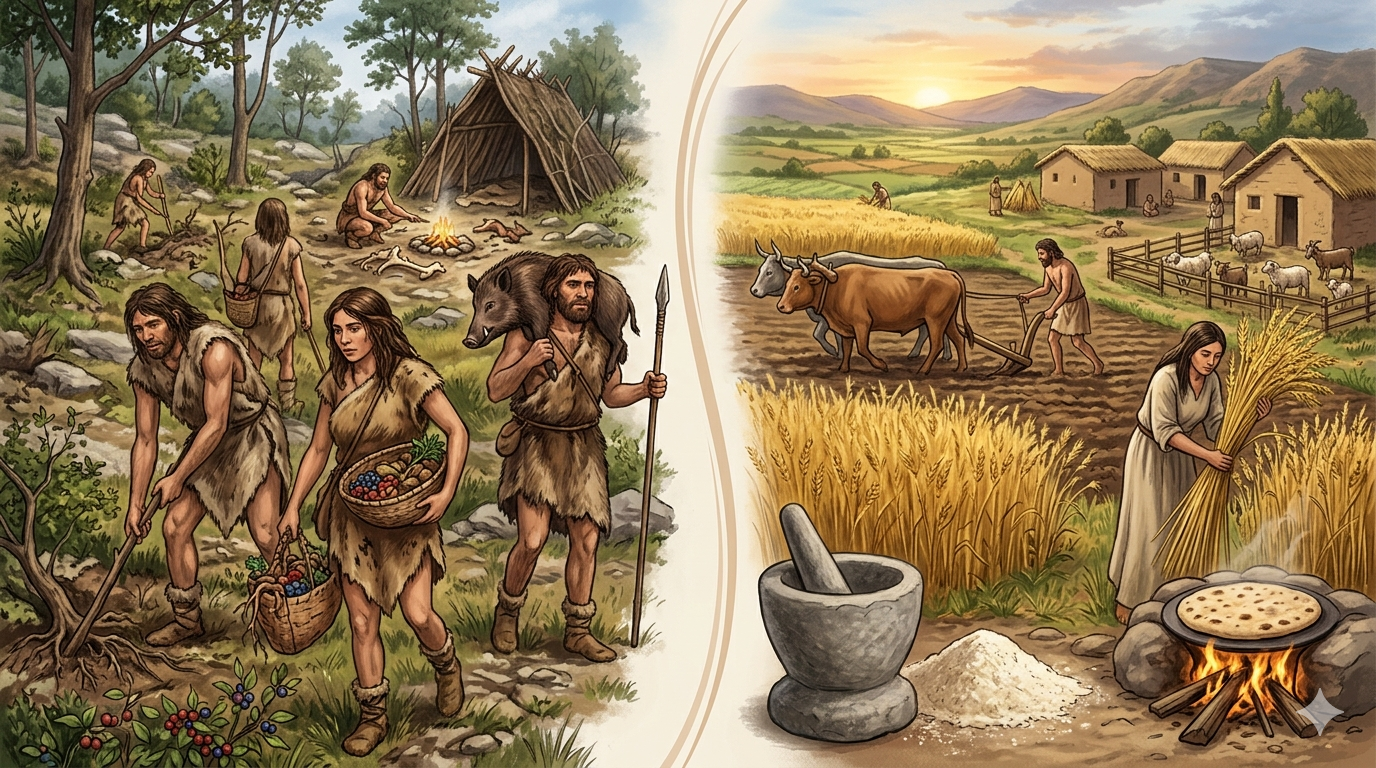
For most of human history, people did not buy food from stores, follow diet plans, or count calories. They survived by finding food in the environment around them. They hunted, gathered, fished, dug roots, collected fruits, ate insects, harvested wild plants, and learned which foods were safe, seasonal, useful, or dangerous.
Then something changed.
Human beings began to farm.
The shift from foraging to farming was one of the biggest turning points in human history. It changed what people ate, how they lived, where they settled, how many children they could raise, how communities formed, and how disease spread. It also changed the relationship between humans and food forever.
Before agriculture, diets were highly diverse and depended on local ecology. After agriculture, many communities began to depend heavily on a few staple crops such as wheat, rice, maize, millet, barley, potatoes, beans, or other cultivated foods.
This change created both benefits and problems. Farming allowed larger populations, permanent villages, food storage, and complex civilizations. But it also reduced dietary diversity in many places, increased dependence on starches, and introduced new health challenges.
Understanding this transition helps us see modern nutrition more clearly. Many of today’s food debates—about grains, starch, meat, dairy, processed food, traditional diets, and metabolic health—are connected to this long history.
What Is Foraging?
Foraging refers to finding food from wild environments rather than growing it through agriculture. Foragers may gather fruits, nuts, seeds, roots, tubers, herbs, mushrooms, honey, eggs, insects, shellfish, fish, and wild plants. They may also hunt animals or scavenge when opportunities appear.
Foraging diets were not all the same. A group living near the ocean might eat a diet rich in fish, shellfish, seaweed, and coastal plants. A group in a tropical forest might eat fruits, tubers, insects, small animals, and plant foods. A group in a cold northern climate might rely more heavily on animal foods, fish, fat, and preserved foods.
This diversity is important. There was no single “caveman diet.” Human beings survived because they were flexible. They learned to read landscapes, seasons, animal behavior, plant cycles, and food signals.
Foragers did not simply eat whatever they found. They developed deep ecological knowledge. They knew which plants were edible, which were poisonous, which roots needed cooking, which animals were worth hunting, which fruits were seasonal, and which foods could be preserved.
Food was not separate from life. It was tied to movement, weather, cooperation, memory, and skill.
What Changed When Humans Began Farming?
Farming changed the food system in a fundamental way. Instead of depending only on wild foods, people began to shape the environment to produce more predictable food supplies.
They planted seeds.
They selected larger grains.
They domesticated animals.
They stored harvests.
They built permanent settlements.
They developed tools for grinding, cooking, irrigation, and storage.
They created food traditions around staple crops.
This did not happen everywhere at once. Agriculture developed gradually in different parts of the world. Different regions domesticated different foods. Wheat and barley became important in parts of the Near East. Rice became central in parts of Asia. Maize transformed diets in the Americas. Potatoes became essential in the Andes. Millet, sorghum, yams, taro, cassava, beans, lentils, and many other foods shaped regional diets.
Agriculture gave humans more control over food, but it also made many communities more dependent on fewer crops.
This is one of the great trade-offs of food history: farming created stability, but it also created vulnerability.
The Benefits of Farming
It is easy to criticize agriculture from a modern health perspective, but farming had powerful advantages.
Farming increased food supply
Cultivated crops could produce more calories from a smaller area of land than many wild food systems. Staple crops such as grains and tubers were especially valuable because they provided concentrated energy.
This made it possible to support larger populations.
Farming allowed food storage
Many wild foods are seasonal and difficult to store. Grains, legumes, dried roots, and certain preserved foods could be stored for months. This helped communities survive dry seasons, winters, droughts, or periods when hunting and gathering were less reliable.
Food storage also allowed planning. It helped create villages, trade, social organization, and eventually cities.
Farming supported permanent settlements
Foragers often moved with food availability. Farmers could stay in one place longer. Permanent settlements led to new forms of family structure, property, craft specialization, architecture, markets, religion, and political organization.
Food changed society.
Farming created culinary traditions
Agriculture did not only produce crops. It produced cuisines. People learned to turn grains into bread, porridge, noodles, beer, flatbreads, steamed cakes, dumplings, fermented batters, and many other foods. Beans became soups, stews, pastes, and fermented products. Milk became yogurt, cheese, kefir, butter, and other dairy traditions.
Many of the world’s beloved traditional foods exist because of agriculture.
The Costs of Farming
Farming also had costs.
When communities became dependent on a few staple crops, dietary diversity often decreased. Instead of eating many wild plants, animals, insects, fish, nuts, fruits, roots, and seasonal foods, people in some farming societies ate large amounts of one or two staple foods.
This could create nutritional gaps.
A grain-based diet could provide calories but not always enough protein, fat, vitamins, or minerals unless it was balanced with legumes, animal foods, vegetables, fermented foods, or other nutrient-rich ingredients.
Agriculture also changed disease patterns. Larger settlements meant people lived closer together. Domesticated animals lived near humans. Waste accumulated. Infectious diseases could spread more easily. Food storage could attract pests and mold. Crop failure could lead to famine.
In other words, farming helped humans multiply, but it did not automatically make every individual healthier.
From Wild Diversity to Staple Dependence
One of the biggest dietary changes from foraging to farming was the move from broad food diversity to staple dependence.
Foragers often ate many different foods across the year. Their diets could include dozens or even hundreds of plant and animal species depending on the environment.
Farmers often relied on fewer species. A region might depend heavily on rice, wheat, maize, potatoes, millet, or cassava. These staples became the foundation of meals.
This was not always bad. Staple foods are powerful because they are dependable. Rice can feed millions. Wheat can be stored and turned into many forms. Maize can grow in different conditions. Potatoes can produce a large amount of food from a small area.
But the human body needs more than calories.
When staple foods are not balanced with nutrient-dense foods, deficiencies can appear. This is especially true when grains are polished, refined, or stripped of their outer layers. Traditional diets often solved this problem by combining staples with legumes, vegetables, seafood, animal foods, fermented condiments, herbs, spices, and mineral-rich ingredients.
Modern diets often keep the refined starch but lose the traditional balancing foods.
Farming Changed the Meaning of Starch
Starch became one of the great engines of civilization.
Grains and tubers provided energy that could be grown, stored, transported, taxed, traded, and turned into countless foods. Rice, wheat, maize, millet, potatoes, yams, taro, cassava, and other starches became the backbone of many traditional diets.
But starch is often misunderstood today.
Some modern diet debates treat starch as automatically harmful. Others treat traditional staples as automatically healthy. Both views are too simple.
Traditional starches were usually eaten in context. They were cooked, fermented, soaked, ground, sprouted, or combined with other foods. They were often eaten by people who moved more, worked physically, ate fewer ultra-processed snacks, and lived within seasonal food patterns.
Modern refined starches are different. White flour products, sweetened cereals, pastries, chips, crackers, and soft processed foods are often easy to overeat. They may be stripped of fiber and nutrients, combined with added sugar and industrial oils, and eaten in a sedentary lifestyle.
This is why the question should not be “Is starch good or bad?” A better question is: What kind of starch, prepared how, eaten with what, and in what lifestyle?
Farming Made Food Processing Necessary
Agriculture produced foods that often required preparation.
Many grains are not easy to eat raw. Beans and legumes can contain compounds that make them difficult to digest unless they are soaked, cooked, fermented, or sprouted. Some tubers contain toxins if not properly prepared. Seeds need grinding, soaking, or cooking. Milk spoils quickly unless fermented or turned into cheese or yogurt.
This led to the development of food preparation wisdom.
Traditional processing methods included:
Soaking grains and legumes
Fermenting doughs and batters
Grinding grains with stones
Sprouting seeds
Nixtamalizing maize
Cooking tubers thoroughly
Drying and storing harvests
Fermenting vegetables
Turning milk into yogurt, cheese, or kefir
Using salt, smoke, and sun for preservation
These methods were not just about taste. They often improved digestibility, safety, storage, and nutrient availability.
Modern processing is different. Traditional processing usually made food more usable. Industrial processing often makes food more profitable, shelf-stable, convenient, and hyper-palatable.
That difference matters.
The Rise of Bread, Porridge, Beer, and Fermentation
Farming gave rise to many food traditions that still define cultures today.
Wheat became bread, noodles, flatbreads, and pastries. Rice became steamed rice, rice noodles, rice cakes, congee, fermented rice drinks, and countless regional dishes. Maize became tortillas, tamales, porridge, and fermented foods. Barley and other grains became beer. Milk became yogurt, cheese, butter, kefir, and cultured dairy.
Fermentation became especially important because it helped preserve food and transform flavor. It also changed the chemical structure of foods and sometimes made them easier to digest.
A fermented grain food is not the same as a highly refined modern flour product. A traditional sourdough bread is not the same as a sweet packaged bread. A fermented dairy food is not the same as a sugary milkshake. A traditional bean paste is not the same as a processed snack made from refined starch.
This is why food history helps us understand the difference between traditional diets and modern food products.
Farming and Animal Foods
Farming also changed the relationship between humans and animals.
Before agriculture, animal foods came from hunting, fishing, gathering eggs, collecting shellfish, or eating insects. After domestication, humans began to keep animals for meat, milk, eggs, labor, hides, manure, and transportation.
This created new foods and new adaptations.
Dairy is a major example. In some populations, long-term dairy use was associated with genetic adaptation that allowed adults to digest lactose. In other populations, dairy remained less central or was consumed mostly in fermented forms that reduced lactose.
Domesticated animals also became part of mixed farming systems. Animals could eat grasses, scraps, or byproducts that humans could not digest and turn them into milk, meat, or eggs. Manure could fertilize fields. Animals could pull plows and transport goods.
However, animal domestication also brought people into closer contact with animal diseases and changed the ecology of human settlements.
Again, farming created both benefits and trade-offs.
Farming Changed the Human Body
The move to agriculture may have influenced the human body in many ways.
In some early farming communities, skeletal evidence suggests changes in height, dental health, workload, and disease patterns. More carbohydrate-heavy diets could increase tooth decay, especially when foods became sticky or processed. Repetitive farming labor could affect bones and joints. Living close to animals and other people could increase infectious disease exposure.
At the same time, farming allowed more children to survive in many communities because food supplies could support larger families. Population growth was one of agriculture’s greatest successes.
This creates an important distinction: a way of eating can be successful for population growth without being ideal for every individual’s health.
Agriculture helped build civilization. But it also introduced new nutritional challenges.
The Role of Food Security
One reason farming spread is that it offered food security.
Foraging can provide diverse nutrition, but it requires deep knowledge, mobility, and access to healthy ecosystems. Farming can produce more predictable calories, especially when communities learn irrigation, storage, and crop rotation.
In times of abundance, agricultural societies could grow. In times of crop failure, they could suffer greatly.
This trade-off still exists today.
Modern food systems are highly productive, but they often depend on a small number of crops: wheat, rice, maize, soy, potatoes, and a few others. These crops feed the world, but they also dominate processed food production.
Many packaged foods are built from refined versions of agricultural staples: refined flour, corn syrup, soybean oil, corn starch, potato starch, and other industrial ingredients.
The ancient move toward staple crops has become something very different in the modern food industry.
From Traditional Farming to Industrial Food
Traditional farming diets were not the same as modern industrial diets.
A traditional rice-based meal might include vegetables, fish, fermented condiments, herbs, broth, eggs, legumes, or small amounts of meat. A traditional wheat-based diet might include sourdough bread, soups, beans, vegetables, olive oil, cheese, or fermented foods. A traditional maize-based diet might include nixtamalized corn, beans, squash, chilies, herbs, and regional sauces.
Industrial diets often separate staples from their traditional context.
Wheat becomes refined white flour.
Corn becomes syrup, starch, and snack ingredients.
Soy becomes refined oil and additives.
Potatoes become chips and fries.
Rice becomes polished white rice or processed cereals.
Fruit becomes juice and sweetened products.
The problem is not simply farming. The problem is what happens when agricultural foods are refined, concentrated, sweetened, and engineered for overconsumption.
This is why ancestral nutrition does not reject farming completely. Instead, it asks how agricultural foods were traditionally prepared and how modern processing has changed them.
What Modern Eaters Can Learn from the Foraging-to-Farming Shift
The history of human diets teaches several practical lessons.
1. Diversity matters
Foragers often ate a wide variety of foods. Modern eaters can learn from this by including different vegetables, fruits, proteins, herbs, spices, legumes, nuts, seeds, seafood, or traditional staples when tolerated.
2. Staples need balance
Rice, wheat, maize, potatoes, and other starches can be part of healthy traditional diets, but they work best when balanced with protein, fiber, minerals, healthy fats, and micronutrient-rich foods.
3. Preparation matters
Soaking, fermenting, sprouting, cooking, and slow preparation can change how foods affect the body. Traditional methods often existed for good reasons.
4. Modern refinement changes food
A grain in its traditional form is not the same as a refined snack food. A whole tuber is not the same as a fried chip. A fermented dairy food is not the same as a sweetened dessert.
5. Lifestyle matters
Traditional agricultural diets were often paired with physical labor, outdoor time, seasonal rhythms, and home cooking. Modern sedentary life changes how the body responds to the same foods.
Should We Eat Like Foragers or Farmers?
This is the wrong question.
Most people today cannot and do not need to live exactly like ancient foragers. Farming gave us many valuable foods and traditions. Many agricultural diets are deeply nourishing when they are diverse, properly prepared, and minimally processed.
The better question is: what can we learn from both?
From foragers, we can learn the value of diversity, seasonality, movement, ecological awareness, and whole foods.
From traditional farmers, we can learn the value of food preparation, fermentation, staple balance, storage, cooking, culture, and community meals.
From modern science, we can learn about food safety, nutrient deficiencies, metabolic health, allergies, microbiome research, and individual variation.
A wise modern diet does not need to copy the past exactly. It can combine traditional wisdom with modern knowledge.
Common Myths About the Shift to Farming
Myth 1: Farming made people instantly healthier
Farming increased food supply and population growth, but it also introduced new health challenges, including less dietary diversity, more infectious disease exposure, and possible nutrient gaps in some communities.
Myth 2: All grains are unhealthy
Grains vary widely. Whole, fermented, sprouted, or traditionally prepared grains are different from refined flour products and sweet packaged foods.
Myth 3: Foragers ate only meat
Some foraging groups ate a lot of animal food, especially in cold climates, but many others ate tubers, fruits, insects, nuts, seeds, plants, fish, shellfish, honey, and seasonal foods.
Myth 4: Traditional farming diets were just carbs
Many traditional agricultural diets included vegetables, legumes, fermented foods, herbs, fish, eggs, dairy, meat, broths, spices, and regional condiments. The staple was only one part of the meal.
Myth 5: Modern processed food is the natural result of farming
Farming produced staple foods. Industrial processing transformed those staples into highly refined products. These are not the same thing.
How to Apply This History to Your Diet Today
You do not need to choose between being a “forager eater” or a “farmer eater.” Instead, you can use food history as a guide.
Eat more foods that still look close to their natural or traditional form. Choose whole roots instead of chips. Choose cooked grains or fermented bread instead of sweet refined pastries. Choose whole fruit instead of fruit juice. Choose beans or lentils prepared in ways your body tolerates. Add herbs, spices, fermented foods, and mineral-rich ingredients. Include protein with meals. Reduce ultra-processed foods made from refined starch, added sugar, and refined oils.
Most importantly, pay attention to your own body.
Some people do well with traditional grains. Others need to limit wheat or choose different starches. Some people tolerate beans well. Others need careful soaking, smaller portions, or alternatives. Some people thrive with dairy. Others do better with fermented dairy or no dairy.
History provides clues, not rigid rules.
Conclusion
The shift from foraging to farming changed human food forever.
Foraging diets were diverse, seasonal, and deeply connected to local environments. Farming brought staple crops, food storage, permanent settlements, population growth, culinary traditions, and civilization. But it also introduced dependence on fewer foods, new disease patterns, and nutritional trade-offs.
Modern nutrition problems did not begin with farming alone. Many problems come from the later transformation of traditional agricultural foods into refined, industrial, ultra-processed products.
This is why ancestral nutrition takes a balanced view.
The goal is not to reject agriculture. The goal is to understand how human diets changed, what was gained, what was lost, and how modern eaters can make wiser choices.
A healthy modern diet can learn from foragers by valuing diversity and whole foods. It can learn from farmers by respecting preparation, cooking, fermentation, and food culture. It can learn from science by recognizing personal tolerance, metabolic health, and food safety.
Food history does not give us one perfect diet. It gives us a better way to ask questions.
What foods shaped human life?
How were they prepared?
What changed when they became refined?
How does my body respond to them today?
Those questions can lead to a more thoughtful, flexible, and nourishing way of eating.
Disclaimer: This article is for educational purposes only and is not medical advice. If you have a medical condition, food allergy, digestive disorder, pregnancy-related concern, or specific dietary need, consult a qualified healthcare professional before making major changes to your diet.