
Grains are among the most debated foods in modern nutrition.
Some people see grains as essential staples that have fed civilizations for thousands of years. Others believe grains are difficult to digest, too high in carbohydrates, or too far removed from ancestral eating patterns. Some diets encourage whole grains, while others recommend avoiding wheat, rice, corn, oats, barley, or other grains almost completely.
But many modern debates miss an important question.
How were grains traditionally prepared?
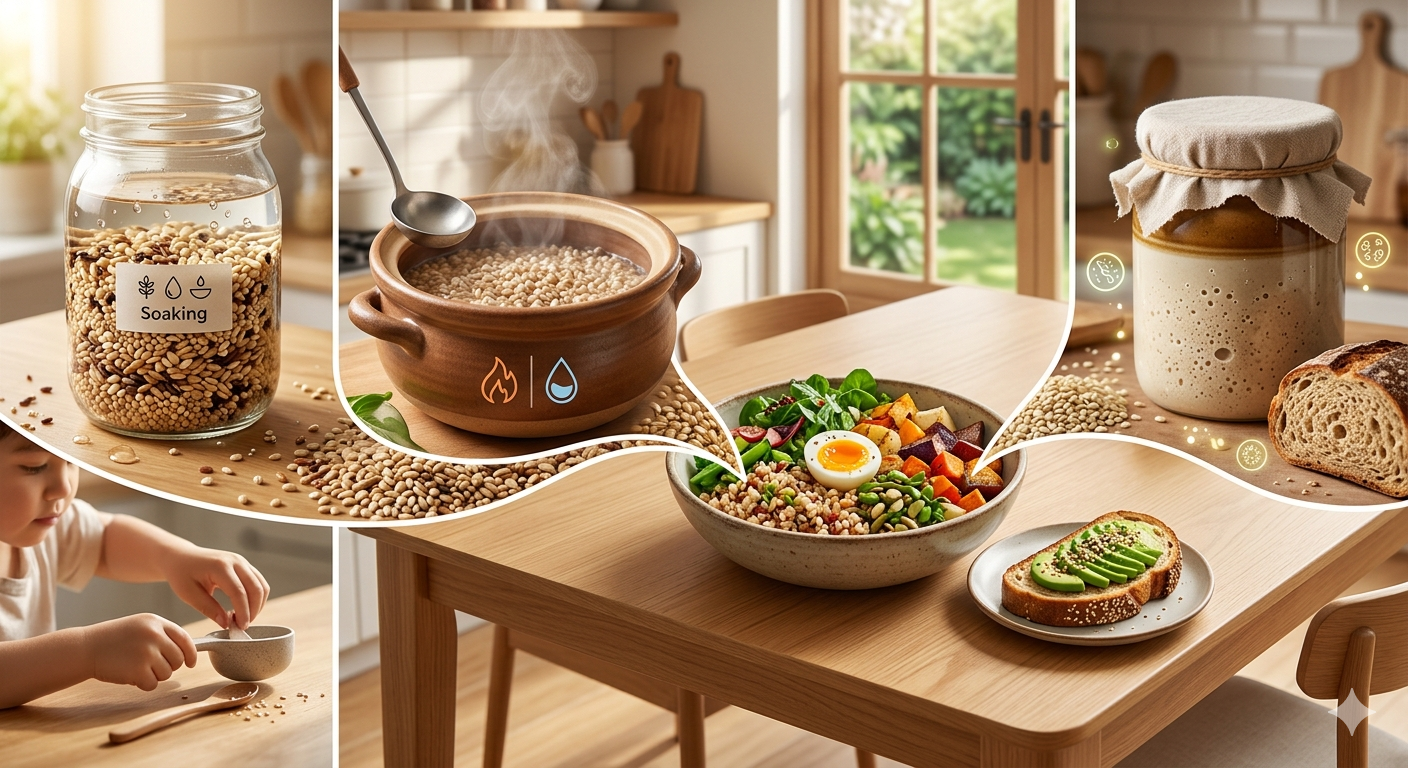
For much of human history, people did not simply take grains from a field and turn them into instant breakfast cereal, sweet pastries, soft white bread, snack crackers, or refined flour products. Traditional cultures often soaked, cooked, fermented, sprouted, stone-ground, boiled, steamed, or slow-prepared grains before eating them.
These methods mattered.
Soaking could soften grains and begin changing their structure. Cooking made grains edible, safer, and more digestible. Fermentation transformed flavor, texture, acidity, and sometimes tolerance. Across many cultures, grain preparation was not a small detail. It was part of the food itself.
Today, many people ask whether grains are healthy or unhealthy. A better question is: what kind of grain, prepared how, eaten with what, and for whom?
That is why soaking, cooking, and fermenting grains still matter.
Grains Were Never Just Raw Seeds
A grain is a seed.
Wheat, rice, oats, barley, rye, millet, sorghum, corn, and other cereal grains are the reproductive structures of plants. In nature, seeds are designed to survive until conditions are right for growth. They are compact, durable, and protected.
This is one reason grains became so important to human civilizations. They could be harvested, dried, stored, transported, traded, and cooked into many forms. Grains helped support large populations because they provided reliable energy and could be stored through difficult seasons.
But grains are not naturally soft, sweet, or ready-to-eat in the way many modern grain products appear.
Raw grains are hard. Many are difficult to chew and digest. Some contain compounds that protect the seed. Some require grinding, soaking, boiling, fermenting, or other preparation before they become pleasant and useful foods.
Traditional cultures understood this. They built entire cuisines around grain transformation.
Rice became steamed rice, congee, noodles, rice cakes, fermented rice foods, and porridges. Wheat became sourdough bread, flatbreads, noodles, dumplings, and porridges. Corn became tortillas, tamales, porridges, and fermented foods. Oats became porridge. Millet and sorghum became flatbreads, porridges, and fermented drinks.
The grain was only the beginning. Preparation made it food.
Why Traditional Grain Preparation Developed
Traditional grain preparation developed because people had practical problems to solve.
Grains needed to be stored without spoiling.
They needed to be softened.
They needed to be cooked.
They needed to be made flavorful.
They needed to be digestible.
They needed to fit into meals.
They needed to be combined with other foods.
They needed to feed families reliably.
Soaking, cooking, and fermenting were not invented as wellness trends. They were household technologies.
Before modern food factories, people had to know how to work with grains directly. They used water, heat, time, microbes, grinding stones, clay pots, fermentation vessels, and repeated experience.
These methods were passed down because they worked. They helped turn hard seeds into meals that could nourish communities.
Modern grain products often skip or shorten these processes. Industrial milling can refine grains quickly. Commercial bread can be made rapidly. Breakfast cereals can be extruded, sweetened, flavored, and packaged. Crackers and snacks can be made from refined flour, oils, and additives.
This is why traditional grain foods and modern grain products should not be treated as the same thing.
A slow-fermented sourdough bread is not the same as a sweet packaged bread. A bowl of cooked oats is not the same as a sugary cereal. Steamed rice with fish and vegetables is not the same as refined rice snacks. Traditional corn tortillas are not the same as flavored chips.
Preparation changes the meaning of grains.
Soaking Grains: The Role of Water and Time
Soaking is one of the simplest traditional preparation methods.
It involves placing grains in water for a period of time before cooking or further processing. This may seem basic, but it can change texture, shorten cooking time, and begin the process of hydration.
Dry grains are hard because they contain little water. Soaking allows water to penetrate the grain. This can make cooking more even and improve the final texture. In some grains, soaking may also help reduce certain water-soluble compounds.
Soaking is not always necessary for every grain. White rice, rolled oats, and many modern grain products may cook easily without soaking. But for whole grains, older varieties, cracked grains, or grains used in traditional recipes, soaking can still be helpful.
Soaking also teaches a different relationship with food. It slows the process down. It asks the cook to plan ahead. It turns grain preparation from instant consumption into a small ritual of care.
In traditional kitchens, time was often part of the recipe.
Cooking Grains: Making Seeds Edible
Cooking is the most essential grain preparation method.
Heat changes grains in several ways. It softens the grain, gelatinizes starches, improves texture, reduces microbial risk, and makes the food easier to chew and digest. Without cooking, many grains would be unpleasant or difficult to eat.
Cooking methods vary widely across cultures.
Rice may be steamed, boiled, or cooked into porridge. Oats may be simmered into oatmeal. Wheat may be baked into bread, boiled as berries, made into noodles, or shaped into dumplings. Corn may be boiled, ground, steamed, baked, or transformed into tortillas. Millet and sorghum may become porridges, flatbreads, or fermented batters.
Cooking also changes how grains fit into meals.
A bowl of porridge can carry nuts, fruit, yogurt, seeds, or spices. Rice can support vegetables, fish, eggs, legumes, broth, and fermented condiments. Bread can pair with soup, beans, cheese, olive oil, or vegetables. Noodles can carry broth, herbs, meat, tofu, or greens.
Cooking turns grains from storage seeds into meal foundations.
The problem in modern diets is often not cooked grains themselves. It is the replacement of cooked grain meals with refined, sweetened, ultra-processed grain products.
Fermenting Grains: Microbial Transformation
Fermentation is one of the most fascinating ways humans prepare grains.
In grain fermentation, microbes such as yeasts and bacteria transform doughs, batters, or cooked grains over time. They may produce acids, gases, aromas, and flavor compounds. This can change texture, taste, digestibility, and shelf life.
Sourdough bread is one of the best-known examples. A sourdough starter contains wild yeasts and lactic acid bacteria that ferment flour and water. Over time, the dough becomes more acidic, flavorful, and complex before baking.
Many cultures also ferment grain or grain-legume batters. Fermented rice and lentil batters, fermented millet porridges, fermented corn foods, and traditional grain drinks all show how widespread grain fermentation has been.
Fermentation can make grains taste deeper and more satisfying. It can create sourness, aroma, softness, and complexity. It can also reduce the need for artificial flavor because the food develops flavor naturally.
This is one reason traditional fermented grain foods often feel more satisfying than bland refined products.
Fermentation is not magic, and it does not make every grain suitable for every person. But it shows that grains can be transformed in meaningful ways before they reach the plate.
Phytates and Mineral Availability
One reason soaking and fermentation are often discussed is phytic acid, or phytate.
Phytate is found in grains, legumes, nuts, and seeds. Plants use it to store phosphorus. In human digestion, phytate can bind minerals such as iron, zinc, calcium, and magnesium, potentially reducing their absorption.
This is why phytate is often called an “anti-nutrient.”
However, the term can be misleading if used too fearfully. Many phytate-containing foods are also nutrient-rich and valuable. Whole grains, legumes, nuts, and seeds can provide fiber, minerals, protein, and other compounds. For many healthy people eating a varied diet, phytate is not something to panic about.
The concern becomes more relevant when someone relies heavily on unrefined grains or legumes without enough dietary diversity, animal foods, mineral-rich foods, vitamin C-rich foods, or traditional preparation.
Traditional methods such as soaking, sprouting, and fermentation may help reduce phytate levels to varying degrees depending on the food and method.
The practical lesson is not “avoid grains.” The lesson is “prepare grains thoughtfully and eat them in a balanced diet.”
Gluten, Wheat, and Individual Tolerance
Wheat deserves special attention because it contains gluten, a group of proteins that gives dough elasticity and helps bread rise.
For most people, wheat can be eaten in some form if tolerated. But for people with celiac disease, gluten must be strictly avoided because it triggers an autoimmune reaction. Some people may also have wheat allergy or non-celiac gluten sensitivity. Others may react to fermentable carbohydrates in wheat rather than gluten itself.
This is why grain advice must be personalized.
Traditional preparation may improve tolerance for some people, but it does not make gluten safe for someone with celiac disease. Sourdough fermentation may change wheat dough, but it is still not appropriate for people who require a gluten-free diet unless it is made from certified gluten-free ingredients.
At the same time, people without gluten-related conditions do not necessarily need to fear wheat. The form matters. A slow-fermented bread eaten with a meal is different from sweetened refined pastries, cookies, or packaged white bread.
Wheat is not one single experience. Preparation, processing, portion, and individual tolerance all matter.
Whole Grains vs Refined Grains
Another important distinction is whole grains versus refined grains.
Whole grains contain the bran, germ, and endosperm. Refined grains have much of the bran and germ removed, which changes fiber, texture, nutrient content, and how the grain behaves in the diet.
Refining grains made them softer, lighter, longer-lasting, and more desirable in many societies. White flour and white rice became symbols of refinement in some cultures. But refining can also remove fiber, minerals, and vitamins naturally found in the outer parts of the grain.
In some historical contexts, heavy reliance on refined grains contributed to nutrient deficiency problems when the rest of the diet did not compensate.
Modern refined grains often appear in products that are also high in sugar, refined oils, salt, and additives. This makes the issue more complicated. The problem is not only refining; it is the entire processed food pattern.
A bowl of white rice with fish, vegetables, soup, and fermented condiments is not the same as a sweet refined grain cereal. Refined flour in a homemade flatbread is not the same as packaged cakes and cookies eaten daily.
Still, for many people, choosing more intact or minimally processed grains more often can improve diet quality.
Grain Foods Are Not All the Same
It is not useful to speak about “grains” as if all grain foods are identical.
Consider the differences:
Steel-cut oats cooked slowly
Instant sweetened oatmeal packets
Traditional sourdough bread
Sweet packaged white bread
Steamed rice
Rice crackers with flavor powders
Corn tortillas
Corn chips
Millet porridge
Sugary breakfast cereal
Barley soup
Refined pastries
Fermented rice-lentil batter
Commercial cookies
All of these may involve grains, but they are very different foods.
The structure, processing, preparation, added ingredients, fiber, sugar, fat, salt, and meal context all matter.
This is why people often get confused. One person says grains are healthy because they think of oats, rice, barley soup, and traditional breads. Another says grains are unhealthy because they think of pastries, crackers, cereals, and refined snacks.
Both may be talking about different foods under the same category.
A more useful approach is to judge grain foods by preparation and context.
Grains Need Meal Companions
Traditional grain-based diets rarely relied on grains alone.
Rice may be eaten with fish, eggs, tofu, vegetables, broth, seaweed, fermented sauces, or pickles. Wheat bread may be eaten with soup, cheese, olive oil, beans, vegetables, or meat. Corn tortillas may be eaten with beans, salsa, vegetables, avocado, or protein. Oats may be eaten with nuts, seeds, yogurt, milk, fruit, or spices.
Grains are often best understood as meal foundations, not complete meals by themselves.
When grains are eaten alone, especially in refined form, they may be less satisfying. When grains are paired with protein, fiber, fat, acidity, herbs, and vegetables, the meal becomes more balanced.
Modern eating often removes these companions. A person may eat refined toast with sugary spread, cereal with sweetened milk, crackers as snacks, or pastries with coffee. These patterns are different from traditional grain meals.
The lesson is simple: if you eat grains, build meals around them wisely.
Why Fermented Grain Foods Often Feel More Satisfying
Fermented grain foods often have more flavor than quick refined grain products.
Sourdough bread has acidity, aroma, chew, and complexity. Fermented batters can be tangy and light. Fermented porridges can have depth. Traditional grain drinks can have layered flavors.
This matters because satisfaction is part of healthy eating.
If food is bland, people often seek extra sugar, salt, fat, or snacks afterward. If food is flavorful and balanced, it can be easier to feel satisfied with simpler meals.
Fermentation can make grains taste more complete without relying on artificial flavors or excessive sweetness.
A slice of well-made sourdough with soup may feel more satisfying than soft sweet bread eaten alone. A fermented grain-legume dish may be more enjoyable than plain starch. A tangy porridge may be more interesting than instant cereal.
Flavor helps real food compete with processed food.
Sprouting Grains: Another Traditional Transformation
Sprouting is another method used in some traditional and modern grain preparation.
When grains are soaked and allowed to germinate, they begin the process of becoming a plant. This changes enzymes, texture, flavor, and nutrient profile. Sprouted grains may be dried, cooked, ground into flour, or used in breads and porridges.
Sprouting is not necessary for everyone, and sprouted grain products vary in quality. Some are still highly processed. But sprouting illustrates a larger principle: grains are living seeds that can be transformed before eating.
Traditional cultures often used multi-step preparation because they understood that seeds were not always best eaten in their raw dormant form.
Soaking, sprouting, fermenting, grinding, and cooking are all ways humans make seeds more usable.
The Modern Problem: Fast Grain Products
Many modern grain products are designed for speed.
Instant cereal.
Soft white bread.
Crackers.
Cookies.
Breakfast bars.
Sweet pastries.
Chips.
Microwave grain products.
Refined noodles.
Snack cakes.
Flavored grain snacks.
These foods are often easy to chew, quick to digest, and highly palatable. They may combine refined flour with sugar, oils, salt, flavorings, and additives. They may be eaten quickly and frequently without much satiety.
This is very different from traditional grain preparation, which often required time, water, heat, fermentation, chewing, and meal structure.
Fast grain products are not the same as traditional grains.
A major step toward better eating is to replace some ultra-processed grain products with slower, more recognizable grain foods.
Examples include cooked oats, rice with balanced meals, barley soup, millet porridge, sourdough bread, whole-grain flatbreads, fermented batters, or properly cooked corn, wheat, or rye dishes.
Should Everyone Eat Grains?
No single food category is required for everyone.
Some people do well with grains. Others feel better limiting them. People with celiac disease must avoid gluten-containing grains. Some people with digestive conditions may need to be careful with wheat, barley, rye, or certain fibers. People managing blood sugar may need to choose type and portion thoughtfully.
However, many people can include grains in a balanced diet, especially when they are minimally processed, properly prepared, and eaten with protein, vegetables, healthy fats, and fiber.
The question is not whether everyone should eat grains. The question is whether grains work for your body, culture, lifestyle, and health needs.
A person doing heavy physical labor may tolerate more grain-based meals than someone sedentary with blood sugar concerns. A person raised on rice may build healthy meals around rice. A person with wheat sensitivity may choose oats, rice, millet, buckwheat, or gluten-free grains. A person who struggles with cravings may need to reduce refined grain snacks.
Personalization matters.
How to Prepare Grains Better Today
You do not need to use ancient methods perfectly to improve grain quality.
Here are practical ways to make grain eating more traditional and balanced:
Choose cooked grains more often than packaged grain snacks.
Try soaking tougher whole grains before cooking.
Choose sourdough or traditionally fermented breads when available.
Pair grains with protein, vegetables, and fats.
Use grains in soups, stews, bowls, or balanced meals.
Avoid making sweet refined grain products the daily foundation.
Try oats, barley, millet, rice, buckwheat, or other grains for variety.
Use herbs, spices, broths, and fermented condiments for flavor.
Let grains be part of a meal, not constant grazing.
Pay attention to digestion, energy, and satiety.
The goal is not perfection. It is better context.
A Practical Grain Decision Framework
Before eating a grain food, ask five questions.
1. What is the form?
Is it intact, cracked, rolled, stone-ground, refined, puffed, extruded, or ultra-processed?
2. How was it prepared?
Was it soaked, cooked, fermented, sprouted, baked slowly, or quickly processed?
3. What is added?
Does it contain added sugar, refined oils, artificial flavors, or excessive salt?
4. What is it eaten with?
Is it part of a balanced meal with protein, fiber, vegetables, fat, and flavor?
5. How does your body respond?
Does it support steady energy and digestion, or does it lead to discomfort, cravings, or blood sugar swings?
This framework is more helpful than asking whether grains are simply good or bad.
Examples of Better Grain-Based Meals
Here are simple examples of grain meals that follow traditional principles:
Oatmeal cooked with nuts, seeds, berries, and plain yogurt
Rice with fish, vegetables, broth, and fermented condiments
Barley soup with beans, herbs, and vegetables
Sourdough bread with eggs and greens
Millet porridge with spices and nuts
Corn tortillas with beans, salsa, avocado, and vegetables
Buckwheat with mushrooms, herbs, and yogurt sauce
Rice congee with eggs, herbs, and vegetables
Whole-grain flatbread with lentil stew
Fermented grain-legume pancakes with vegetables
These meals are not defined by grains alone. They are defined by balance.
Common Myths About Soaking, Cooking, and Fermenting Grains
Myth 1: Grains are healthy no matter how they are prepared
Preparation matters. Whole cooked grains are different from sweet refined grain snacks.
Myth 2: Grains are always harmful
Many cultures have eaten grains for centuries. The type, preparation, portion, and personal tolerance matter.
Myth 3: Fermentation makes wheat safe for people with celiac disease
No. People with celiac disease must avoid gluten-containing grains unless a product is certified gluten-free and medically appropriate.
Myth 4: Soaking removes all anti-nutrients
Soaking may reduce some compounds, but it does not make all grains perfect or remove every concern. It is one tool, not magic.
Myth 5: Refined grains and traditional grains are the same
They are not. A refined packaged pastry and a traditional fermented grain food behave very differently in the diet.
When to Be Cautious with Grains
Some people should be more careful with grains or specific grain types.
People with celiac disease must avoid gluten-containing grains.
People with wheat allergy must avoid wheat.
People with irritable bowel syndrome may react to certain grain fibers or fermentable carbohydrates.
People with diabetes or insulin resistance may need portion guidance.
People with mineral deficiencies may need to consider overall diet quality and preparation methods.
People with digestive discomfort may need to test different grains and preparation styles.
This does not mean grains are bad for everyone. It means grain choices should fit the individual.
If you have a medical condition or persistent symptoms, speak with a qualified healthcare professional.
Conclusion
Soaking, cooking, and fermenting grains still matter because grains are not just ingredients. They are seeds that humans learned to transform.
Traditional cultures did not usually eat grains as instant, sweetened, refined products. They soaked, cooked, fermented, sprouted, ground, boiled, steamed, and baked them. These methods improved texture, flavor, storage, and sometimes digestibility. They also helped grains become part of complete meals rather than isolated snacks.
Modern debates often ask whether grains are good or bad. That question is too simple.
A better question is:
What grain is it?
Is it whole or refined?
How was it prepared?
Was it fermented or cooked properly?
What is it eaten with?
Does it fit your body and lifestyle?
Grains can be part of a balanced diet for many people, but they work best when treated with the respect traditional kitchens gave them. They should be prepared well, paired wisely, and eaten in forms that support real meals rather than constant processed snacking.
The wisdom of soaking, cooking, and fermenting grains is not outdated. It reminds us that food is transformed by time, water, heat, microbes, and human care.
And sometimes, the difference between a food that nourishes and a food that merely fills us lies in the preparation.
Disclaimer: This article is for educational purposes only and is not medical advice. Grain tolerance varies by individual. If you have celiac disease, wheat allergy, diabetes, digestive disorders, mineral deficiencies, food sensitivities, pregnancy-related questions, or specific dietary needs, consult a qualified healthcare professional before making major dietary changes.