
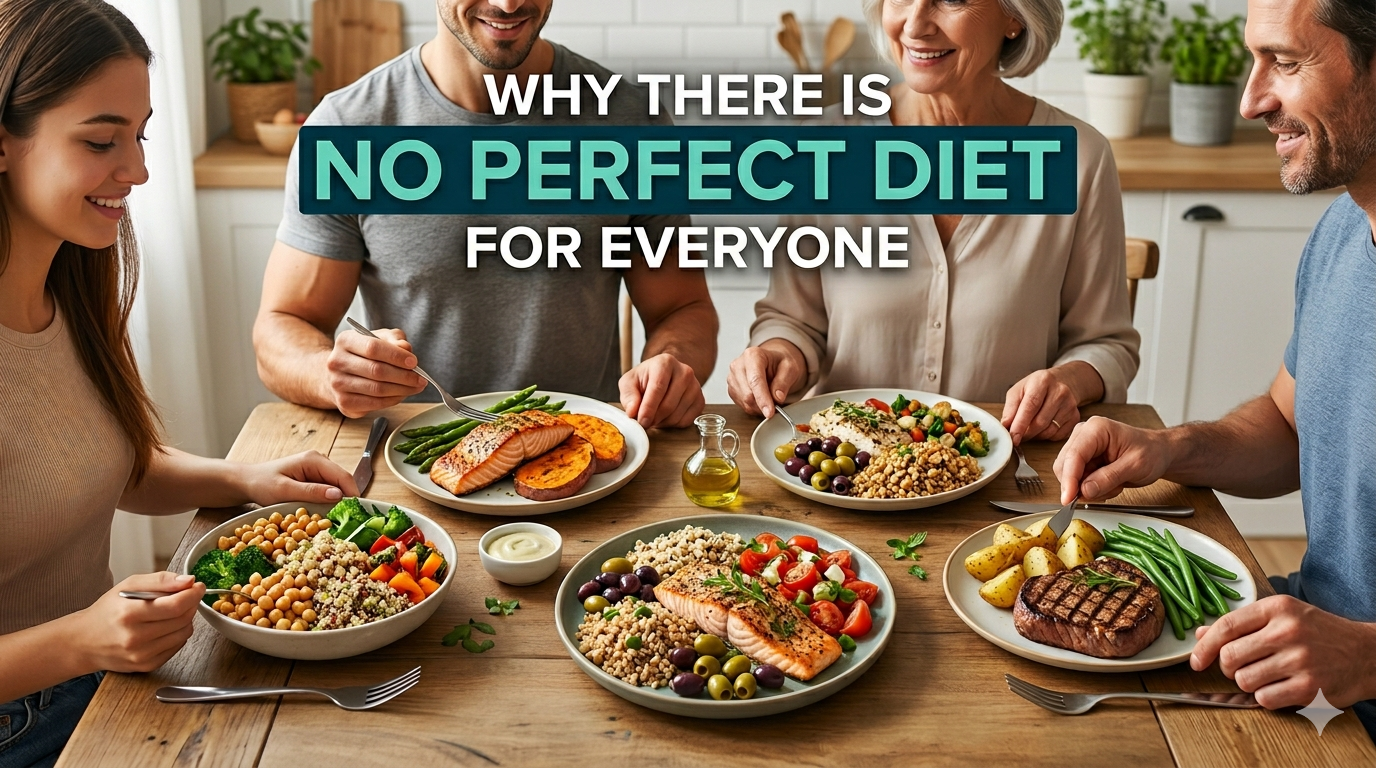
Many people search for the perfect diet.
Some hope the answer is low-carb. Others believe it is plant-based. Some feel best eating more protein. Others do better with more whole-food carbohydrates. Some people drink milk every day without a problem, while others feel bloated after a small amount of dairy. Some people can eat spicy food, fermented foods, beans, or wheat easily, while others struggle with digestion.
This is why nutrition often feels confusing. One person says a food changed their life. Another person says the same food made them feel worse. One expert praises grains. Another warns against them. One diet book celebrates meat. Another warns readers to reduce animal foods. One culture builds meals around rice. Another around dairy. Another around seafood, tubers, maize, millet, legumes, or fermented vegetables.
So who is right?
The better question may be: why do we expect one diet to work for everyone?
Human beings did not evolve in one place, eating one menu, under one lifestyle. Across history, people adapted to many environments, climates, food sources, cooking methods, and cultural traditions. Because of this, the idea of one perfect diet for all humans is too simple.
A better approach is to understand nutrition through context.
The Problem with One-Size-Fits-All Diet Advice
Modern diet culture often presents food as a universal formula. It tells people to follow a fixed set of rules:
Eat this.
Avoid that.
Cut this macro.
Add this superfood.
Never eat this ingredient.
Follow this plan forever.
This kind of advice can be appealing because it feels simple. When people are confused, they want certainty. A clear rule can feel safer than a nuanced explanation.
But human nutrition is not that simple.
A food does not affect every body in the same way. A diet that improves one person’s energy, digestion, or weight may not produce the same result for another person. Even when broad nutrition principles are useful, the details often need to be adjusted.
For example, a diet rich in beans, whole grains, and vegetables may be excellent for one person, but difficult for someone with certain digestive sensitivities. A dairy-rich diet may support one person’s protein and calcium intake, but cause discomfort for someone who does not digest lactose well. A lower-carbohydrate diet may help one person manage cravings, while another person may feel tired, restricted, or socially disconnected eating that way.
This does not mean “anything goes.” It means nutrition must be understood in relation to the person, not just the food.
Human Diets Have Always Been Diverse
There was never one original human diet.
People living near oceans often relied on fish, shellfish, seaweed, and coastal plants. People in cold climates often depended more on animal foods and preserved foods. Tropical communities had access to fruits, tubers, insects, leafy plants, fish, and fermented foods. Agricultural societies developed diets based on rice, wheat, maize, millet, barley, beans, lentils, dairy, or regional staples.
Even within traditional societies, diets changed with season, age, social role, food availability, and local ecology.
This diversity matters because it shows that humans are adaptable omnivores. We survived not because we ate one perfect diet, but because we learned to eat many different foods in many different ways.
Cooking, fermentation, soaking, drying, salting, smoking, grinding, sprouting, and preserving allowed people to turn difficult foods into useful foods. These methods became part of culture because they helped communities survive.
This is one of the central lessons of ancestral nutrition: food should not be judged only by its nutrient label. It should also be understood through history, preparation, environment, and adaptation.
Genetics Shape Food Tolerance
One reason there is no perfect diet for everyone is genetic variation.
A clear example is lactose tolerance. Some populations developed the ability to digest lactose, the sugar in milk, into adulthood. In those populations, milk and dairy could become important foods. In other populations, many adults lose much of their ability to digest lactose after childhood, making milk more likely to cause bloating, gas, cramps, or diarrhea.
This does not mean dairy is universally good or universally bad. It means dairy is context-dependent.
Alcohol tolerance is another example. Some people, especially in certain East Asian populations, carry genetic variations that make alcohol metabolism less efficient. These people may experience facial flushing, nausea, rapid heartbeat, or discomfort after drinking. For them, alcohol may carry different risks and effects than it does for people who metabolize it more easily.
Starch digestion can also vary. Some people may produce more salivary amylase, an enzyme that helps break down starch. Others may have different responses to high-starch diets, especially when starch is refined and eaten in large amounts.
Genes do not determine everything, but they influence how food interacts with the body.
This is why nutrition advice should be careful with absolutes. A food that has been useful for one group of people may not be ideal for another group in the same amount, form, or frequency.
Culture Is a Form of Nutritional Memory
Food culture is not random. Traditional diets often carry generations of trial and error.
A culture may ferment vegetables because fresh produce was seasonal. It may soak beans because unsoaked beans caused discomfort. It may eat fish with herbs, spices, sour flavors, or fermented condiments because these pairings improved flavor, preservation, or digestion. It may use certain fats, grains, roots, or animal foods because those were available and practical in that environment.
In this sense, culture is a kind of nutritional memory.
Traditional eating patterns often contain clues about what worked for a community over time. That does not mean every traditional food practice is automatically healthy, but it does mean we should not dismiss traditional food wisdom too quickly.
For example, many traditional grain-based diets did not rely on highly refined flour, sweetened breakfast cereals, packaged pastries, and constant snacking. They often used whole grains, sourdough fermentation, long cooking, legumes, vegetables, soups, broths, herbs, and seasonal foods.
The problem is not always the traditional staple itself. Sometimes the problem is the modern version: refined, sweetened, softened, stripped of fiber, combined with industrial fats, and eaten in a sedentary lifestyle.
Digestion Is Personal
Another reason there is no perfect diet for everyone is that digestion varies widely.
Some people digest beans well. Others experience gas and bloating. Some tolerate wheat. Others may have celiac disease, wheat allergy, gluten sensitivity, or sensitivity to certain fermentable carbohydrates. Some people enjoy fermented foods daily. Others may need to introduce them slowly or avoid specific types.
The gut microbiome also plays a role. The microbes living in the digestive tract help process fibers, starches, polyphenols, and other food compounds. A person’s microbiome is influenced by birth, childhood diet, antibiotics, environment, stress, travel, infections, long-term eating habits, and lifestyle.
This means two people can eat the same meal and respond differently.
One person may feel energized after a bowl of lentils and vegetables. Another may feel bloated. One person may do well with yogurt. Another may react poorly. One person may tolerate spicy food. Another may experience reflux or discomfort.
This does not make the food “good” or “bad” in a universal sense. It means the food-body relationship is personal.
Lifestyle Changes the Meaning of Food
Food does not act in isolation.
A traditional high-starch meal eaten by a physically active farmer is not the same as a refined high-starch meal eaten by someone who sits most of the day, sleeps poorly, and experiences chronic stress.
A meal high in animal fat may affect the body differently depending on whether it is part of a whole-food traditional diet or part of a modern pattern that includes processed meats, fried foods, refined bread, sugary drinks, and very little movement.
Fruit eaten whole after physical activity is different from drinking large amounts of fruit juice while sedentary. Grains prepared through slow fermentation are different from refined flour products eaten quickly and often. Dairy from fermented yogurt or aged cheese may affect digestion differently than sweetened milkshakes or processed dairy desserts.
This is why ancestral nutrition pays attention to lifestyle.
Traditional diets were connected to movement, outdoor work, seasonal rhythms, home cooking, community meals, and food scarcity. Modern diets often exist in a world of constant availability, stress, convenience, artificial light, poor sleep, and reduced physical effort.
A food that was reasonable in one lifestyle may become problematic in another.
Modern Food Makes the Question More Complicated
When people argue about whether a food is healthy, they often forget to ask what version of the food they mean.
Take carbohydrates as an example. Traditional carbohydrates may come from roots, tubers, legumes, whole grains, fruits, or slowly prepared starches. Modern carbohydrates often come from refined flour, sweetened drinks, pastries, candy, white bread, chips, and ultra-processed snacks.
These are not the same.
The same is true for meat. Traditional animal foods may include fresh meat, organ meats, fish, shellfish, eggs, broths, and preserved foods eaten within a physically active lifestyle. Modern animal foods may include processed meats, fast-food burgers, deep-fried items, and heavily salted packaged products.
The same is true for fat. Traditional fats may come from whole foods, nuts, fish, dairy, olives, coconut, or animal foods. Modern fats may appear in refined oils, packaged snacks, fried foods, and ultra-processed products designed to be hard to stop eating.
This means the question is not only “Should I eat carbs, fat, or protein?” A better question is: what kind, in what form, prepared how, eaten with what, and in what lifestyle?
Why Diet Tribes Become So Convincing
People often become loyal to a diet because it worked for them.
This is understandable. If someone feels better after removing ultra-processed foods, reducing sugar, eating more protein, avoiding gluten, cutting alcohol, or increasing vegetables, they may believe they have found the universal answer.
But often, what helped them may not be the exact diet label. It may be one or more changes hidden inside the diet.
For example, someone who goes low-carb may also stop drinking soda, eating pastries, snacking at night, and consuming refined flour. Someone who goes plant-based may start eating more beans, vegetables, fruits, and fiber while reducing fast food. Someone who follows a traditional diet may cook more at home, eat fewer packaged foods, and pay more attention to meals.
The improvement may be real, but the explanation may be more complex than the diet community claims.
This is why we should be careful with diet identity. A diet can be useful without becoming a belief system.
Broad Principles Still Matter
Saying there is no perfect diet for everyone does not mean nutrition has no structure. There are still broad principles that apply to many people.
Most people benefit from reducing ultra-processed foods. Most people do better when they eat enough protein, fiber, vitamins, and minerals. Most people benefit from limiting added sugars and sweetened drinks. Most people need foods they can digest well. Most people need a diet that fits their life, not just a short-term challenge.
Useful principles include:
Eat mostly whole or minimally processed foods.
Prioritize foods that provide real nourishment.
Pay attention to digestion and tolerance.
Avoid making ultra-processed foods the foundation of the diet.
Include enough protein for your body and lifestyle.
Include fiber-rich foods if you tolerate them.
Choose carbohydrates based on activity level, metabolic health, and food quality.
Respect cultural food traditions while adjusting for modern life.
Cook more often when possible.
Notice how sleep, stress, and movement affect appetite and food response.
These principles are flexible enough to support different diets while still guiding people away from the most harmful patterns of modern eating.
How to Find the Diet That Fits You
Instead of searching for the perfect diet, it may be better to search for a diet that fits your body, culture, values, and lifestyle.
Start by observing your current eating pattern. Are most of your foods whole or heavily processed? Do you cook often? Do you feel energized after meals or sleepy and uncomfortable? Do certain foods repeatedly cause bloating, reflux, cravings, or fatigue? Are you eating in a way you can maintain for years?
Then adjust gradually.
You might begin by reducing sweetened drinks, packaged snacks, and refined flour products. You might add more whole foods, protein, vegetables, fermented foods, or traditional starches. You might test how you respond to dairy, wheat, legumes, or high-sugar foods. You might experiment with meal timing, portion size, or cooking methods.
The goal is not perfection. The goal is feedback.
Your body gives information. Your culture gives information. Your family history gives information. Your lab results, if reviewed with a healthcare professional, can give information. Your digestion, energy, mood, sleep, and cravings can also give clues.
A good diet is not just one that looks healthy on paper. It is one that supports your real life.
What Ancestral Nutrition Adds to the Conversation
Ancestral nutrition helps us move beyond diet wars.
It reminds us that humans have eaten many different diets successfully. It teaches us to respect traditional food preparation. It helps explain why dairy works for some people and not others, why refined carbs are not the same as traditional starches, why fish can be valuable but not risk-free, and why food culture matters.
It also reminds us that modern food changed quickly. Our bodies may be flexible, but they are not always prepared for constant access to refined sugar, refined flour, industrial snacks, sweetened drinks, and low physical activity.
The ancestral view does not say, “Eat exactly like the past.” It says, “Use the past to understand the present.”
That is a more balanced and realistic way to think about nutrition.
Common Mistakes to Avoid
Mistake 1: Assuming your diet is right for everyone
Your personal success with a diet is useful, but it is not universal proof. Other people may have different genetics, digestion, culture, and health needs.
Mistake 2: Judging foods without context
Rice, wheat, dairy, meat, fruit, beans, and fermented foods can all be helpful or problematic depending on form, amount, preparation, and personal tolerance.
Mistake 3: Confusing traditional foods with modern processed versions
Traditional bread is not the same as sweet packaged bread. Whole fruit is not the same as fruit juice. Fresh meat is not the same as processed meat. Traditional starches are not the same as refined snack foods.
Mistake 4: Ignoring digestion
A food can be nutrient-dense but still not work well for your body. Digestion matters.
Mistake 5: Forgetting lifestyle
Food works together with movement, sleep, sunlight, stress, social connection, and daily routine. A diet cannot fully compensate for an unhealthy lifestyle.
Conclusion
There is no perfect diet for everyone because there is no single human story.
We come from different ancestries, cultures, climates, food traditions, lifestyles, and biological backgrounds. We digest foods differently. We tolerate dairy, wheat, alcohol, starch, fiber, spice, and fermented foods differently. We also live in a modern food environment that is very different from the one that shaped traditional diets.
This does not mean nutrition is hopelessly confusing. It means we need better questions.
Instead of asking, “What is the perfect diet?” ask:
What foods does my body tolerate well?
What traditional foods make sense for my background and lifestyle?
What modern processed foods should I reduce?
How do I feel after eating this way consistently?
Can I maintain this pattern for years?
Does this diet support my energy, digestion, metabolic health, and daily life?
A good diet is not a universal formula. It is a thoughtful relationship between food, body, culture, and lifestyle.
The best diet for you is not necessarily the diet that wins the loudest argument online. It is the one that nourishes you, fits your life, respects your biology, and helps you build long-term wellbeing.
Disclaimer: This article is for educational purposes only and is not medical advice. If you have a medical condition, food allergy, digestive disorder, pregnancy-related concern, or specific dietary need, consult a qualified healthcare professional before making major changes to your diet.