
Put two plates on a table.
On the first plate is a bowl of slow-cooked beef stew with carrots, onions, herbs, broth, and potatoes. The meat is tender. The vegetables are soft. The broth carries flavor from bones, time, and careful cooking.
On the second plate is a fast-food processed meat sandwich with refined bread, processed cheese, sugary sauce, fries, and a sweet drink.
Both plates may contain meat.
But are they really the same kind of food?
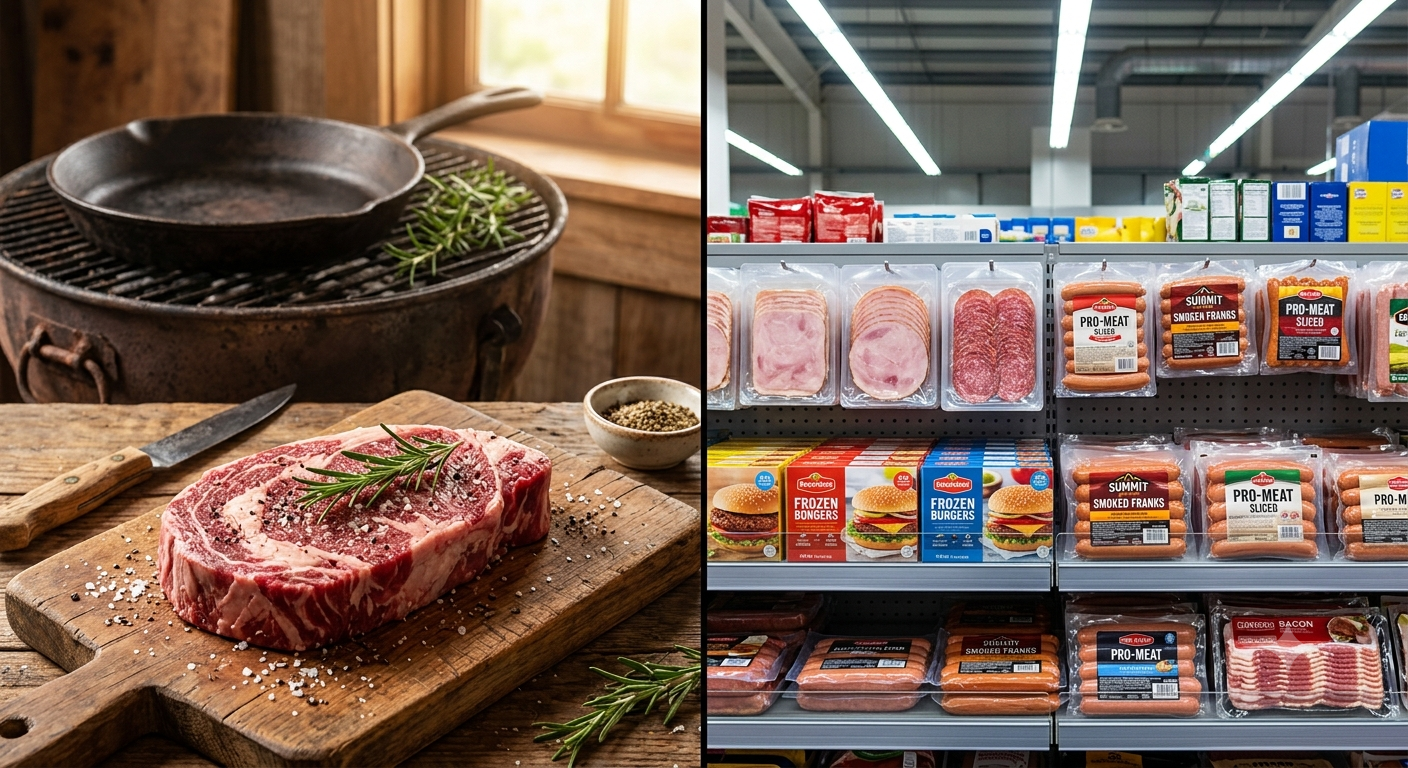
This is where modern nutrition often becomes confused. People talk about “meat” as if all meat foods belong to one category. But traditional animal foods and modern processed meats are very different in source, preparation, ingredients, purpose, cultural role, and how they are eaten.
Traditional animal foods often came from whole animals, local ecosystems, seasonal rhythms, preservation needs, and slow cooking. Modern processed meats often come from industrial food systems built for convenience, shelf life, flavor intensity, low cost, and mass distribution.
That does not mean every traditional animal food was perfect. It also does not mean every modern meat product must be feared. But it does mean we need a better framework.
The real question is not simply, “Is meat healthy or unhealthy?”
A better question is: what kind of animal food is it, how was it prepared, what was added, how often is it eaten, and what does the whole meal look like?
What Are Traditional Animal Foods?
Traditional animal foods are foods from animals that were prepared through older culinary methods and eaten within cultural meal patterns.
They may include:
Fresh meat
Wild game
Fish
Shellfish
Eggs
Milk
Yogurt
Kefir
Cheese
Organ meats
Bone broth
Animal fat used traditionally
Dried fish
Salted fish
Smoked meats
Fermented seafood
Small amounts of cured meats
Whole-animal stews
Soups made with bones and connective tissue
Traditional animal foods were usually connected to place. A coastal culture might rely on fish and shellfish. A pastoral culture might use milk, yogurt, cheese, and meat. A cold-climate culture might depend more on animal fat and preserved fish. A farming culture might use small amounts of meat to flavor grains, beans, roots, or vegetables.
The important point is that traditional animal foods were usually part of a food system.
They were not just isolated protein products. They were tied to survival, cooking skill, preservation, family meals, seasonality, and respect for the animal.
What Are Modern Processed Meats?
Modern processed meats are meat products that have been altered for preservation, flavor, texture, convenience, or shelf life. Processing may include curing, smoking, salting, grinding, emulsifying, adding preservatives, adding flavorings, shaping, packaging, or combining meat with fillers and additives.
Examples may include:
Hot dogs
Sausages
Bacon
Deli meats
Ham products
Pepperoni
Salami
Meat sticks
Processed burger patties
Chicken nuggets
Breaded meat products
Canned meats
Fast-food meat fillings
Highly seasoned packaged meats
Frozen processed meat meals
Some traditional foods are also preserved by smoking, salting, drying, or curing. This is where confusion begins.
A traditionally cured meat and an industrial processed meat product may share certain methods, but they are often very different in ingredients, frequency of use, portion size, and meal context.
A small piece of cured meat used to flavor a pot of beans is not the same as eating processed meat as a daily meal foundation.
Processing is not one single thing. Purpose and pattern matter.
The First Difference: Purpose
Traditional animal food processing often began with survival.
Before refrigeration, animal foods spoiled quickly. Meat, fish, milk, and organs had to be cooked, preserved, fermented, dried, salted, smoked, or eaten soon. Preservation prevented waste and helped people survive seasonal scarcity.
Modern processed meats are often created for different reasons:
Convenience
Shelf life
Uniform texture
Strong flavor
Low production cost
Fast cooking
Portability
Mass distribution
Brand consistency
High palatability
Traditional preservation asked: how do we keep this valuable food from spoiling?
Modern processing often asks: how do we make this product easy to sell, easy to store, and easy to eat repeatedly?
That difference changes the food.
A smoked fish from a traditional coastal kitchen carries a survival story. A highly processed meat snack carries an industrial story.
Both may be preserved animal foods, but they are not the same story.
The Second Difference: Ingredients
Traditional animal foods often had short ingredient lists.
Meat.
Fish.
Milk.
Salt.
Smoke.
Herbs.
Spices.
Time.
Fermentation.
Broth.
Fire.
Modern processed meats may contain many additional ingredients, depending on the product:
Added sodium
Sugar
Corn syrup
Starches
Fillers
Artificial flavors
Color stabilizers
Preservatives
Emulsifiers
Refined oils
Texturizers
Smoke flavoring
Flavor enhancers
Bread coatings
Processed cheese
Sweet sauces
Not every additive is automatically harmful, and food safety technology has value. But long ingredient lists can signal that the food has moved far away from traditional animal food preparation.
This matters because modern processed meats are rarely eaten alone. They often appear with refined bread, fries, sugary drinks, processed sauces, and low vegetable intake.
The meat product becomes part of a larger ultra-processed meal pattern.
The Third Difference: Time
Traditional animal foods often required time.
A stew simmered for hours.
Bones became broth slowly.
Fish dried in the sun.
Meat was smoked carefully.
Milk fermented into yogurt or cheese.
Tough cuts became tender through slow cooking.
Salted foods aged.
Fermented sauces developed flavor over months.
Time was part of the food.
Modern processed meats often remove time from the eater. They are ready-to-eat, ready-to-fry, ready-to-microwave, ready-to-slice, or ready-to-pack into a sandwich.
Convenience is not always bad. Busy people need practical food. But when all food becomes instant, people lose contact with preparation.
Traditional animal foods often transformed through patience. Modern processed meats often transform through industrial speed.
That change affects texture, flavor, satisfaction, and how we relate to food.
The Fourth Difference: Portion Size
In many traditional diets, meat was valuable and sometimes limited. It might be eaten in smaller portions, shared among family members, stretched into soups, or used to flavor larger meals.
A small amount of meat could enrich beans.
Bones could make broth.
Fish sauce could season rice.
Dried fish could flavor vegetables.
Cheese could preserve milk and add depth.
A little cured meat could flavor a pot of soup.
Modern meat consumption often looks different.
Processed meat can appear at breakfast, lunch, dinner, and snacks. Bacon at breakfast, deli meat at lunch, sausages at dinner, pepperoni pizza at night, and meat sticks between meals can make processed meat a daily habit.
The issue is not only whether meat is present. It is how often, how much, and in what form.
Traditional animal foods were often used with more restraint because they required effort and carried value.
Modern processed meats are designed for constant availability.
The Fifth Difference: Meal Context
Traditional animal foods usually appeared in meals.
Meat with roots.
Fish with rice and vegetables.
Eggs with greens.
Yogurt with grains or fruit.
Bone broth with herbs.
Stew with vegetables.
Cheese with bread and soup.
Small fish with fermented vegetables.
Animal foods were part of a wider pattern that included plants, starches, herbs, acids, broths, fermented foods, and social eating.
Modern processed meats often appear in less balanced patterns:
Hot dogs with refined buns
Deli meat with white bread and chips
Pepperoni pizza with soda
Fast-food burgers with fries
Sausage biscuits with sweetened coffee drinks
Chicken nuggets with sugary sauce
Processed meat snacks eaten alone
The whole meal matters.
A fresh meat stew with vegetables is a different nutritional and cultural event from a processed meat meal built around refined starch, salt, sugar, and frying.
Traditional Meat Often Used the Whole Animal
Traditional animal food cultures often practiced whole-animal use.
This did not always happen perfectly, but the general principle was strong: if an animal was killed, more of it should be used.
Muscle meat was eaten.
Organs were cooked.
Bones became broth.
Fat was rendered.
Skin was used.
Blood became food in some cultures.
Connective tissue became gelatin-rich soups.
Tough cuts became stews.
Leftovers became new meals.
This approach reduced waste and created nutritional diversity.
Modern processed meat culture often narrows the animal into standardized products: patties, nuggets, slices, links, strips, or uniform portions. Consumers may become disconnected from the animal itself.
The food becomes a product, not a living source.
Traditional animal foods often carried a sense of respect. Modern processed meats can make meat feel anonymous and disposable.
That difference matters ethically, culturally, and nutritionally.
Organ Meats: Traditional but Often Forgotten
Organ meats were valued in many traditional diets because they are nutrient-dense and practical. Liver, heart, kidney, tongue, and other organs were used in different cuisines.
Modern eaters often avoid organ meats because they are unfamiliar, strong-tasting, or emotionally uncomfortable. Instead, many people eat mostly muscle meat and processed meats.
This creates a strange reversal.
Traditional diets often used the parts modern people reject. Modern diets often overuse the processed forms traditional people would not recognize.
Organ meats are not necessary for everyone, and they require portion awareness because some nutrients can be very concentrated. But they show an important principle: traditional animal eating was often more diverse than modern meat eating.
The modern meat diet is not always “more traditional.” Sometimes it is less traditional because it is less varied, more processed, and more disconnected.
Bone Broth and Slow Cooking
Bone broth has become trendy, but it is also very old.
Traditional kitchens often used bones because wasting them made little sense. Bones, cartilage, joints, and connective tissue could be simmered to create broth. This broth could flavor soups, stews, grains, vegetables, and sauces.
The value of broth is not only nutrients. It is also economy, flavor, warmth, hydration, and respect for the animal.
A broth-based meal can stretch small amounts of animal food across a large family meal. It can bring vegetables and roots together. It can make tough cuts and leftovers useful.
Modern processed meat culture often ignores this kind of cooking. It favors speed and convenience.
A nugget is fast.
A broth is slow.
Both may involve animal food, but they represent different food philosophies.
Fermented and Preserved Animal Foods
Traditional diets often preserved animal foods through fermentation, drying, salting, smoking, and aging.
Examples include:
Yogurt
Kefir
Cheese
Fermented fish sauce
Shrimp paste
Dried fish
Salted fish
Smoked fish
Cured meats
Fermented sausages in some cultures
These foods helped prevent spoilage and created deep flavors.
However, preserved animal foods were often strong and used in small amounts. Fish sauce seasons a dish. Aged cheese adds richness. Dried fish flavors soup. Cured meat may be used as an accent.
Modern processed meats are often eaten in larger amounts and more frequently.
This is why it is misleading to defend daily processed meat consumption by pointing to traditional preservation. Traditional preserved animal foods had context, purpose, and usually stronger natural limits.
They were not always meant to dominate the plate.
The Sodium Issue
Many processed meats are high in sodium.
Salt is important in preservation, and traditional foods often used salt carefully. But modern diets already contain a lot of sodium from packaged foods, restaurant meals, sauces, snacks, and processed meats.
High sodium intake can be a concern for people with high blood pressure, kidney disease, or sodium-sensitive health conditions.
Traditional salted foods were often eaten with unsalted staples, vegetables, soups, or grains. A small salty condiment could season a larger meal.
Modern processed meats may be eaten in large portions alongside other salty foods: fries, chips, cheese, sauces, pickles, and packaged bread.
The issue becomes cumulative.
Salt used with purpose is different from sodium hidden everywhere.
The Preservative Question
Some processed meats contain preservatives such as nitrates or nitrites. These are used to prevent spoilage, preserve color, and improve safety in certain products.
This topic can become confusing because nitrates also occur naturally in vegetables. But the food context differs. Nitrates in leafy greens come with vitamin C, fiber, water, and plant compounds. Nitrite-cured meats come with animal protein, salt, processing, and sometimes high-heat cooking.
The concern with processed meats is not usually one ingredient alone. It is the combination of processing, sodium, preservatives, cooking method, frequency, and overall diet.
A balanced approach does not require panic. It asks people to limit processed meats as everyday staples and choose fresher animal foods more often.
Smoking: Traditional Flavor, Modern Caution
Smoking was a traditional preservation method. It helped preserve fish and meat while adding deep flavor.
But smoked foods should still be eaten with awareness.
Traditional smoked foods were often seasonal, preserved, and eaten in context. Modern smoked processed meats may be eaten frequently and may also contain high sodium, preservatives, and other additives.
Smoke flavor can be real or artificial. The process can vary widely.
This does not mean smoked foods must be avoided completely. But they are better treated as occasional flavor foods rather than daily foundations.
Traditional smoke was a preservation tool. Modern smoke is often a flavor marketing tool.
The difference matters.
Fried and Breaded Meats
Many modern meat products are breaded and fried.
Chicken nuggets, fried chicken patties, fish sticks, breaded pork products, and crispy meat snacks often contain refined flour, starches, oils, salt, and additives. The meat may be only part of the product.
This is very different from traditional animal foods.
A roasted chicken is not the same as a chicken nugget.
A grilled fish is not the same as a breaded fish stick.
A meat stew is not the same as a fried processed patty.
Frying and breading can turn animal food into an ultra-processed product. It can also make the food easier to overeat, especially when paired with sauces and refined sides.
If people want animal foods to support a balanced diet, simpler cooking methods are usually better: stewing, baking, grilling carefully, steaming, boiling, poaching, or slow cooking.
The Fast-Food Meat Pattern
Fast-food meat is not only about meat.
It is a complete pattern:
Refined bun
Processed meat
Processed cheese
Sweet sauce
Fried potatoes
Sugary drink
Large portion
Fast eating
Low fiber
High sodium
High palatability
Low vegetable content
When people study or discuss processed meat, this meal context matters.
A burger patty eaten with salad and vegetables is not the same as a fast-food combo meal. A sausage in a bean stew is not the same as processed sausage with refined bread and soda.
The modern processed meat problem is often a food system problem.
The meat is part of a larger industrial meal.
Traditional Animal Foods and Fiber
Animal foods do not contain fiber.
Traditional diets that included animal foods often balanced them with plant foods: roots, grains, beans, fruits, vegetables, herbs, seaweed, fermented vegetables, nuts, seeds, and spices.
Modern processed meat meals often lack these balancing foods.
This is important because fiber supports digestive health, satiety, and overall diet quality for many people. A diet high in processed meats and low in fiber-rich foods is very different from a diet that includes animal foods alongside vegetables, legumes, and traditional starches.
If someone eats animal foods, they should still think about fiber.
A plate with meat, beans, greens, herbs, and potatoes is very different from meat and refined bread alone.
Traditional food wisdom usually builds meals, not isolated protein servings.
Traditional Animal Foods and Fermented Sides
Many traditional cuisines pair animal foods with fermented or acidic sides.
Meat with sauerkraut.
Fish with pickled vegetables.
Grilled foods with yogurt sauce.
Rich stews with sour condiments.
Eggs with fermented vegetables.
Cheese with sourdough.
Seafood with vinegar or citrus.
These pairings are not random.
Acid, fermentation, herbs, and bitterness can balance rich animal foods. They can make meals feel lighter, more flavorful, and more satisfying.
Modern processed meat meals often replace these balancing elements with sugary sauces, refined bread, and fried sides.
That shift changes the meal.
One way to modernize animal foods wisely is to bring back balance: herbs, vegetables, sour flavors, fermented foods, and fiber-rich companions.
What Makes Processed Meat Easy to Overeat?
Processed meats can be easy to overeat because they are designed for convenience and intense flavor.
They may be salty, smoky, fatty, soft, crispy, sweet, spicy, or umami-rich. They often require little chewing and little preparation. They can be eaten in sandwiches, snacks, pizzas, breakfast items, fast food, frozen meals, and party foods.
This makes them different from many traditional animal foods that required cooking, bones, texture, sharing, or meal structure.
A slow-cooked stew has natural limits. A bag of processed meat snacks or slices of deli meat can be eaten quickly.
Food design affects appetite.
This is why the issue is not only ingredients. It is also texture, convenience, and eating behavior.
The Role of Advertising
Modern processed meats are often heavily marketed.
They may be presented as convenient, high-protein, family-friendly, masculine, indulgent, nostalgic, or perfect for busy lifestyles. Packaging can make processed meats feel normal and harmless as daily foods.
Traditional animal foods did not need this kind of branding. Their value came from culture, family, ecology, and cooking.
Advertising can blur the line between real food and processed product.
A “high-protein” label does not automatically make a processed meat product a good daily choice. Protein matters, but so do sodium, additives, saturated fat, processing, fiber balance, and the whole meal.
Consumers need more than marketing claims. They need food literacy.
Are All Processed Meats Equally Concerning?
No. Processed meats vary.
A traditionally made sausage from simple ingredients is different from an ultra-processed meat product with many additives. A small amount of cured meat used occasionally is different from daily processed meat meals. A smoked fish eaten with vegetables is different from a fast-food processed meat sandwich.
The category is broad.
However, as a general pattern, processed meats are better treated as occasional foods or flavor accents rather than daily foundations.
When choosing processed meats, consider:
Ingredient list
Sodium level
Preservatives
Added sugar
Meat quality
Processing method
Portion size
Frequency
What you eat with it
This approach is more useful than panic or denial.
Are Traditional Animal Foods Always Healthy?
No.
Traditional does not automatically mean healthy.
Some traditional animal foods are very salty. Some are high in saturated fat. Some preservation methods may create compounds of concern if used frequently. Some raw or fermented animal foods carry food safety risks if handled poorly. Some traditional diets existed because of scarcity, not ideal nutrition.
The goal is not to romanticize the past.
The goal is to learn from the past.
Traditional animal food wisdom offers useful principles: use whole foods, waste less, cook carefully, preserve with skill, share meals, balance animal foods with plants, respect seasonality, and avoid turning meat into a constant processed habit.
Modern science can help refine these traditions with food safety, nutrition research, and individual health guidance.
Old wisdom and modern knowledge should work together.
A Better Way to Choose Animal Foods
Use this simple framework.
1. Is it recognizable?
A piece of fish, an egg, plain yogurt, or a cut of meat is easier to understand than a heavily processed product.
2. How many ingredients does it have?
Shorter ingredient lists are often a good sign, though not always perfect.
3. How was it prepared?
Slow-cooked, grilled, baked, steamed, fermented, dried, fried, cured, or industrially processed?
4. Is it part of a real meal?
Does it come with vegetables, roots, grains, legumes, herbs, or fermented foods?
5. How often do you eat it?
Frequency matters. Occasional processed meat is different from daily processed meat.
6. Does it fit your health needs?
Blood pressure, cholesterol, kidney health, allergies, pregnancy, digestion, and personal values matter.
This framework helps readers think clearly without extreme diet rules.
Practical Swaps
Here are realistic swaps that move from modern processed meat patterns toward more traditional animal-food patterns:
Instead of daily deli meat sandwiches, try chicken soup, egg salad, tuna with beans, or leftover roasted meat with vegetables.
Instead of hot dogs as a regular meal, try grilled fish, bean stew with a small amount of meat, or eggs with potatoes and greens.
Instead of processed breakfast sausage every morning, try eggs with vegetables, plain yogurt with nuts, or leftover stew.
Instead of chicken nuggets, try baked chicken pieces with herbs and roasted roots.
Instead of pepperoni pizza as a frequent meal, try flatbread with vegetables, cheese, herbs, and a smaller amount of meat.
Instead of meat snacks, try nuts, yogurt, boiled eggs, fruit with cheese, or traditional leftovers.
The goal is not perfection. The goal is better defaults.
How to Build a Traditional Animal-Food Plate
A balanced plate may include:
A modest portion of animal food: fish, eggs, yogurt, poultry, meat, shellfish, or cheese
A plant foundation: vegetables, greens, herbs, mushrooms, seaweed, or fermented vegetables
A traditional starch if tolerated: potatoes, rice, oats, beans, lentils, roots, or whole grains
A flavor element: lemon, vinegar, herbs, spices, mustard, yogurt sauce, fermented condiment, or broth
A fiber source: beans, vegetables, fruit, oats, barley, roots, nuts, or seeds
Examples:
Chicken soup with vegetables and rice
Eggs with greens, potatoes, and fermented vegetables
Fish with herbs, rice, and pickles
Beef stew with carrots, onions, and roots
Plain yogurt with fruit, nuts, and oats
Sardines with salad and sourdough
Small amount of cured meat in bean soup
Lamb with lentils, herbs, and yogurt sauce
These meals use animal foods in context.
Common Myths About Traditional Animal Foods and Processed Meats
Myth 1: All meat is the same
Fresh fish, eggs, yogurt, stew meat, organ meats, and processed sausages are very different foods.
Myth 2: Traditional processed meats prove modern processed meats are harmless
Traditional preservation and industrial processing are not the same in ingredients, frequency, portion, and meal context.
Myth 3: If it is high in protein, it is automatically healthy
Protein matters, but sodium, additives, processing, fat quality, and meal balance matter too.
Myth 4: Traditional animal foods were eaten in unlimited amounts
Many traditional diets used animal foods carefully, seasonally, or as part of shared meals.
Myth 5: Processed meat must be completely avoided forever
For many people, occasional processed meat may fit, but it should not be a daily foundation.
Myth 6: Traditional foods are always safe
Traditional foods require proper preparation and food safety. Raw, fermented, smoked, or preserved animal foods need care.
When to Be More Careful
Some people should be especially mindful with processed meats and animal food choices:
People with high blood pressure
People with kidney disease
People with high LDL cholesterol
People with heart disease risk
Pregnant people
Young children
People with food allergies
People with gout or uric acid concerns
People with digestive disorders
People advised to limit sodium or saturated fat
People with immune system concerns around raw or fermented animal foods
These groups should follow professional guidance.
General food education is useful, but personal health context matters.
The Deeper Lesson: Processing Changes Meaning
The biggest lesson is not that animal foods are good or bad.
The lesson is that processing changes meaning.
Meat from a slow-cooked stew is not the same as processed meat in a fast-food meal. Fermented fish sauce used in small amounts is not the same as ultra-processed meat snacks. Yogurt is not the same as sweetened dairy dessert. Traditional cured meat used occasionally is not the same as daily processed meat intake.
Food categories can mislead us.
We need to look at the story behind the food.
Who made it?
Why was it made?
How was it preserved?
What was added?
How much is eaten?
What is it eaten with?
What lifestyle surrounds it?
These questions reveal the difference between traditional food wisdom and modern food engineering.
Conclusion
Traditional animal foods and modern processed meats are not the same.
Traditional animal foods often came from whole animals, local environments, slow preparation, preservation needs, family meals, and cultural wisdom. They were cooked, shared, stretched, fermented, dried, smoked, or used with respect. They often appeared alongside vegetables, roots, grains, legumes, herbs, broths, and fermented foods.
Modern processed meats often come from a different system. They are designed for convenience, shelf life, strong flavor, and easy consumption. They may contain high sodium, preservatives, fillers, added sugars, refined oils, and other additives. They are often eaten with refined bread, fries, sugary drinks, and low-fiber sides.
This does not mean you must fear every processed meat. It does mean processed meats should not be treated as equal to traditional animal foods.
The wisest approach is balance.
Choose fresh or minimally processed animal foods more often.
Use processed meats occasionally, if at all.
Treat preserved meats as flavor accents, not daily foundations.
Cook with vegetables, herbs, roots, legumes, and broth.
Respect food safety.
Watch sodium and saturated fat if they matter for your health.
Think in meals, not isolated protein.
Animal foods can have a place in a thoughtful diet. But the form matters. The preparation matters. The meal matters. The frequency matters.
The next time someone asks whether meat is healthy, the best answer may be:
Which meat?
Prepared how?
Eaten with what?
How often?
And in what kind of life?
That is the difference between eating with confusion and eating with wisdom.
Disclaimer: This article is for educational purposes only and is not medical advice. Processed meat and animal food choices may need to be personalized based on blood pressure, cholesterol, kidney health, cardiovascular risk, pregnancy, allergies, digestive conditions, gout, sodium sensitivity, and dietary needs. Consult a qualified healthcare professional before making major dietary changes.