
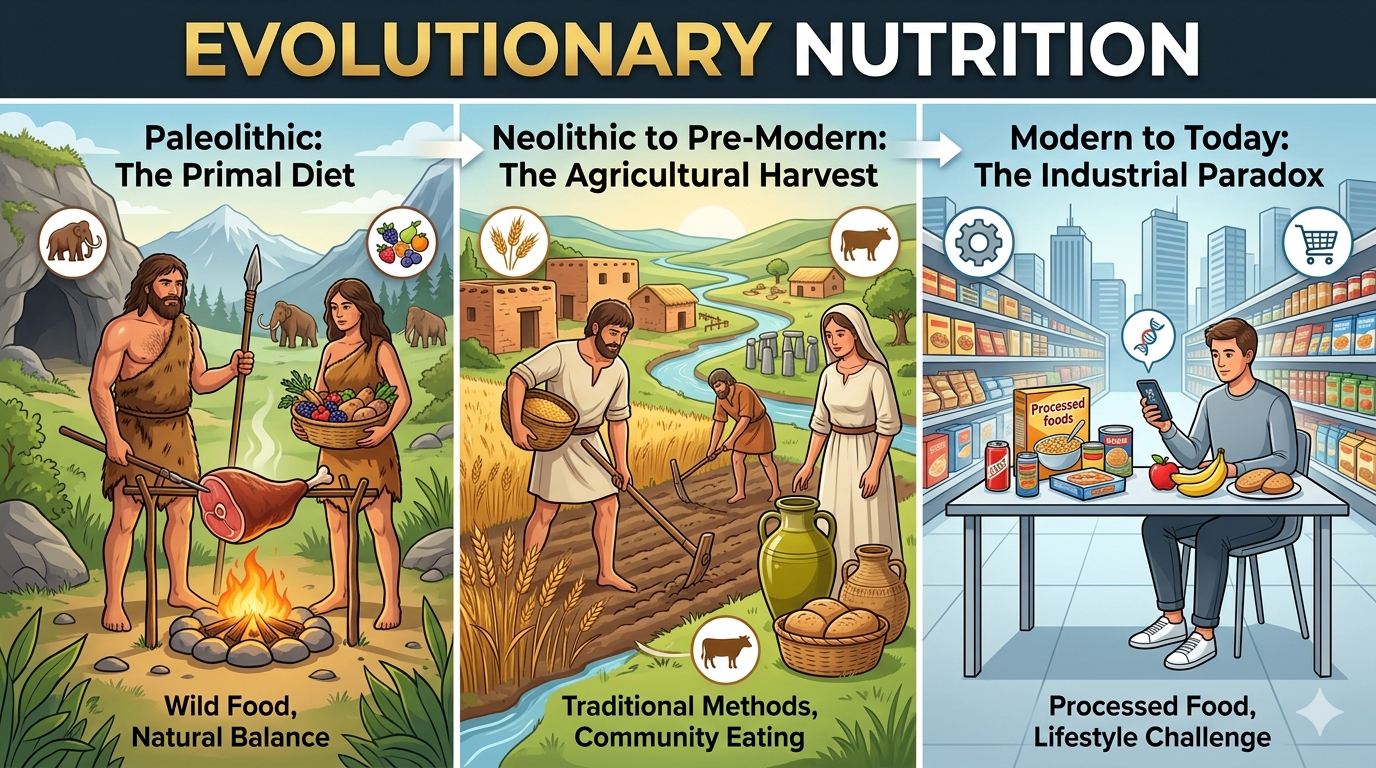
Food is not only a modern health topic. It is part of the human story.
Long before supermarkets, restaurants, nutrition labels, diet apps, protein powders, and calorie calculators, human beings had to find food in the natural world. They searched for fruits, roots, leaves, nuts, insects, shellfish, fish, eggs, meat, honey, grains, tubers, and many other foods. They learned what was safe, what was poisonous, what needed cooking, what could be stored, and what helped them survive.
Over time, humans changed food, and food changed humans.
We learned to cook. We learned to use fire. We developed tools. We hunted cooperatively. We gathered plants. We preserved food through drying, salting, smoking, and fermentation. We domesticated plants and animals. We built farming societies. We created food cultures. Eventually, we built a modern food system that can deliver packaged snacks, sweet drinks, refined grains, processed meats, and convenience meals almost anywhere, at any time.
Evolutionary nutrition is the study of this long relationship between human biology and food history.
It asks a simple but powerful question: how did the diets of the past shape the bodies we have today, and what happens when modern foods change faster than our biology can adapt?
This does not mean we should copy the past exactly. The past was not perfect. People faced hunger, disease, parasites, famine, unsafe water, and limited medical care. But food history can help us understand why certain modern eating patterns may create problems and why traditional food wisdom still matters.
What Is Evolutionary Nutrition?
Evolutionary nutrition is an approach to food that looks at human eating through the lens of evolution, adaptation, environment, and culture.
Instead of asking only, “Is this food healthy?” it asks deeper questions:
How long have humans been eating this food?
Was this food common across many cultures or only recently introduced?
How was it traditionally prepared?
Did humans develop biological adaptations to it?
Does everyone tolerate it the same way?
How does the modern version differ from the traditional version?
What lifestyle usually surrounded this food in the past?
How does modern life change its effect on the body?
This approach helps us avoid overly simple diet claims.
For example, evolutionary nutrition does not say “grains are always bad” or “grains are always healthy.” It asks whether the grains are whole, refined, fermented, soaked, stone-ground, sweetened, ultra-processed, or eaten with a balanced meal. It also asks whether the person eating them tolerates them well and whether their lifestyle supports that amount of starch.
The same applies to meat, fruit, dairy, fish, beans, alcohol, fermented foods, and fats.
Evolutionary nutrition is not a rigid diet. It is a framework for understanding food in context.
Humans Are Adaptive Eaters
One of the most important ideas in evolutionary nutrition is that humans are adaptive eaters.
We are not like animals that can only survive on one narrow food source. Human beings have lived in deserts, forests, coastlines, mountains, islands, grasslands, river valleys, tropical climates, and cold northern regions. Each environment offered different foods, and humans learned to survive in many of them.
Some communities relied heavily on fish and seafood. Others used tubers, fruits, insects, and wild plants. Some ate more meat and animal fat. Some built diets around rice, wheat, maize, millet, potatoes, beans, dairy, or fermented foods.
This diversity shows that there was never one perfect ancestral diet.
Human survival came from flexibility. We learned to transform food through tools, fire, social cooperation, storage, and cooking. This flexibility is one of our greatest strengths.
However, flexibility does not mean we can thrive equally well on every modern food invention. There is a difference between adapting to a traditional diet over many generations and being suddenly surrounded by refined sugar, refined flour, industrial oils, sweetened drinks, and ultra-processed snacks.
Evolutionary nutrition helps us understand that difference.
The Role of Fire and Cooking
Cooking may be one of the most important events in human food history.
Raw food can be difficult to chew, digest, and extract energy from. Cooking softens plants, makes starches more available, kills many harmful microbes, improves the safety of meat and fish, and changes flavor. It also allowed humans to get more energy from certain foods with less chewing and digestive effort.
Cooking did more than change food. It may have changed human life.
Cooked food could support larger brains, more complex social behavior, and more time for activities beyond constant chewing and digestion. Meals around fire likely supported social bonding, storytelling, teaching, and cooperation.
Modern people often think of cooking as optional, but from an evolutionary view, cooking is part of what made human diets human.
This matters today because many people no longer cook regularly. Instead, they rely on ready-to-eat foods designed by industry. These foods are technically “processed,” but not in the same way that traditional cooking processes food. Traditional cooking transforms ingredients into meals. Ultra-processing often transforms ingredients into products.
The difference is important.
The Evolution of Taste
Our taste preferences did not appear by accident.
Sweetness often signaled energy-rich foods such as ripe fruit or honey. Saltiness helped guide humans toward sodium and minerals. Umami signaled protein-rich foods. Bitterness could warn of plant toxins. Sourness could signal fermentation, ripeness, or spoilage depending on context. Fat provided dense energy.
These taste preferences helped humans survive in environments where food was limited and effort was required.
But modern food companies can use these ancient taste systems in ways that overwhelm natural appetite regulation. A snack can combine refined starch, sugar, fat, salt, flavor enhancers, and soft texture in a form that is much easier to overeat than traditional foods.
In nature, sweetness came with fiber, water, seasonality, and chewing. In modern food, sweetness can come as soda, candy, syrup, sweetened cereal, or flavored drinks. In traditional diets, fat often came as part of whole foods such as fish, nuts, dairy, eggs, meat, or olives. In modern diets, refined fats can be added to snacks, fried foods, pastries, and sauces.
Evolutionary nutrition helps explain why modern ultra-palatable foods are so powerful: they speak directly to ancient survival systems.
From Wild Foods to Domesticated Foods
As humans developed agriculture, food changed again.
Wild plants were often smaller, more fibrous, more bitter, less sweet, and more seasonal than many modern crops. Through selection and farming, humans encouraged plants that were larger, sweeter, easier to harvest, less bitter, and more productive.
This created great benefits. Agriculture allowed food storage, population growth, permanent settlements, and complex cultures. But it also changed the nutritional landscape.
Domesticated grains, fruits, vegetables, and animals became central to human diets. People learned to make bread, porridge, noodles, rice dishes, fermented batters, beer, yogurt, cheese, pickles, sauces, and many traditional foods.
The key point is that domestication is not automatically bad. It is part of human food history. But domesticated foods are different from wild foods, and modern industrial foods are different again.
A wild fruit is not the same as a very sweet modern fruit juice. A traditional fermented grain food is not the same as a packaged pastry. A fresh animal food is not the same as heavily processed meat. A cooked tuber is not the same as a fried snack.
Evolutionary nutrition teaches us to notice these differences.
Why Food Preparation Matters in Human Evolution
Humans did not only adapt to foods. We also adapted foods to us.
Many traditional preparation methods helped make food safer, more digestible, or more useful. These methods include:
Cooking roots and tubers
Soaking grains and legumes
Fermenting doughs and vegetables
Sprouting seeds
Drying meat and fish
Smoking foods
Salting and curing
Grinding grains
Making yogurt, cheese, and kefir
Using herbs and spices
Combining foods in balanced meals
These methods often solved real problems.
Some plants contain natural defense compounds. Some beans are hard to digest. Some grains contain compounds that can interfere with nutrient absorption. Some foods spoil quickly. Some roots contain toxins unless prepared properly. Milk can be difficult to digest unless fermented. Fish can spoil rapidly without preservation.
Traditional cultures learned practical solutions.
Modern nutrition often focuses on what foods contain. Evolutionary nutrition also asks what humans did to those foods before eating them.
This is important because the same ingredient can behave differently depending on preparation. A soaked and slow-cooked bean may affect digestion differently from an undercooked bean. A fermented sourdough bread is different from a sweet packaged bread. Yogurt is different from sweetened dairy dessert. Whole fruit is different from juice.
Preparation is part of nutrition.
Evolutionary Mismatch and Modern Diets
A central idea in evolutionary nutrition is evolutionary mismatch.
This means that the environment we live in today may be very different from the environment our bodies were shaped to handle.
For most of human history, food required effort. People walked, gathered, hunted, farmed, cooked, carried, dug, preserved, and shared food. Highly concentrated sweetness was rare. Food was seasonal. Physical movement was normal. Meals were connected to work and community.
Today, many people live in a food environment of constant access, low movement, high stress, poor sleep, and ultra-processed options.
This does not mean modern life is bad in every way. Modern food safety, refrigeration, medicine, sanitation, and transportation have improved life greatly. But the modern food environment can also push the body in directions it was not designed for.
Examples of mismatch include:
Sweet drinks replacing water
Refined flour replacing traditional grains
Packaged snacks replacing meals
Constant eating replacing natural meal rhythms
Sedentary routines replacing daily movement
Ultra-processed foods replacing cooking
Artificial light and poor sleep affecting appetite
Large portions replacing seasonal scarcity
Stress eating replacing social meals
Evolutionary nutrition does not blame one nutrient for every problem. It looks at the whole environment.
Why There Is No Single Evolutionary Diet
Some people hear “evolutionary nutrition” and assume it means everyone should follow the same prehistoric diet. That is a mistake.
Human diets were diverse across geography and time. Even hunter-gatherer diets varied widely. Some were rich in animal foods. Some included many plants. Some relied heavily on fish. Some used tubers. Some ate insects. Some gathered honey. Some depended on seasonal fruits, nuts, or roots.
Later, farming created even more diversity. Traditional agricultural diets could be based on rice, wheat, maize, millet, potatoes, yams, beans, lentils, dairy, seafood, or many other foods.
This means evolutionary nutrition should not become a rigid ideology.
It should help us understand patterns:
Humans generally ate whole foods.
Food required effort.
Cooking was central.
Traditional preparation mattered.
Diets varied by environment.
Seasonality shaped eating.
Food culture helped organize meals.
Movement was built into life.
Ultra-processed foods were absent.
Personal and population-level adaptations mattered.
These patterns are more useful than trying to recreate one imagined ancient menu.
Dairy, Alcohol, and Genetic Adaptation
Evolutionary nutrition also helps explain why people respond differently to certain foods.
Dairy is one example. In some populations, adults developed the ability to digest lactose, the sugar in milk. This made dairy a valuable food source in those groups. In other populations, lactose digestion often decreases after childhood, and milk may cause digestive discomfort.
Alcohol is another example. Some people have genetic variations that affect how alcohol is metabolized. This can lead to flushing, nausea, rapid heartbeat, or discomfort after drinking. For these people, alcohol may carry different risks.
Starch digestion may also vary. Some people produce more salivary amylase, an enzyme that begins starch digestion in the mouth. This may influence how people respond to starch-rich diets, although lifestyle and food quality still matter.
These examples show why one-size-fits-all nutrition advice often fails.
Human evolution did not produce identical bodies. It produced variation.
The Evolution of Plant Foods in Human Diets
Plant foods have played many roles in human history.
Fruits, roots, tubers, grains, legumes, leaves, nuts, seeds, herbs, and spices have provided energy, fiber, vitamins, minerals, flavors, and medicinal compounds. But plant foods are also chemically complex.
Plants cannot run away, so many produce defense compounds to protect themselves from insects, fungi, animals, and environmental stress. Some of these compounds may be beneficial in small amounts. Others can irritate digestion, interfere with nutrient absorption, or become harmful if the food is not prepared properly.
Traditional cultures learned how to manage plant foods through cooking, soaking, fermentation, peeling, grinding, sprouting, and combining them with other ingredients.
This is why evolutionary nutrition avoids extreme claims. It does not say all plants are automatically perfect. It also does not say plant foods are dangerous. It says plants are complex, and preparation matters.
A traditional bowl of cooked beans, herbs, and fermented vegetables is very different from a raw, poorly prepared, or ultra-processed plant-based product.
Context is everything.
The Evolution of Animal Foods in Human Diets
Animal foods have also been important across human history.
Meat, fish, shellfish, eggs, insects, dairy, and animal fats can provide dense nutrition, including protein, vitamin B12, iron, zinc, omega-3 fats, iodine, calcium, and other nutrients. In some environments, animal foods were essential because plant foods were limited seasonally or geographically.
However, evolutionary nutrition does not simply say “eat more animal foods.” It asks what kind, how often, how prepared, and in what lifestyle.
There is a major difference between fresh fish in a coastal traditional diet and deep-fried fast food. There is a difference between occasional wild meat and daily processed meat. There is a difference between fermented dairy and sweetened dairy dessert.
Animal foods can be valuable, but the modern form matters.
The same is true for plant foods. Evolutionary nutrition is not about choosing sides. It is about understanding food through context.
Modern Processed Foods Are Evolutionarily New
Many foods that dominate modern diets are extremely new in human history.
Refined sugar, industrial seed oils, sweetened drinks, packaged snacks, refined breakfast cereals, ultra-soft breads, processed meats, candy, fast food, and many convenience meals are recent inventions compared with the long timeline of human eating.
The issue is not that every new food is automatically harmful. Some modern foods and technologies are helpful. Freezing vegetables, improving hygiene, pasteurizing unsafe foods, and reducing contamination can be beneficial.
The concern is that ultra-processed foods often combine ingredients in ways that bypass normal satiety signals. They are easy to chew, quick to digest, intensely flavored, calorie-dense, and available constantly.
This is very different from the food environment that shaped human appetite.
Evolutionary nutrition helps explain why “just eat less” is often not enough. Modern foods are designed to be easy to overeat.
What Evolutionary Nutrition Can Teach Modern Eaters
Evolutionary nutrition offers practical lessons without requiring extreme diets.
1. Eat mostly real foods
Choose foods that are closer to their whole or traditional form: eggs, fish, beans, roots, vegetables, fruit, yogurt, nuts, seeds, whole grains if tolerated, herbs, and simple cooked meals.
2. Respect traditional preparation
Soaking, fermenting, cooking, sprouting, and slow preparation can change food. These methods are part of human food wisdom.
3. Reduce ultra-processed foods
The most evolutionarily unfamiliar foods are often packaged products made from refined flour, sugar, oils, starches, and flavorings.
4. Pay attention to personal tolerance
Not everyone tolerates dairy, wheat, beans, alcohol, spicy foods, or fermented foods the same way. Observe your own body.
5. Move more
Food and movement evolved together. A healthy eating pattern works better when paired with daily physical activity.
6. Eat with culture and rhythm
Meals are more than fuel. Cooking, sharing food, eating slowly, and respecting food traditions can improve the way we relate to food.
7. Avoid diet extremism
Human diets have always been diverse. A healthy diet should be flexible, realistic, and sustainable.
Evolutionary Nutrition and Modern Wellness
Modern wellness often focuses on quick fixes: a supplement, a cleanse, a superfood, a strict diet, or a 30-day challenge. Evolutionary nutrition offers a deeper view.
It asks us to look at the whole pattern of life.
What foods dominate your diet?
How much of your food is ultra-processed?
Do you cook?
Do you eat enough protein and fiber?
Do you tolerate your staple foods well?
Do you move daily?
Do you sleep well?
Do you eat while stressed or distracted?
Do your meals connect you to culture, family, or place?
These questions are more useful than chasing one perfect rule.
Evolutionary nutrition matters because it helps us see modern health problems as part of a larger mismatch between ancient biology and modern environments. Food is only one part of that mismatch, but it is an important part.
Common Myths About Evolutionary Nutrition
Myth 1: Evolutionary nutrition means eating like a caveman
Evolutionary nutrition is not about copying one imagined prehistoric diet. It is about understanding how human diets evolved across environments and cultures.
Myth 2: All modern foods are bad
Not all modern food technology is harmful. Refrigeration, freezing, sanitation, and food safety can be beneficial. The main concern is ultra-processed food that displaces real meals.
Myth 3: All traditional foods are healthy
Traditional foods can offer wisdom, but the past was not perfect. Some traditional practices were shaped by scarcity or survival. Traditional knowledge should be combined with modern science.
Myth 4: Evolutionary nutrition is the same as low-carb
Some ancestral diets were lower in carbohydrates, but others included tubers, fruits, grains, legumes, and starches. Human diets varied widely.
Myth 5: Everyone should eat the same way
Different people have different genetics, digestion, cultures, and lifestyles. Evolutionary nutrition supports personalization.
How to Build an Evolutionary-Inspired Diet
A modern evolutionary-inspired diet does not need to be complicated.
Start by building meals from recognizable ingredients. Include a protein source, whole-food carbohydrates if tolerated, vegetables or fruits, natural fats, herbs or spices, and fermented foods if they work for you.
For example:
Eggs with vegetables and potatoes
Fish with rice, herbs, and fermented vegetables
Lentil soup with olive oil and greens
Plain yogurt with nuts and fruit
Beans with vegetables and traditional spices
Chicken soup with roots and herbs
Sourdough bread with eggs or cheese if tolerated
Oats with seeds and berries
Grilled meat with vegetables and cooked tubers
The exact foods can vary by culture and preference. The goal is not to follow a strict ancestral menu. The goal is to move away from ultra-processed eating and toward food patterns that make sense for the human body.
Conclusion
Evolutionary nutrition helps us understand food through the long story of human history.
It shows that humans are adaptive eaters, but not limitless machines. We can thrive on many different traditional diets, but we may struggle when surrounded by foods that are refined, concentrated, sweetened, softened, and engineered for overconsumption.
It reminds us that cooking matters. Preparation matters. Culture matters. Environment matters. Personal tolerance matters. Lifestyle matters.
The goal is not to return to the past. The goal is to learn from the past so we can make better choices in the present.
A wise modern diet does not need to be extreme. It can include traditional foods, whole ingredients, careful preparation, cultural meals, and modern scientific understanding.
Evolutionary nutrition gives us a better question than “What is the perfect diet?”
It asks:
What foods fit the human story?
What foods fit my body?
What foods fit my culture and lifestyle?
What modern foods should I treat with caution?
What traditional wisdom is worth preserving?
By asking these questions, we can build a healthier, more thoughtful, and more sustainable relationship with food.
Disclaimer: This article is for educational purposes only and is not medical advice. If you have a medical condition, food allergy, digestive disorder, pregnancy-related concern, or specific dietary need, consult a qualified healthcare professional before making major changes to your diet.