
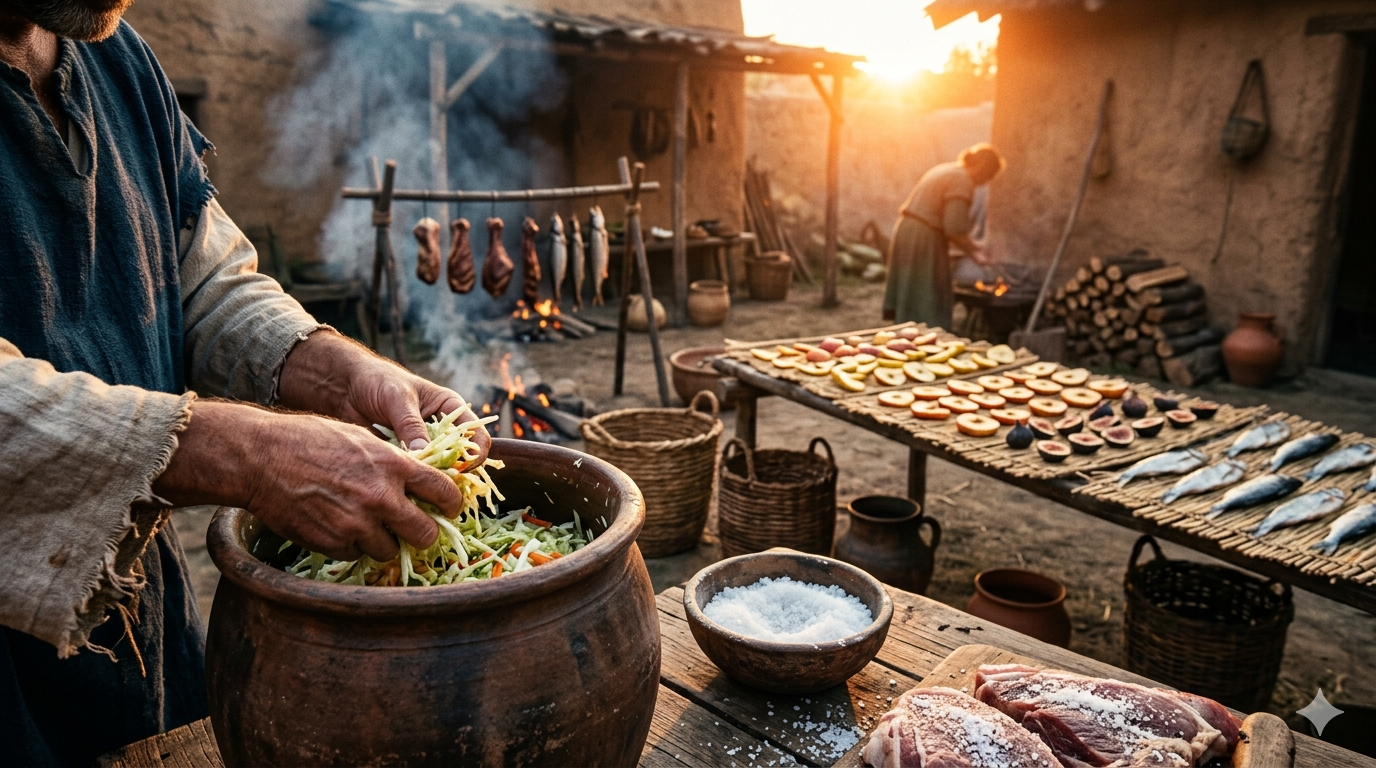
Before refrigerators, freezers, canned goods, plastic packaging, chemical preservatives, and global food shipping, food had a short life.
Fish spoiled quickly. Meat could become unsafe. Milk turned sour. Vegetables rotted. Fruits bruised and fermented. Grains could mold. Seasonal abundance could disappear in days. A successful harvest, a good fishing trip, or a slaughtered animal could either feed a community for months or be lost to spoilage if people did not know how to preserve it.
Ancient cultures had to solve one of the most important human problems: how do we make food last?
Their answers were simple, powerful, and surprisingly intelligent.
They used salt.
They used smoke.
They used sunlight.
They used fermentation.
These methods appear in food traditions across the world because they solved practical problems. They helped preserve food, reduce waste, improve flavor, make meals more satisfying, and allow people to survive difficult seasons.
Today, these methods are often discussed as culinary techniques. But historically, they were much more than that. They were survival technologies. They shaped diets, trade, culture, identity, and health.
To understand traditional diets, we need to understand why these methods mattered.
Food Preservation Was a Matter of Survival
Modern people often think of food preservation as a matter of taste or convenience. In the past, it was often a matter of life and death.
A community might have plenty of food during one season and very little during another. Fish might be abundant during certain months. Fruits might ripen all at once. Vegetables might be harvested before winter. Animals might be slaughtered at specific times. Milk production might rise and fall with seasons.
Without preservation, abundance could not be saved.
Preservation allowed people to turn a temporary food supply into a future food supply. It helped communities survive winter, drought, travel, migration, war, storms, failed harvests, and long periods when fresh foods were scarce.
Salt, smoke, sunlight, and fermentation were especially valuable because they used forces available in the natural world. People did not need factories. They needed observation, patience, skill, and experience.
This is the hidden intelligence of traditional food cultures: they learned how to work with nature’s conditions instead of depending entirely on modern technology.
Why Salt Was So Important
Salt is one of the most important substances in food history.
It enhances flavor, but its value goes far beyond taste. Salt helps preserve food because it draws out moisture and creates conditions that many spoilage organisms do not like. By reducing available water in food, salt can slow microbial growth and extend shelf life.
This made salt essential for preserving fish, meat, vegetables, cheese, olives, sauces, and many fermented foods.
Salted fish, cured meat, pickled vegetables, aged cheese, fermented sauces, and brined foods all show how salt helped humans store food before refrigeration.
Salt was so valuable in many societies that it became a trade good, a form of wealth, and even a political resource. Communities with access to salt could preserve more food and trade preserved foods over longer distances.
But salt was not used randomly. Traditional cultures learned how much salt was needed for different foods and climates. Too little salt could allow spoilage. Too much salt could make food difficult to eat. Skilled food preparation required balance.
In traditional diets, salt was often used with purpose: to preserve, ferment, season, and transform real foods.
In modern diets, salt often appears differently. Much of the sodium people consume today comes from packaged snacks, fast foods, processed meats, instant meals, and refined products. This is not the same as small amounts of salt used to preserve vegetables, season soup, or make traditional fermented foods.
Salt itself is not the whole story. The food pattern matters.
Salt as a Flavor Tool
Salt also helped make simple foods satisfying.
Many traditional diets were built around staples such as rice, grains, roots, beans, tubers, or vegetables. These foods can be nourishing, but they may be plain on their own. Salted and fermented condiments added depth and intensity.
A small amount of salted fish, cheese, miso, fermented sauce, pickled vegetable, or cured food could flavor a much larger meal. This allowed communities to stretch valuable ingredients while making everyday staples more enjoyable.
Salt helped create balance.
It brought out sweetness in vegetables, reduced bitterness, strengthened savory flavors, and made preserved foods more appealing. In many traditional cuisines, salty foods were not eaten alone in large quantities. They were used as part of a meal.
This is a useful lesson for modern eating. Strong flavors do not need to come from artificial snacks. Traditional foods used small amounts of intense preserved ingredients to make real meals satisfying.
Why Smoke Was Used to Preserve Food
Smoke is another ancient preservation tool.
Smoking exposes food to smoke from burning wood or plant material. This can dry the surface of food, add antimicrobial compounds, discourage insects, and create distinctive flavors. Smoking was often used for meat, fish, sausages, cheese, and sometimes other foods.
In many climates, smoking was especially useful when sunlight drying was difficult. Humid or cold regions could make simple drying less reliable. Smoke helped preserve food while also adding flavor.
Smoking also made food portable. Smoked fish or meat could be carried during travel, stored for later, or traded.
The taste of smoked food became deeply tied to culture. In some places, smoked fish is a staple. In others, smoked meat marks holidays, winter storage, or rural cooking traditions. The smell of smoke can carry memories of home, fire, land, and community.
However, smoking also requires balance. Some modern smoked or processed meats may be high in salt, additives, or compounds that are not ideal in large amounts. Traditional smoked foods were often eaten differently: in smaller portions, as preserved foods, alongside staples, or during specific seasons.
The lesson is not that smoked food is automatically good or bad. The lesson is that smoke was a tool, and like all tools, context matters.
Smoke as a Cultural Signature
Smoke does more than preserve food. It creates identity.
Different woods create different flavors. Different regions developed different smoking methods. The length of smoking, temperature, humidity, salt level, and type of food all change the final result.
This is why smoked foods can taste so different from one culture to another. A smoked fish from a northern coastal village is not the same as smoked meat from a mountain community or smoked cheese from a pastoral region.
Smoke turned preservation into art.
It also linked food to place. The flavor of a smoked food could reflect local trees, weather, fuel, storage needs, and cooking traditions.
Modern food often uses artificial smoke flavor to imitate this depth. But traditional smoking was more than a flavor additive. It was a whole process involving fire, air, time, wood, skill, and patience.
Why Sunlight Was Used
Sunlight was one of the oldest and simplest preservation tools.
The sun provides heat and dryness. When foods are dried properly, moisture is reduced. Less moisture means many spoilage organisms cannot grow easily. This allowed people to preserve fruits, vegetables, herbs, mushrooms, grains, fish, meat, and roots.
Sun-drying was especially important in dry, sunny climates. It required no expensive equipment. People could use mats, rocks, rooftops, hanging racks, or open spaces. Food could be dried during harvest season and stored for later.
Dried foods had many advantages.
They were lighter.
They lasted longer.
They were easier to transport.
They concentrated flavor.
They reduced waste.
They allowed seasonal foods to be eaten later.
Sun-dried tomatoes, dried fish, dried fruit, dried herbs, jerky, dried mushrooms, and dried roots all reflect this principle.
Sunlight turned time and climate into preservation.
Sun-Drying and Nutrient Density
Drying removes water, which concentrates the remaining nutrients and flavors. This is why dried foods can taste intense.
Dried fruit is sweeter by weight than fresh fruit because water is removed. Dried herbs are more concentrated than fresh herbs. Dried fish can become a strong source of flavor and protein in a small amount.
This concentration is useful, but it also requires awareness.
Dried foods can be easy to overeat, especially dried fruit. A small handful of dried fruit may represent several pieces of fresh fruit. Traditional cultures often used dried foods strategically: in soups, stews, porridges, travel food, winter storage, or as flavoring ingredients.
Modern dried foods can also be very different from traditional versions. Some are sweetened, fried, flavored, preserved with additives, or turned into snack products.
Again, the method and context matter.
A simple sun-dried food is different from a heavily processed dried snack.
Why Fermentation Became Essential
Fermentation may be the most complex of the ancient preservation methods because it uses microbes to transform food.
Bacteria, yeasts, and molds can change sugars, starches, proteins, and other compounds in food. They may produce acids, alcohol, gases, enzymes, and flavor compounds. These changes can help preserve food, improve flavor, alter texture, and sometimes make foods easier to digest.
Fermentation created some of the world’s most important traditional foods:
Yogurt
Kefir
Cheese
Sauerkraut
Kimchi
Miso
Tempeh
Natto
Soy sauce
Fish sauce
Shrimp paste
Sourdough bread
Vinegar
Fermented grains
Fermented drinks
Pickled vegetables
Fermentation was especially valuable because it could preserve foods without heat. It could turn milk into longer-lasting dairy, vegetables into winter food, grains into flavorful bread, soybeans into savory pastes, and fish into powerful condiments.
It also created flavors that cannot be easily produced by ordinary cooking alone.
Fermentation is a reminder that humans did not only fight microbes. We also learned to cooperate with them.
Fermentation as Microbial Cooking
One useful way to understand fermentation is to think of it as microbial cooking.
In ordinary cooking, heat transforms food. In fermentation, microbes transform food over time.
They break down some compounds. They create new acids and aromas. They change texture. They make food sour, savory, fizzy, creamy, pungent, or complex.
Traditional cultures may not have known the scientific names of these microbes, but they understood the practical results. They knew which smells were desirable, which textures were safe, which vessels worked, how much salt to use, and how long to wait.
Fermentation required observation. A good ferment was not just left alone carelessly. It was watched, smelled, tasted, stored, and passed down through practice.
This is why fermentation belongs to food wisdom, not just food science.
Salt, Smoke, Sunlight, and Fermentation Often Worked Together
These preservation methods were not always used separately. Many traditional foods combined them.
Fish might be salted and sun-dried.
Meat might be salted and smoked.
Vegetables might be salted and fermented.
Cheese might be salted and aged.
Fish sauce might involve salt and fermentation.
Sausages might involve salt, fermentation, and drying.
Grains might be fermented and then baked.
Herbs might be sun-dried and later used in preserved dishes.
The combination of methods made preservation more reliable.
Salt could control microbial growth. Sunlight could remove moisture. Smoke could add protection and flavor. Fermentation could create acidity and complexity. Together, these methods allowed people to store foods safely for longer periods when done properly.
This layered approach shows how sophisticated traditional food preparation could be.
Ancient people were not guessing randomly. They were building systems.
Preservation Created Trade
Preserved foods changed human economies.
Fresh fish can spoil quickly, but dried or salted fish can travel. Milk spoils quickly, but cheese can be traded. Fresh vegetables wilt, but fermented vegetables can last. Fruits rot, but dried fruits can be stored and carried. Meat decays, but cured or smoked meat can be transported.
Preservation allowed food to move across distance.
This helped create trade routes, markets, cultural exchange, and regional specialties. Salted fish, dried fruit, spices, cheese, fermented sauces, cured meats, tea, coffee, wine, vinegar, and many other preserved foods became part of economic life.
Food preservation did not only help households survive. It helped civilizations connect.
When a food could last, it could travel. When it traveled, it carried culture with it.
Preservation Reduced Waste
Food waste is a modern problem, but ancient cultures were often forced to be careful because food was harder to obtain.
If a community caught many fish, they preserved them. If vegetables were harvested in abundance, they pickled or fermented them. If fruit ripened all at once, they dried it, fermented it, or turned it into vinegar or preserves. If milk was available, they cultured it. If an animal was slaughtered, many parts were used, preserved, or cooked.
Preservation was a form of respect.
It recognized that food required labor, land, water, animals, plants, time, and risk. Wasting food could mean hunger later.
Modern convenience can make food feel disposable. Traditional preservation teaches a different attitude: abundance should be managed, not wasted.
This lesson is still useful today. Preserving food at home, freezing leftovers, making soups from scraps, drying herbs, fermenting vegetables, or cooking with seasonal abundance can help reduce waste and reconnect us with food value.
Preservation Changed Flavor Expectations
Many of the flavors people love today come from preservation.
Sourness from fermentation.
Saltiness from curing.
Smokiness from fire.
Sweet intensity from dried fruit.
Umami from aged cheese, miso, soy sauce, fish sauce, and fermented foods.
Sharpness from vinegar.
Depth from slow aging.
These flavors were not created by modern flavor labs. They emerged from survival.
This is one of the most interesting facts about food culture: preservation created pleasure.
People first needed to keep food from spoiling. Over time, they learned to love the flavors created by preservation. What began as necessity became cuisine.
Modern processed foods often imitate these flavors with additives, artificial smoke, acidity regulators, flavor enhancers, and salt. But traditional preserved foods often contain more complexity because they develop through time and transformation.
Understanding this helps us appreciate why traditional foods can be so satisfying even in small amounts.
Preservation and Food Safety
Preservation can improve food safety, but only when done properly.
Salt, smoke, drying, and fermentation can reduce the risk of spoilage, but they do not make food automatically safe in every situation. Poor technique, contamination, incorrect storage, wrong temperature, too little salt, too much moisture, or unsafe ingredients can create danger.
Traditional cultures developed rules because preservation required skill.
Modern home cooks should respect this. If you want to ferment, smoke, dry, cure, or preserve foods at home, use reliable instructions. Understand the method. Use clean equipment. Pay attention to temperature, moisture, salt levels, acidity, and storage. Be especially careful with meat, fish, dairy, and low-acid foods.
Traditional preservation is powerful, but it is not careless.
A good modern approach combines traditional wisdom with modern food safety knowledge.
The Difference Between Traditional Preservation and Ultra-Processing
Traditional preservation and modern ultra-processing are not the same.
Traditional preservation usually starts with whole foods and uses natural forces: salt, air, microbes, sunlight, fire, time, and temperature. The goal is to make food last, improve flavor, and support survival.
Ultra-processing often breaks foods into industrial ingredients and rebuilds them into products. These products may be designed for long shelf life, low cost, intense flavor, and repeat consumption.
A sun-dried tomato is not the same as a flavored chip.
A fermented vegetable is not the same as a packaged sour snack.
A smoked fish is not the same as a heavily processed meat product.
A traditional sourdough is not the same as sweet packaged bread.
Aged cheese is not the same as a processed cheese-flavored product.
The difference is not only ingredients. It is purpose, method, structure, and relationship to meals.
Traditional preservation often deepens food. Ultra-processing often detaches food from its original form.
What Modern Eaters Can Learn from Ancient Preservation
You do not need to live without refrigeration to benefit from traditional preservation wisdom.
You can apply these lessons in simple ways.
Use fermented vegetables as small side dishes.
Choose plain yogurt or kefir if tolerated.
Try sourdough bread instead of sweet refined bread.
Use vinegar, herbs, and spices to make simple meals more flavorful.
Choose dried herbs instead of artificial flavor packets.
Use sun-dried or dried foods thoughtfully, not as unlimited snacks.
Eat smoked or cured foods occasionally and in context, not as daily processed staples.
Learn how to store food properly.
Cook soups and stews from leftovers.
Respect seasonal abundance.
Reduce food waste.
Use traditional condiments to make whole foods more enjoyable.
The point is not to make every food yourself. The point is to understand the wisdom behind these methods so you can choose better foods and build better meals.
How to Evaluate a Preserved Food
When looking at a preserved food, ask these questions:
1. What was the original food?
Was it a whole vegetable, fish, milk, grain, fruit, bean, or meat? Or is it mostly refined ingredients?
2. What method preserved it?
Was it fermented, dried, salted, smoked, cured, pickled, aged, frozen, canned, or chemically preserved?
3. Was the method traditional or industrial?
Traditional does not always mean healthy, but it often gives clues about how the food was meant to be eaten.
4. Is it eaten as a meal, side dish, or snack product?
Fermented vegetables with rice and fish are different from salty packaged snacks eaten mindlessly.
5. How much salt, sugar, or additives does it contain?
Some preserved foods can be very salty or sweet. Portion and frequency matter.
6. Does your body tolerate it?
Some people are sensitive to fermented foods, histamine-rich foods, smoked foods, high-salt foods, or certain preservatives.
This simple framework helps you separate useful traditional foods from modern products that only borrow traditional flavors.
Common Myths About Salt, Smoke, Sunlight, and Fermentation
Myth 1: Ancient preservation methods were primitive
These methods were simple, but not primitive. They required careful observation, skill, and knowledge passed down through generations.
Myth 2: Natural preservation is always safe
Natural does not automatically mean safe. Fermentation, drying, curing, and smoking require proper technique.
Myth 3: Salt is always bad
Excess sodium can be a concern, especially in modern processed diets. But traditional salt use was often tied to preservation and meal balance. Context matters.
Myth 4: Smoked foods are always traditional and healthy
Some smoked foods are traditional, but modern smoked and processed meats may contain high salt, additives, or compounds that should be limited.
Myth 5: Dried fruit is the same as fresh fruit
Dried fruit is concentrated. It can be useful, but it is easier to overeat than whole fresh fruit.
Myth 6: Fermented foods are magic
Fermented foods can be valuable, but they are not cures. They should be eaten as part of a balanced diet and tolerated individually.
A Balanced Modern Approach
A balanced approach to ancient preservation methods does not require extremes.
You do not need to avoid all salt. You do not need to eat smoked foods every day. You do not need to ferment everything at home. You do not need to replace fresh food with dried food.
Instead, use these methods wisely.
Salt can season real meals and support traditional fermented foods.
Smoke can add flavor occasionally.
Sun-dried foods can provide concentrated flavor and storage value.
Fermented foods can add acidity, complexity, and microbial tradition.
Preserved foods can reduce waste and make simple meals more satisfying.
The key is to keep preserved foods connected to meals rather than letting them become constant processed snacks.
Ancient preservation methods work best when they support whole-food eating.
Conclusion
Ancient cultures used salt, smoke, sunlight, and fermentation because food was precious and spoilage was dangerous.
These methods helped people preserve seasonal abundance, survive harsh conditions, reduce waste, travel, trade, and build cuisines that carried flavor and identity across generations.
Salt drew out moisture and controlled preservation.
Smoke protected food while adding deep flavor.
Sunlight dried foods and made them portable.
Fermentation used microbes to transform ingredients into something longer-lasting, more complex, and often easier to enjoy.
These methods were not random traditions. They were intelligent responses to the realities of climate, hunger, storage, and survival.
Today, we no longer depend on them in the same way, but we can still learn from them. They teach us that food is not only about nutrients. Food is also about time, place, preservation, culture, skill, and respect.
Modern eating often gives us convenience without connection. Ancient preservation methods remind us that the best food traditions were built through patience, observation, and care.
We do not need to copy the past exactly. But we can recover its wisdom.
Use salt with purpose.
Enjoy smoke with context.
Respect the power of sunlight and drying.
Appreciate fermentation as a partnership with microbes.
Choose preserved foods that support real meals, not mindless snacking.
When we understand why ancient cultures preserved food this way, we gain more than cooking knowledge. We gain a deeper respect for the long human effort to turn fragile ingredients into lasting nourishment.
Disclaimer: This article is for educational purposes only and is not medical advice. Preserved, salted, smoked, dried, or fermented foods may not be suitable for everyone. If you have high blood pressure, kidney disease, digestive disorders, immune system concerns, histamine intolerance, pregnancy-related concerns, food allergies, or specific dietary needs, consult a qualified healthcare professional before making major dietary changes.