
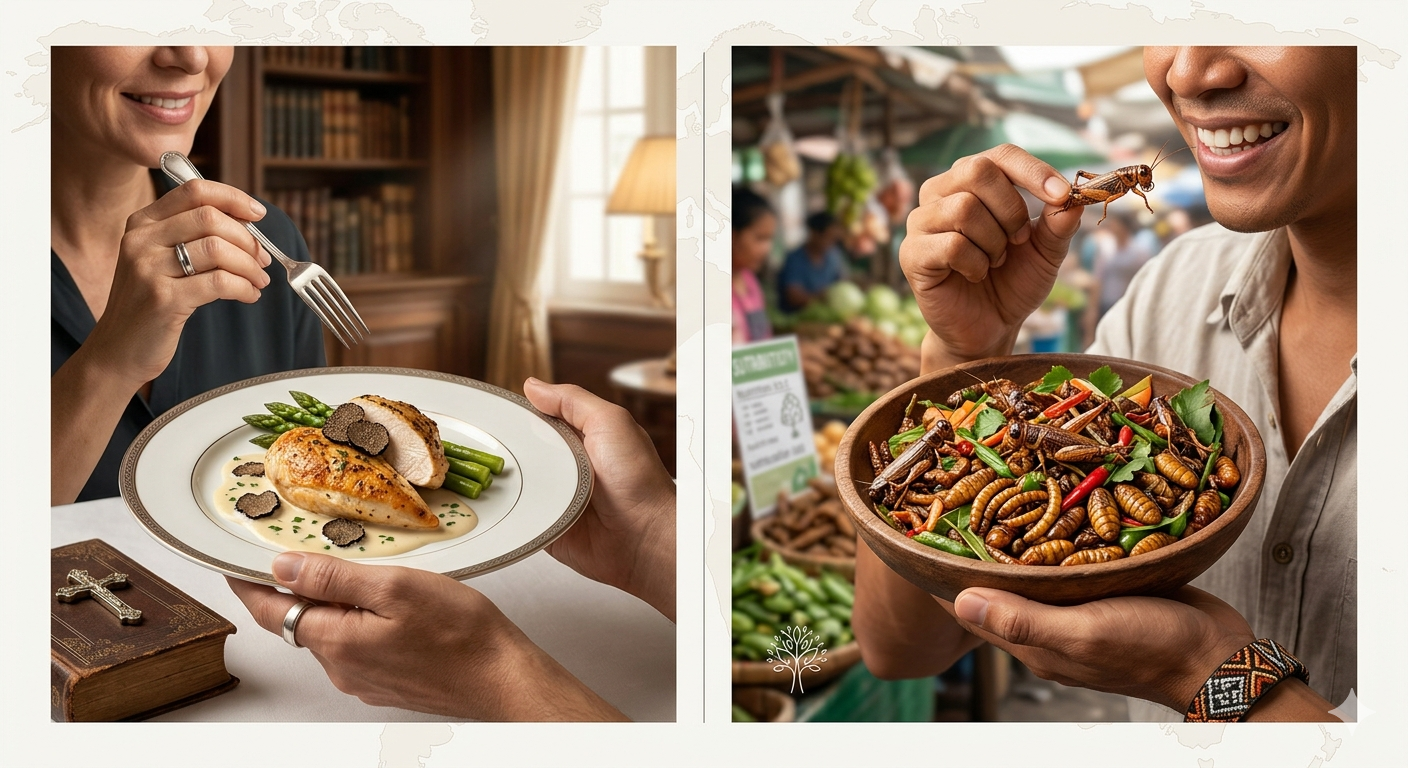
Imagine two people standing in front of the same plate.
On the plate are roasted crickets, lightly salted, crispy, and served with herbs.
One person sees food.
The other person sees something impossible to eat.
That difference is not only about taste. It is about culture, memory, habit, identity, environment, religion, childhood learning, and the invisible rules that tell us what counts as food.
In many parts of the world, insects have been eaten for generations. Grasshoppers, crickets, ants, termites, beetle larvae, palm weevil larvae, silkworm pupae, caterpillars, and other edible insects appear in traditional diets across regions of Africa, Asia, Latin America, and Oceania. They may be roasted, fried, dried, ground, smoked, boiled, fermented, or used in sauces and snacks.
In other cultures, insects are strongly rejected. They are associated with dirt, pests, disease, decay, crop damage, or fear. Even the idea of eating them may create disgust.
So why do some cultures eat insects while others avoid them?
The answer reveals something much bigger than insects. It shows how humans decide what food is. It shows how the same animal can be a delicacy in one place and a nightmare in another. It shows that food is never just nutrients.
Food is a story a culture tells the body.
Edible Insects Are Not a New Trend
In recent years, edible insects have been discussed as a future food. People talk about insect protein, sustainability, climate change, food security, and alternative protein sources.
But insects are not new foods.
For many cultures, they are old foods.
Long before protein bars made from cricket flour or conversations about sustainable protein, humans were collecting edible insects from forests, grasslands, farms, riversides, trees, and seasonal environments. Insects were part of local knowledge. People knew which species were edible, when to collect them, how to prepare them, and which ones to avoid.
This matters because modern discussions often frame insect eating as a futuristic solution. But in many regions, insect eating is traditional food knowledge.
The modern world may be rediscovering something that many communities never forgot.
However, tradition does not mean every insect is safe. Only certain species are eaten, and preparation matters. Edible insects require knowledge, just like mushrooms, fish, shellfish, wild plants, or fermented foods.
A culture that eats insects is not eating random bugs. It is using inherited food intelligence.
Why Insects Became Food in Some Places
Insects became food where they were available, nutritious, seasonal, and culturally accepted.
In many environments, insects appear in abundance during specific seasons. A swarm of grasshoppers, a termite emergence, a supply of caterpillars, or larvae from certain trees could provide a valuable food source. When food requires effort to obtain, a concentrated source of protein and fat is worth noticing.
For some communities, insects were not emergency foods. They were preferred foods.
They could be crispy, nutty, savory, rich, fatty, or aromatic depending on species and preparation. They could be eaten as snacks, added to stews, ground into powders, roasted over fire, or sold in markets.
Insects also fit the logic of traditional diets: eat what the environment provides.
A coastal culture may eat shellfish. A pastoral culture may drink milk. A forest culture may eat wild plants and insects. A farming culture may eat grains and legumes. A river culture may eat fish. Food traditions grow from ecology.
In places where insects were abundant, safe to collect, and culturally integrated, they became food.
In places where they were associated with filth, crop damage, or taboo, they did not.
Why Many People Feel Disgust Toward Insects
Disgust is one of the strongest forces in food choice.
Disgust protects humans from possible danger. Rotten food, feces, disease, parasites, and contamination can make people sick. A strong disgust response can help prevent harmful eating.
But disgust is not purely biological. It is also learned.
A child raised in a culture where roasted insects are normal may not feel disgust. A child raised in a culture where insects are only pests may feel immediate rejection. The same object enters two different mental categories.
In one culture: “snack.”
In another culture: “contamination.”
This is why food disgust can feel natural even when it is cultural.
People often assume their food boundaries are obvious. But every culture eats some things and rejects others. Some cultures eat cheese with mold. Some eat raw fish. Some eat fermented cabbage. Some eat blood sausage. Some eat snails. Some eat oysters. Some eat insects. Some eat strong-smelling fermented seafood.
To outsiders, many traditional foods can seem strange.
Disgust is often culture wearing the mask of instinct.
The “Food or Pest” Problem
Insects are often avoided in modern urban cultures because they are seen mainly as pests.
Cockroaches in kitchens.
Flies around garbage.
Mosquitoes biting skin.
Termites damaging homes.
Locusts destroying crops.
Ants invading food.
Maggots in spoiled meat.
If these are the main insect experiences someone has, eating insects will feel impossible.
But edible insects are not the same as household pests. Just as edible mushrooms are not the same as poisonous mushrooms, edible insects are specific species collected, raised, prepared, and eaten in known ways.
The problem is category confusion.
Many people hear “eat insects” and imagine eating random bugs from the floor. That is not what traditional insect eating means.
A culture that eats grasshoppers may avoid cockroaches. A culture that eats silkworm pupae may not eat flies. A culture that eats palm weevil larvae may know exactly which larvae are safe and how they should be cooked.
Food culture creates categories.
Without those categories, insects remain pests.
Ecology Decides What Becomes Normal
Food culture begins with environment.
If a region has abundant edible insects, people may experiment with them. If the insects are easy to collect and taste good when prepared, they may become part of the cuisine. If they appear seasonally, they may become a seasonal delicacy.
In some regions, grasshoppers are collected after harvest or during swarming seasons. Termites may be eaten when they emerge. Caterpillars may be gathered from certain trees. Ant eggs may be treated as a special food. Silkworm pupae may become a byproduct of silk production and then a food.
Ecology creates opportunity.
But opportunity alone is not enough. Culture must approve.
There are many edible things in nature that people do not eat because they are taboo, inconvenient, unsafe, or simply not part of the local food imagination. A food becomes normal only when ecology, preparation, taste, safety, and social acceptance come together.
That is why insect eating is common in some places and absent in others.
Agriculture Changed the Insect Relationship
Agriculture created a complicated relationship between humans and insects.
On one hand, some insects became food. On the other hand, many insects became enemies of crops. Locusts, beetles, caterpillars, and other pests could destroy harvests. Farmers often saw insects as threats to survival.
This may have shaped attitudes toward insects in some agricultural societies.
If insects are mostly experienced as crop destroyers, they may not be welcomed as food. If they are seasonal and edible, a community may turn a threat into a resource. In some places, eating crop pests may have been a practical response: if grasshoppers eat the crops, people eat the grasshoppers.
This is a fascinating reversal.
The pest becomes protein.
Traditional food wisdom often works this way. It asks: how can a problem become food?
Fermentation turned spoilage risk into preservation. Drying turned seasonal abundance into storage. Insect eating could turn seasonal swarms into nourishment.
Religion and Food Rules
Religious and spiritual traditions also influence whether insects are accepted or rejected.
Food rules help communities define purity, identity, discipline, and belonging. Some traditions allow certain insects while forbidding others. Some discourage insect eating altogether. Some classify insects as unclean. Others have no strong prohibition.
Food taboos are powerful because they are learned early and reinforced by family and community.
If a food is religiously forbidden, people may not evaluate it primarily through nutrition. They evaluate it through obedience, purity, identity, and tradition.
This is why telling people “insects have protein” is not enough to change their minds.
Food decisions are not only rational. They are moral, social, and symbolic.
A food that violates identity will not become accepted simply because it has nutrients.
Insects as Protein
From a nutritional perspective, many edible insects can provide protein. Some also contain fat, minerals, fiber-like chitin, and micronutrients depending on species, life stage, diet, and preparation.
This is one reason insects are discussed as alternative protein sources.
However, it is important to avoid exaggerated claims. Insects are not magic. Their nutritional value varies widely. A cricket is not the same as a caterpillar. A larva is not the same as a grasshopper. A whole roasted insect is not the same as a processed insect protein powder.
Also, protein quality and digestibility vary. The amount eaten matters. Preparation matters. Safety matters.
In traditional diets, insects were usually one food among many. They might supplement grains, roots, fruits, vegetables, fish, meat, or legumes. They were not necessarily the entire diet.
The balanced view is that edible insects can be nutrient-rich foods in cultures that know how to use them, but they should not be treated as a universal solution to nutrition problems.
Insects as Fat and Flavor
Some edible insects are valued not only for protein but also for fat and flavor.
Larvae, for example, may be rich and fatty. Roasted insects can be crispy and savory. Some have nutty, earthy, smoky, or umami qualities depending on preparation.
This matters because people do not eat nutrients alone. They eat sensory experiences.
If insects are prepared well, they can be enjoyable. If they are presented poorly, they may confirm disgust.
Traditional preparation methods often include roasting, frying, drying, salting, smoking, seasoning, grinding, or adding insects to stews and sauces. These methods create texture and flavor.
A roasted cricket with spices is a different experience from imagining a raw insect. A ground insect flour in a familiar food is different from seeing a whole insect. A larvae dish prepared by someone skilled is different from a novelty challenge.
Culinary skill can turn fear into curiosity.
Chitin: The Crunchy Shell Question
Many insects have exoskeletons made partly of chitin, a structural material also found in the shells of crustaceans and fungi cell walls.
Chitin is sometimes described as a type of fiber-like compound. It may influence texture and digestion. Some people may tolerate it well; others may find it difficult.
The exoskeleton is one reason preparation matters. Some insects are eaten whole. Others may be processed, ground, roasted, or cooked in ways that change texture.
For people with shellfish allergies, caution is important because insect proteins may cross-react in some cases. Anyone with shellfish allergy should be careful and seek professional guidance before trying insect-based foods.
This is another example of why “natural protein” is not automatically safe for everyone.
Food safety and personal health context matter.
Safety: Not Every Insect Is Edible
This point is essential.
Not every insect should be eaten.
Some insects are toxic. Some carry parasites or pathogens. Some may have been exposed to pesticides, heavy metals, or contaminated environments. Some may trigger allergies. Some require specific preparation. Some are safe only at certain life stages.
Traditional insect-eating cultures usually know which insects to collect and how to prepare them. That knowledge is not optional.
Modern edible insect production must also follow safety standards. Insects raised for food should come from controlled, food-grade environments, not random household or outdoor sources.
Never eat insects collected from unknown environments, especially areas exposed to pesticides, pollution, garbage, or disease.
Insect eating requires the same seriousness as mushroom foraging, raw seafood, fermented foods, or wild plant use. Knowledge is safety.
Why Western Cultures Often Avoid Insects
Many Western cultures avoid insects for several reasons.
Urbanization separated people from wild food gathering. Industrial food systems created a preference for clean, packaged, visually standardized foods. Insects became associated with dirt, infestation, disease, and poor hygiene. Food norms narrowed around familiar animals such as cows, pigs, chickens, sheep, and fish.
There is also a psychological issue: insects are too visible as whole animals.
A steak does not look like a cow. A chicken nugget does not look like a bird. A sausage hides animal form. But a roasted cricket still looks like a cricket.
This visual recognition can trigger disgust.
Modern consumers often prefer animal foods that hide the animal. Insects do not hide easily unless ground into flour or processed into familiar forms.
This is one reason insect protein bars or cricket flour may be more acceptable than whole insects for some people.
The form changes the reaction.
Why Some Cultures Embrace Insects
Cultures that eat insects usually have different associations.
Insects may be linked with seasonality, family gathering, markets, childhood snacks, festivals, rural knowledge, or regional pride. They may be considered tasty, normal, affordable, or even special.
A food that outsiders see as strange may be deeply familiar to insiders.
This shows how powerful early learning is. Foods introduced in childhood become part of normal life. Foods introduced as adult novelty can feel threatening.
If a child grows up eating roasted grasshoppers with family, the experience may be positive. If a child grows up being told insects are dirty, the idea of eating them may feel impossible later.
Food culture creates comfort through repetition.
The Sustainability Argument
Edible insects are often discussed as sustainable protein sources.
In general, many insects can be efficient at converting feed into body mass, require less land and water than some conventional livestock, and produce fewer greenhouse gas emissions depending on production system. This is why they are discussed in future food conversations.
However, sustainability is not automatic.
It depends on species, feed source, farming method, processing, energy use, transportation, regulation, and consumer acceptance. If insects are raised on human-edible feed, processed heavily, packaged in plastic, and shipped globally, the environmental advantage may shrink.
The most sustainable insect foods may be those integrated into local food systems, using safe and appropriate production methods.
The sustainability conversation should be serious, not hype-driven.
Insects may be part of future food systems, but they are not a single solution to global food problems.
The “Novel Food” Paradox
Insects are old foods in some places and novel foods in others.
This creates a paradox.
A cricket may be traditional in one market and futuristic in another. A silkworm pupa may be a normal snack in one country and a shocking novelty in another. Ant eggs may be a delicacy in one cuisine and unthinkable in another.
Food identity depends on cultural location.
This is why global nutrition conversations must be humble. A food that seems innovative to one audience may be ancestral to another. A food that seems disgusting to one culture may be cherished in another.
Wellness culture often forgets this. It discovers old foods and rebrands them as new.
Insects remind us that “new” often means “new to us.”
Insect Flour: A Bridge Food
One way edible insects enter cultures that normally reject them is through insect flour.
Crickets or other insects can be dried and ground into powder, then added to protein bars, crackers, breads, pastas, or baked goods. This hides the visual insect form and makes the food more familiar.
For some people, this is more acceptable. They may reject a whole roasted cricket but accept a cracker made with cricket flour.
This shows how form shapes food acceptance.
However, insect flour also raises questions. How processed is the product? What else is in it? Is it mostly insect protein or mostly refined starch and sugar with a little insect powder? Is it safe for people with allergies? Is it regulated properly?
A cricket protein cookie is not automatically healthy just because it contains cricket powder.
As always, the whole food matters.
Insects and Class Perception
In some societies, insects have been associated with poverty or rural life. In others, they are delicacies. In still others, they are becoming premium sustainable foods.
This shows how social status shapes food.
A food may be rejected not because of taste or nutrition, but because it is associated with hardship. Later, the same food may become fashionable when presented differently.
This has happened with many foods, not only insects. Lobster, oysters, offal, fermented foods, and certain grains have moved between poverty food, regional food, and luxury food depending on time and culture.
Food status changes.
Insects may follow the same pattern in some modern markets: from ignored traditional food to sustainable gourmet ingredient.
This shift can be positive if it respects the cultures that preserved insect-eating traditions. It can be problematic if it turns traditional foods into expensive trends while ignoring their origins.
The Ethics of Eating Insects
Insect eating also raises ethical questions.
Some people who avoid meat for animal welfare reasons may wonder whether insects are acceptable. Others may oppose eating any animals. Some may consider insects less sentient than mammals, while others still object to farming and killing them.
Science and philosophy continue to discuss insect sentience and welfare. Because this topic is complex, it deserves humility.
Ethical food choices are personal and cultural. A person may choose to eat insects for sustainability reasons. Another may avoid them for animal welfare reasons. Another may eat them because they are traditional. Another may reject them because of religion or disgust.
The goal is not to force agreement. The goal is to understand the factors involved.
What Modern Eaters Can Learn from Insect-Eating Cultures
Even if you never eat insects, there are lessons here.
1. Food categories are learned
What feels normal to eat is often taught by culture.
2. Disgust is partly cultural
A food can be disgusting in one context and delicious in another.
3. Traditional diets used local resources
People ate what their environment provided, including foods modern urban diets may ignore.
4. Sustainability requires creativity
Future food systems may need more diverse protein sources.
5. Nutrients are not enough
A food must be culturally acceptable, safe, tasty, affordable, and meaningful.
6. Food wisdom deserves respect
Cultures that eat insects often have detailed knowledge about species, season, preparation, and safety.
These lessons are useful whether insects enter your diet or not.
If You Want to Try Edible Insects
If someone is curious about edible insects, safety and quality come first.
Choose insects raised specifically for human food.
Do not eat random wild insects.
Avoid insects exposed to pesticides or contaminated environments.
Check allergy warnings, especially if you have shellfish allergy.
Start with small amounts.
Choose reputable brands or restaurants.
Understand local regulations.
Try familiar forms first, such as roasted seasoned insects or insect flour products.
Read ingredient labels on processed insect foods.
Do not treat insect products as automatically healthy.
Trying edible insects should be a food experience, not a dare.
Respect the food and the cultures that know it.
When to Avoid Edible Insects
Some people should avoid or be cautious with edible insects.
People with shellfish allergies may be at risk of cross-reactivity. People with severe food allergies should be careful. Pregnant people, young children, older adults, and immunocompromised individuals should be cautious with unfamiliar foods and follow professional advice. Anyone with digestive issues should start carefully if trying them.
Insects from unknown sources should be avoided completely.
Food safety matters more than novelty.
Common Myths About Eating Insects
Myth 1: Eating insects is primitive
Not true. Insect eating can involve detailed ecological knowledge, preparation skill, and cultural tradition.
Myth 2: All insects are edible
False. Only certain species are eaten, and safety depends on source and preparation.
Myth 3: Insects are only survival food
In many cultures, insects are enjoyed as snacks, delicacies, seasonal foods, or valued ingredients.
Myth 4: Insect protein automatically makes a food healthy
A processed snack with insect flour can still be high in sugar, refined starch, or poor-quality ingredients.
Myth 5: People avoid insects because they are irrational
Avoidance often comes from cultural learning, disgust, religious rules, hygiene associations, and food identity.
Myth 6: Everyone will eat insects in the future
Maybe some will, but acceptance depends on culture, taste, safety, price, regulation, and ethics.
A Simple Framework: Would This Insect Be Food?
To understand whether insects become food in a culture, ask six questions:
1. Is it available?
Does the environment provide edible insects in meaningful amounts?
2. Is it safe?
Does the culture know which species are edible and how to prepare them?
3. Is it tasty?
Does it offer flavor, texture, fat, protein, or culinary value?
4. Is it accepted?
Do family, religion, community, and tradition allow it?
5. Is it useful?
Does it help meet food needs, seasonal shortages, or economic needs?
6. Is it meaningful?
Does it belong to memory, festivals, markets, or regional identity?
If the answer is yes to many of these, insects can become food. If not, they remain pests.
Conclusion
Some cultures eat insects and others avoid them because food is not just biology.
Insects can provide protein, fat, minerals, flavor, and seasonal nourishment. In many regions, they are traditional foods supported by ecological knowledge and culinary skill. They can be roasted, dried, fried, ground, smoked, seasoned, or added to dishes. For some communities, they are not strange at all.
But in other cultures, insects are linked with pests, dirt, disease, fear, crop damage, and disgust. They do not fit the learned category of food. Religious rules, childhood experience, urban life, visual appearance, and social status all shape this rejection.
The same insect can be food or filth depending on the story a culture tells about it.
That is the deeper lesson.
Humans do not eat nutrients directly. We eat through culture. We eat what our communities teach us to recognize as safe, meaningful, and desirable.
Edible insects may become more visible in future food systems because of sustainability and protein needs. But acceptance will not come from nutrition facts alone. It will require safety, good taste, cultural respect, better preparation, clear labeling, and honest conversation.
Whether you choose to eat insects or not, they teach a powerful truth about ancestral nutrition:
Food is not only what nature provides.
Food is what culture teaches us to see.
Disclaimer: This article is for educational purposes only and is not medical advice. Edible insects may cause allergic reactions, especially in people with shellfish allergies, and safety depends on species, source, processing, and preparation. Do not eat wild or unknown insects. If you have food allergies, are pregnant, immunocompromised, or have specific dietary concerns, consult a qualified healthcare professional before trying insect-based foods.