
Traditional diets did not appear by accident.
People did not simply choose foods because they were fashionable, low-carb, high-protein, plant-based, or approved by modern nutrition experts. For most of human history, people ate what their environment allowed, what their culture preserved, and what survival required.
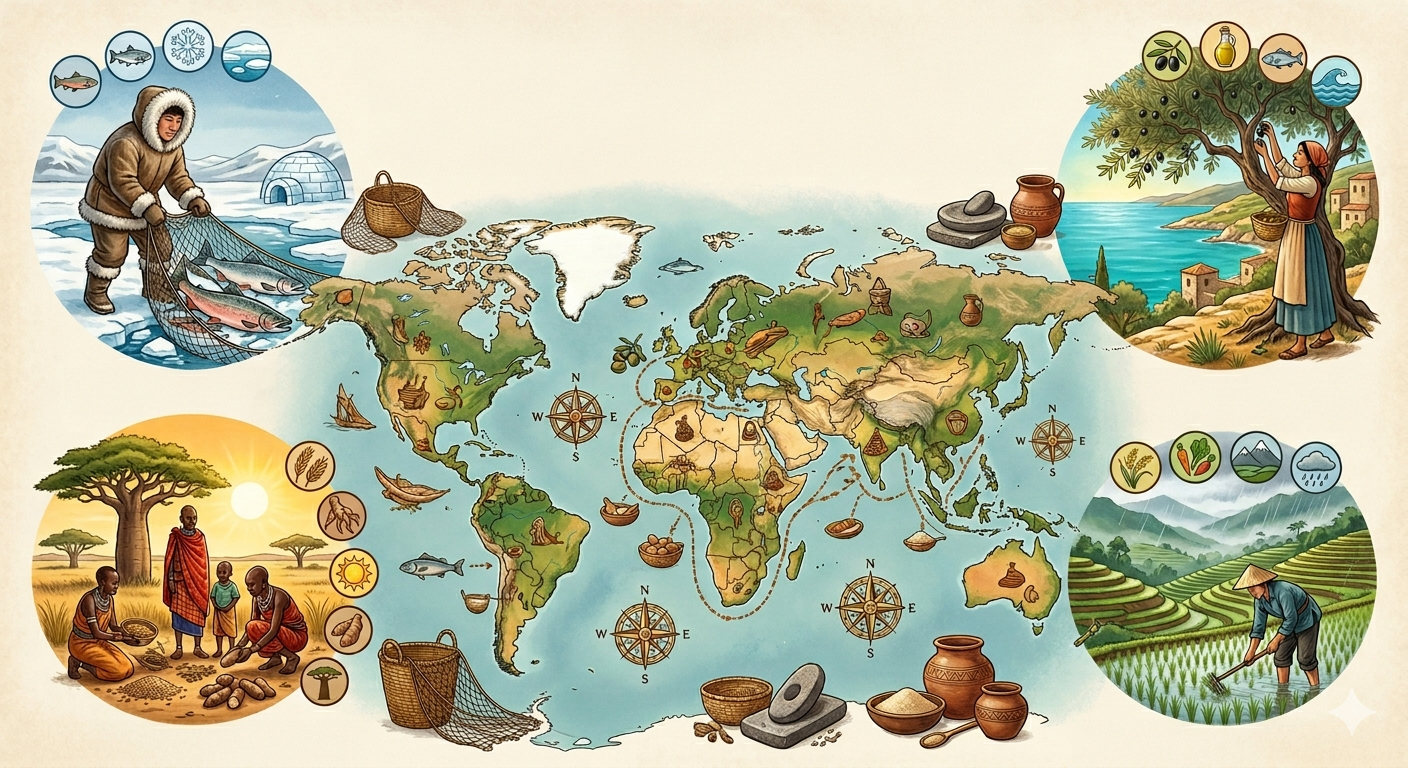
A coastal village built meals around fish because the sea was nearby. A mountain community preserved dairy because animals could graze where crops were harder to grow. A rice-growing region created food traditions around steamed rice, fermented sauces, vegetables, and fish. A cold northern population relied more on animal foods, fat, and preservation because fresh plant foods were limited for much of the year. A tropical community used fruits, tubers, herbs, spices, insects, and fermented foods because those foods matched the climate and ecology.
Traditional diets were shaped by three powerful forces: climate, culture, and survival.
Understanding these forces helps us avoid simplistic diet advice. It also helps us respect why different communities developed different ways of eating. There was never one perfect traditional diet. There were many traditional diets, each shaped by local reality.
This is one of the most important lessons of ancestral nutrition: food makes sense only when we understand its context.
Traditional Diets Were Local Before They Were Nutritional
Today, people often think about food in abstract categories: protein, fat, carbohydrates, calories, fiber, cholesterol, vitamins, minerals, antioxidants, and sugar.
Traditional communities usually did not begin there.
They began with place.
What grows here?
What animals live here?
What fish can be caught?
What fruits appear in this season?
What roots can be dug?
What grains can be stored?
What foods spoil quickly?
What foods can survive winter?
What can be fermented, dried, salted, smoked, or cooked?
What foods keep people alive when harvests fail?
Before food became a health trend, it was a relationship with land, water, climate, animals, plants, microbes, and seasons.
A traditional diet was not just a list of foods. It was a survival system.
This is why traditional diets vary so widely. A healthy diet in one region may look very different from a healthy diet in another. The foods that supported life in the Arctic were not the same as the foods that supported life in tropical forests. The foods that made sense in a rice-growing delta were not the same as those in a dry pastoral landscape.
Nutrition was always shaped by geography.
Climate Decided What Could Grow
Climate strongly influenced traditional diets because climate determined what foods were available.
In warm and wet regions, people often had access to fruits, leafy greens, tubers, rice, spices, herbs, fish, and fermented plant foods. In dry regions, people relied on drought-resistant grains, legumes, animals, preserved foods, dates, olives, or other hardy crops. In cold regions, growing seasons were short, so people depended more on animal foods, fish, stored grains, fermented foods, dried foods, and preserved fats.
Climate affected not only what people ate, but also how they prepared food.
Hot climates made food spoil quickly. This encouraged drying, salting, fermentation, spices, sour flavors, and cooking methods that reduced spoilage or improved safety. Cold climates allowed natural refrigeration but limited fresh plant foods during long winters. Dry climates made dehydration easier. Humid climates required different preservation methods.
This is why food traditions often make more sense when viewed through climate.
Spicy foods are common in many hot regions partly because spices add flavor, but they may also reflect long histories of food preservation, microbial control, appetite stimulation, and cultural adaptation. Fermented foods are common in many regions because fermentation helped preserve seasonal abundance. Salted fish, dried meat, smoked foods, pickles, and sour sauces often developed where preservation was essential.
Climate did not simply influence ingredients. It shaped entire cuisines.
Geography Shaped Staple Foods
Every traditional diet has a foundation, and that foundation was usually shaped by geography.
In some regions, rice became the staple. In others, wheat, barley, maize, millet, sorghum, potatoes, cassava, taro, yams, plantains, beans, or dairy became central. These foods were not chosen because they fit modern diet categories. They were chosen because they grew well, stored well, fed many people, and could be turned into meals.
Staple foods became the base of culture.
Rice became steamed rice, congee, rice noodles, rice cakes, fermented rice, and countless regional dishes. Wheat became bread, noodles, porridge, flatbread, dumplings, and fermented doughs. Maize became tortillas, tamales, porridges, and traditional preparations. Milk became yogurt, cheese, kefir, butter, and other dairy foods. Tubers became boiled, roasted, pounded, fermented, dried, or mashed meals.
A staple food was more than a carbohydrate source. It was a social anchor.
It shaped daily meals, farming systems, trade, family routines, festivals, religious practices, and regional identity.
This is why it is too simple to say “rice is bad” or “wheat is bad” or “dairy is good” or “meat is essential.” Traditional staples must be understood within the whole diet and lifestyle that surrounded them.
Culture Turned Survival Foods Into Cuisine
Survival may explain why people first ate certain foods, but culture explains how those foods became meaningful.
Culture transformed basic ingredients into cuisine.
A grain became bread.
Milk became cheese.
Fish became sauce.
Vegetables became pickles.
Beans became stews.
Roots became comfort food.
Spices became identity.
Fermentation became tradition.
Preservation became flavor.
Scarcity became creativity.
Many traditional foods began as practical solutions. People needed to preserve fish, so they dried, salted, or fermented it. People needed to make grains digestible, so they soaked, ground, fermented, or cooked them. People needed to store milk, so they turned it into yogurt, kefir, butter, or cheese. People needed to survive winter, so they preserved vegetables, roots, meat, and fruits.
Over time, these survival methods became beloved foods.
This is one of the beautiful things about food culture: what begins as necessity can become memory, pleasure, identity, and art.
A traditional dish often carries the intelligence of generations. It may reflect local soil, climate, trade routes, religious rules, family structure, cooking technology, available fuel, preservation needs, and social values.
Food culture is not decoration. It is accumulated survival knowledge.
Preservation Was Central to Traditional Diets
Before refrigeration, preserving food was essential.
Many traditional diets were shaped by the need to make seasonal foods last. A community might have plenty of fish during one season, fruit during another, milk during another, or grain after harvest. Without preservation, abundance would quickly become waste.
Traditional preservation methods included:
Drying
Smoking
Salting
Fermenting
Pickling
Curing
Aging
Burying
Storing in cool cellars
Making cheese or yogurt
Turning grains into fermented doughs
Making sauces, pastes, or condiments
These methods did more than prevent hunger. They created flavor and sometimes improved digestibility.
Fermented cabbage, yogurt, sourdough bread, fish sauce, miso, kimchi, kefir, aged cheese, pickled vegetables, dried fish, and cured meats all reflect the same basic human problem: how do we make food last?
Modern refrigeration solved part of this problem, but it also made many people forget the value of traditional preservation. Today, many preserved foods are industrial products rather than living food traditions. They may contain excess sugar, refined oils, artificial flavors, or preservatives without the same cultural or nutritional context.
Traditional preservation reminds us that food can be transformed by time, microbes, salt, heat, air, and human care.
Scarcity Shaped Eating Patterns
Modern people often eat in a world of abundance. Traditional diets were often shaped by scarcity.
Food was not always available. Seasons changed. Weather failed. Crops died. Animals migrated. Fish disappeared. Droughts happened. Winters were long. Storage could run out. Insects, mold, rodents, and disease threatened food supplies.
Because of scarcity, traditional communities learned not to waste.
They used bones for broth.
They used organs.
They fermented leftovers.
They saved seeds.
They dried fruit.
They cooked tough cuts slowly.
They used herbs, spices, and sour flavors to make simple foods satisfying.
They stretched meat with grains, beans, roots, or vegetables.
They turned imperfect foods into soups, stews, sauces, and preserves.
Modern food culture often separates people from this mindset. Food is cheap, disposable, and abundant in many places. Portions are large. Snacks are constant. Waste is normalized.
Traditional diets teach a different lesson: food has value.
This does not mean we should romanticize hunger. Scarcity caused suffering. But the survival wisdom that emerged from scarcity can still teach us respect, creativity, and moderation.
Traditional Diets Were Seasonal
Seasonality shaped what people ate and when they ate it.
In many traditional communities, spring, summer, autumn, and winter brought different foods. Fresh greens might appear in spring. Fruits might arrive in summer. Grains and roots might be harvested in autumn. Preserved foods might dominate winter. Fish, game, eggs, mushrooms, herbs, and wild plants could all follow seasonal patterns.
This seasonal rhythm naturally created variety.
Modern food systems allow people to eat the same foods all year. This can be convenient, but it may also reduce our awareness of seasonal change. Strawberries in winter, tomatoes all year, tropical fruits in cold climates, and constant access to every food can make eating feel disconnected from place and time.
Seasonal eating does not need to be strict. But it can reconnect us with food quality, freshness, local agriculture, and natural variety.
Traditional diets remind us that food was once part of a calendar, not just a shopping list.
Survival Also Shaped Food Taboos
Traditional diets were not only shaped by what people ate. They were also shaped by what people avoided.
Many cultures developed food taboos, restrictions, rules, and rituals. Some were religious. Some were ecological. Some were related to safety, identity, hygiene, class, season, pregnancy, illness, or social structure.
A food taboo may seem irrational from the outside, but it may have developed for practical reasons in a particular environment. Certain animals may have been risky to eat. Certain foods may have spoiled easily. Some restrictions may have protected important resources. Others may have separated groups culturally.
Not all taboos were nutritionally necessary. Some were symbolic. Some were social. Some may have been based on misunderstanding. But food rules often helped communities organize eating behavior.
Modern diet culture has its own taboos too. Some people fear fat. Others fear carbs. Some fear gluten, dairy, seed oils, meat, sugar, lectins, or fruit. Sometimes these concerns are valid for certain people or contexts. Sometimes they become exaggerated.
Looking at traditional food taboos can teach humility. Humans have always used stories and rules to manage food anxiety.
Culture Helped People Eat Difficult Foods
Many foods that humans eat are not simple.
Plants can contain bitter compounds, toxins, fibers, anti-nutrients, or irritants. Beans can be hard to digest. Grains may need grinding, soaking, or fermentation. Tubers may require cooking. Milk can spoil or cause digestive issues. Fish can spoil quickly. Meat can carry pathogens. Fruits can ferment. Water can be unsafe.
Traditional cultures developed ways to handle these problems.
They cooked cassava to reduce toxins.
They soaked and cooked beans.
They fermented grains.
They turned milk into yogurt or cheese.
They dried fish.
They used spices.
They peeled, pounded, washed, or leached certain plants.
They combined foods to improve flavor and digestion.
This is why traditional diets cannot be understood only by ingredient lists. Preparation is essential.
A food may be nourishing in one form and difficult in another. A grain may be better tolerated when fermented. A bean may be easier to digest when soaked and cooked properly. Dairy may be more tolerable when fermented. A plant may be unsafe raw but safe after traditional preparation.
Culture helped people turn difficult foods into edible foods.
Traditional Diets Were Also Shaped by Technology
Technology has always influenced eating.
Fire was technology.
Stone tools were technology.
Grinding stones were technology.
Clay pots were technology.
Fermentation vessels were technology.
Fishing nets were technology.
Irrigation was technology.
Animal domestication was technology.
Mills, ovens, storage jars, presses, and knives were all food technologies.
Traditional diets were not “untouched nature.” They were shaped by human invention.
The difference is that older food technologies usually developed slowly and were tested across generations. Modern industrial technologies can transform food much faster. Refining, hydrogenation, extrusion, artificial flavoring, chemical preservation, and mass production have changed food in ways traditional cultures never experienced.
This does not mean all modern technology is bad. Refrigeration, sanitation, safe cooking equipment, freezing, and food safety testing can be extremely helpful. But evolutionary nutrition asks whether a technology supports nourishment or mainly supports convenience, profit, and overconsumption.
Technology should serve health, not replace it.
Why Some Traditional Diets Included More Animal Foods
Some traditional diets included more animal foods because climate and ecology made plant foods less available.
In cold northern climates, fresh fruits and vegetables were limited for much of the year. Fish, marine mammals, wild game, eggs, and animal fat could provide essential energy and nutrients. In pastoral regions, milk, yogurt, cheese, butter, and meat made sense because animals could graze on land that was not ideal for crops.
Animal foods were not simply a preference. In many places, they were survival foods.
However, this does not mean all modern people should eat large amounts of animal foods. Traditional animal-food-rich diets were usually connected to specific environments, high physical activity, limited processed foods, and whole-animal use. They were not the same as modern diets built around processed meats, fried foods, refined bread, and sugary drinks.
Context matters.
Animal foods can be nutrient-dense, but the amount, quality, preparation, and lifestyle around them matter greatly.
Why Some Traditional Diets Included More Plant Foods
Other traditional diets included more plant foods because climate and agriculture supported plant abundance.
In tropical regions, fruits, tubers, leafy plants, herbs, spices, legumes, and roots could be widely available. In fertile river valleys, rice, wheat, millet, maize, or other crops supported large populations. In some cultures, religious or philosophical traditions also encouraged plant-focused eating.
Plant-rich diets could be nourishing when they included enough protein, minerals, fats, and preparation methods. Legumes, grains, nuts, seeds, vegetables, fruits, and fermented foods could create deeply satisfying cuisines.
But again, context matters.
A traditional plant-rich diet is not the same as a modern diet of refined flour, sugary cereal, sweetened drinks, processed snacks, and industrial plant oils. The fact that a food comes from a plant does not automatically make it healthy.
Traditional plant foods were usually prepared, cooked, fermented, combined, and eaten as meals.
Trade Changed Traditional Diets
Traditional diets were local, but they were not always isolated.
Trade spread spices, grains, fruits, tea, coffee, sugar, salt, fish, preserved foods, oils, and cooking techniques across regions. The spice trade changed cuisines. The movement of maize, potatoes, tomatoes, peppers, and cacao after the Columbian exchange transformed diets around the world.
Many foods that feel traditional today were once foreign.
Tomatoes became central to Italian cooking after coming from the Americas. Chili peppers became essential in many Asian cuisines after global trade. Potatoes became important in Europe. Maize spread widely. Tea, coffee, sugar, and spices changed daily habits across continents.
This reminds us that tradition is not frozen. Food culture evolves.
A traditional diet is not a museum exhibit. It is a living pattern shaped by environment, trade, adaptation, memory, and need.
Modern Diets Often Remove the Original Context
One problem with modern eating is that it often takes traditional foods out of context.
Rice may be eaten without the vegetables, fish, legumes, fermented foods, and physical labor that once surrounded it. Wheat may appear as refined pastries instead of slow-fermented bread. Dairy may become sweetened desserts instead of yogurt or cheese. Meat may become processed fast food instead of fresh or slow-cooked meals. Fruit may become juice or syrup instead of whole fruit.
When traditional foods are removed from their original context, their effect can change.
This is why many diet arguments are misleading. They discuss single foods without asking how those foods were traditionally eaten.
Traditional diets were patterns, not isolated ingredients.
What Traditional Diets Can Teach Modern Eaters
Traditional diets offer practical lessons for modern life.
1. Eat with context
Do not judge foods only by names. Ask how they are prepared, what they are eaten with, and what lifestyle surrounds them.
2. Respect local and seasonal foods
You do not need to eat only local food, but seasonal and regional foods can improve variety, freshness, and connection.
3. Use traditional preparation methods
Soaking, fermenting, slow cooking, drying, and preserving can still be useful.
4. Build meals, not just snacks
Traditional diets were usually meal-based. Modern constant snacking is a very different pattern.
5. Avoid ultra-processed versions of traditional foods
Bread, rice, dairy, meat, fruit, and grains can all become less nourishing when refined, sweetened, or industrialized.
6. Pay attention to personal tolerance
Your ancestry, gut health, lifestyle, and medical history may influence how you respond to foods.
7. See food as culture, not just fuel
Food traditions can support belonging, memory, satisfaction, and healthier eating rhythms.
How to Apply These Lessons Today
A climate-and-culture-aware approach to eating does not require strict rules.
Start with your own life. What traditional foods are part of your family or region? Which of them are made from whole ingredients? Which ones are balanced and satisfying? Which ones have become overly processed in modern form?
Try cooking more simple meals. Use herbs, spices, vegetables, proteins, traditional starches, fermented foods, or broths. Choose whole fruit instead of juice. Choose cooked roots instead of chips. Choose slow-cooked beans instead of refined snacks. Choose plain fermented dairy instead of sweetened dairy desserts if you tolerate dairy. Choose fish, eggs, legumes, or meat in forms that feel close to real food.
You can also learn from other food cultures respectfully. Many traditional cuisines have brilliant ways of making simple ingredients flavorful and nourishing.
The goal is not to copy the past exactly. The goal is to recover the wisdom of context.
Common Myths About Traditional Diets
Myth 1: Traditional diets were all the same
Traditional diets varied dramatically by climate, geography, culture, and available foods.
Myth 2: Traditional diets were always healthy
Traditional diets contain wisdom, but they were also shaped by scarcity, disease, and limited options. They should be studied, not romanticized.
Myth 3: A traditional staple is healthy in any form
A traditional grain, dairy food, meat, or fruit can become very different when refined, sweetened, fried, or ultra-processed.
Myth 4: Climate no longer matters because we have supermarkets
Modern supply chains make many foods available everywhere, but climate still affects agriculture, food quality, sustainability, culture, and seasonal eating.
Myth 5: Culture is less important than nutrition science
Nutrition science is important, but culture shapes what people actually eat, enjoy, preserve, and sustain over time.
Conclusion
Traditional diets were shaped by climate, culture, and survival.
They were created through long relationships between people and place. Climate determined what could grow. Geography shaped staple foods. Culture transformed survival foods into cuisine. Scarcity taught preservation and respect. Seasonality created variety. Technology changed preparation. Trade introduced new ingredients. Personal and population-level adaptation shaped food tolerance.
This history teaches us that there is no single perfect diet for everyone.
A coastal diet, a mountain diet, a tropical diet, a pastoral diet, and a grain-based farming diet can all make sense in their own contexts. What matters is not only the food itself, but how it is prepared, balanced, eaten, and lived with.
Modern eating often removes food from context. It turns traditional staples into refined products, traditional flavors into artificial snacks, and meals into constant convenience. To eat better today, we do not need to reject modern life. We need to recover the wisdom of context.
Ask where your food comes from.
Ask how it was traditionally prepared.
Ask whether it fits your body and lifestyle.
Ask whether it nourishes you or merely entertains your appetite.
Ask what your culture and environment can teach you.
Traditional diets are not perfect blueprints. They are living lessons in adaptation.
And those lessons may be exactly what modern eating needs.
Disclaimer: This article is for educational purposes only and is not medical advice. If you have a medical condition, food allergy, digestive disorder, pregnancy-related concern, or specific dietary need, consult a qualified healthcare professional before making major changes to your diet.